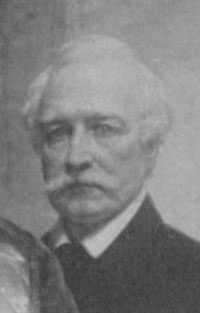
On March 10th, 1854, Cyrus Field and his partners
acquired the Newfoundland Electric Telegraph Company, which had the
exclusive rights to erect telegraphs in Newfoundland, and formed the New York, Newfoundland
& London Telegraph Company.
This was the beginning
of Field’s attempts to lay the Atlantic Cable between Ireland and Newfoundland.
The project occupied him for the next twelve years, concluding in
1866 with the successful installation of two cables.
“When
the first cable was laid in 1858, the Chamber of Commerce elected Cyrus
Field an honorary member, and gave him a gold medal. And again,
in 1866, when the final success was assured, it was celebrated by a
banquet. Now the Chamber of Commerce completes its gracious office
of commemoration by a more permanent memorial of the Atlantic Telegraph
in a historical painting of Mr. Field and his honored associates, that,
as it hangs upon the walls of the Chamber, will remind those who come
after us what manner of men they were who achieved so great a work for
their country and for the world.”
New-York, May
30, 1895.
From the Introductory Note
in The Atlantic Cable Projectors, Chamber of Commerce New-York, 1895. The Chamber of Commerce of the State
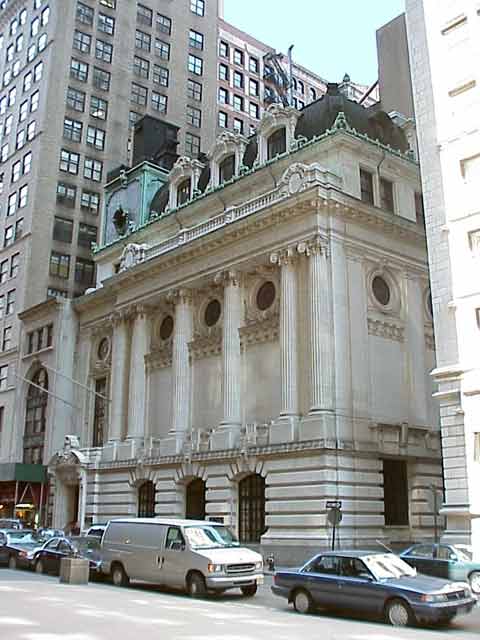
of New-York was organized in 1768, the first in the USA. In
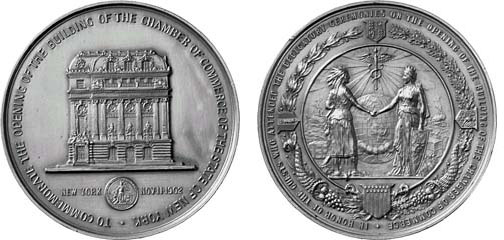
1901 the Chamber occupied its ornate beaux arts landmark building at 65 Liberty Street,
the opening of which was commemorated with a gold
medal produced by Tiffany & Company.
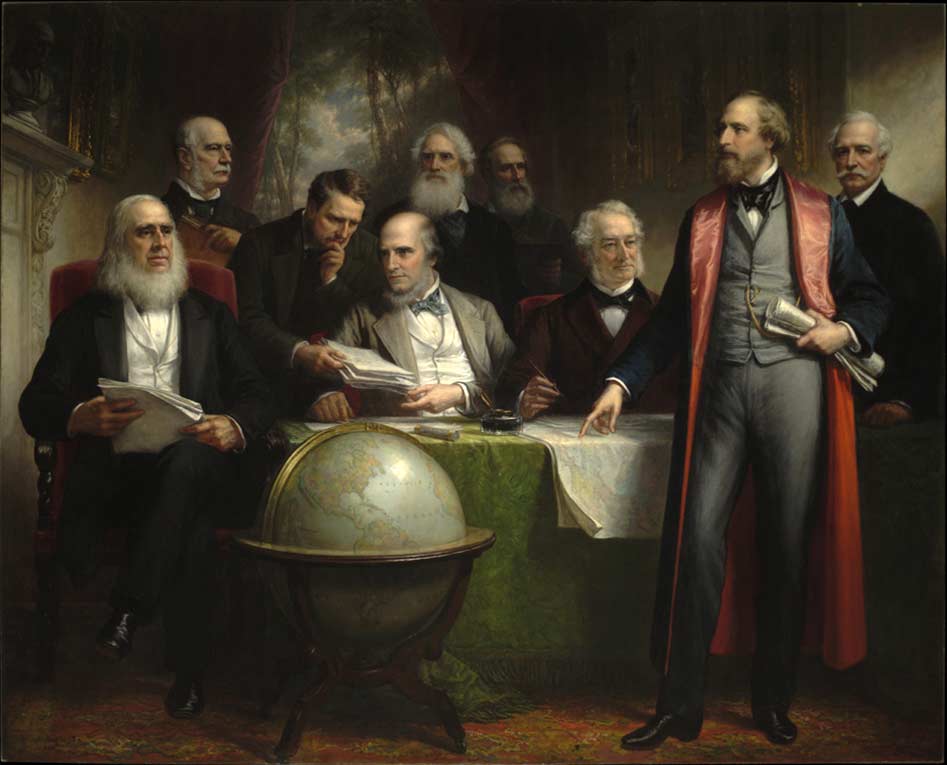
In 2003 the New York State Museum received a donation of over 200 portraits from The Partnership for New York City Inc., including the Atlantic Cable Projectors painting by Daniel Huntington shown below. The Partnership, formed in 2002, was the successor organization to the New York Chamber of Commerce.
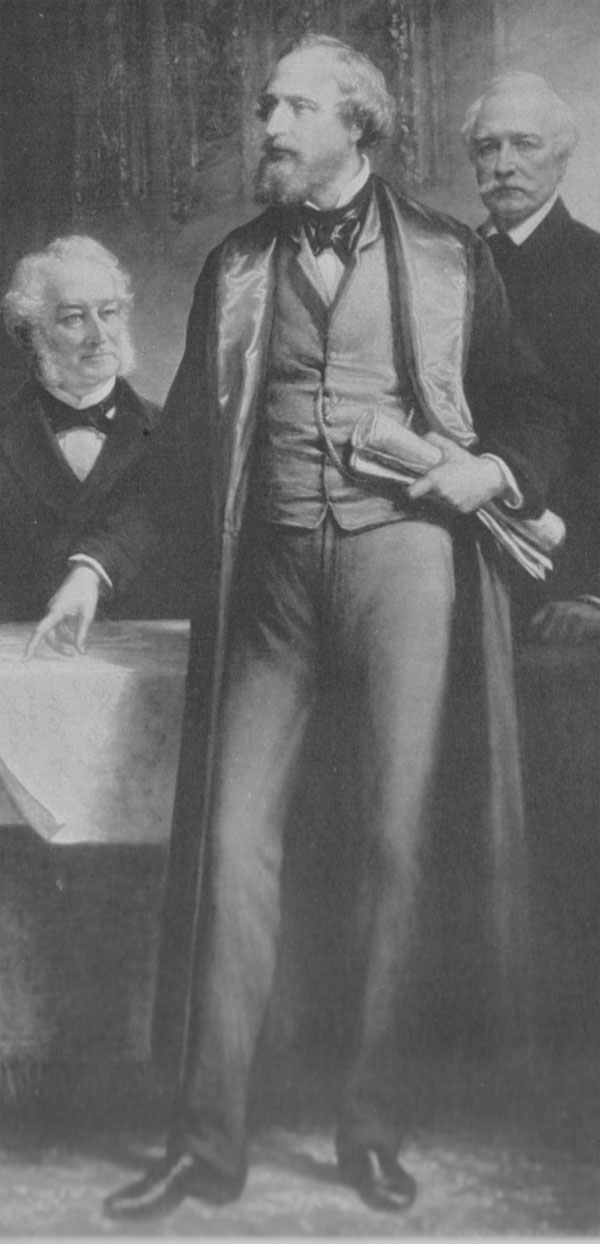
The Atlantic Cable Projectors
Painting
by Daniel Huntington
Presented
to the Chamber of Commerce of the State of New-York
May
23d, 1895
by
Morris K. Jesup, Chairman of the Committee
and
received by
Alexander
E. Orr, President of the Chamber Title
page image |
|
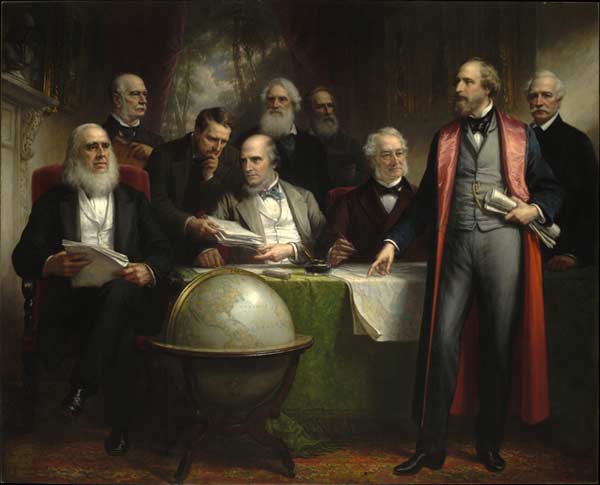
Image courtesy of the New York State Museum, History H-2003.41.3
The New York Chamber of Commerce Portrait Collection [archived]
The canvas is 87" by 108¼"
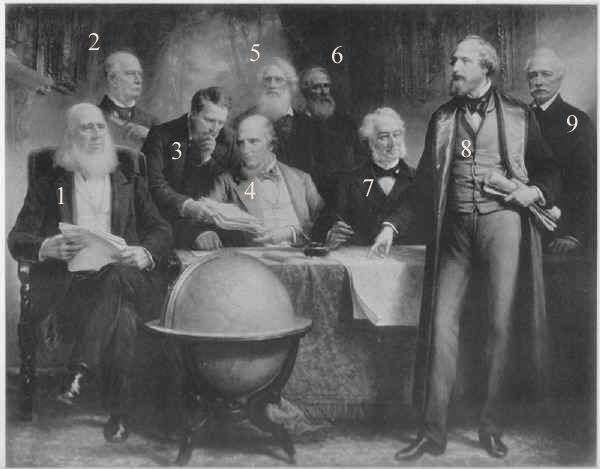
Click
here to see signatures of Cooper and Morse
Click
here for Peter Cooper's story of The
Laying of the Ocean Cable
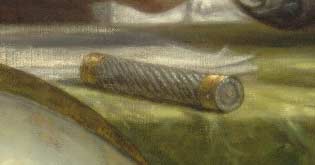
Detail of cable |
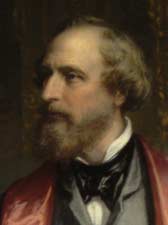
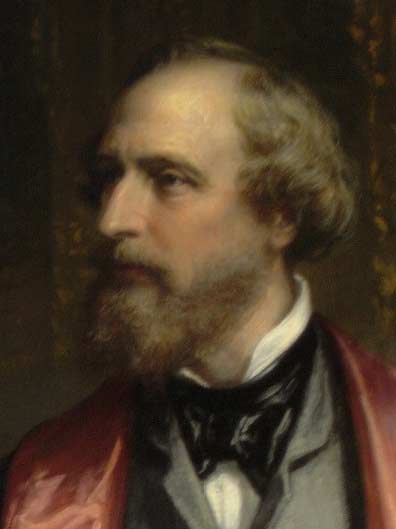
Detail of Cyrus W. Field |
On 6 December 2023, the New York State Museum in made this announcement:
The State Museum is happy to welcome back The Atlantic Cable Projectors (1895) by New York artist Daniel Huntington (1816–1906). The life-size painting recently returned to the Museum from the Williamstown Art Conservation Center in Williamstown, MA, where it spent almost two years undergoing cleaning and repair.
In 2020, the painting was on loan to the Smithsonian American Art Museum in Washington, DC, where it was featured in the exhibition, Alexander von Humboldt and the United States: Art, Nature, and Culture.
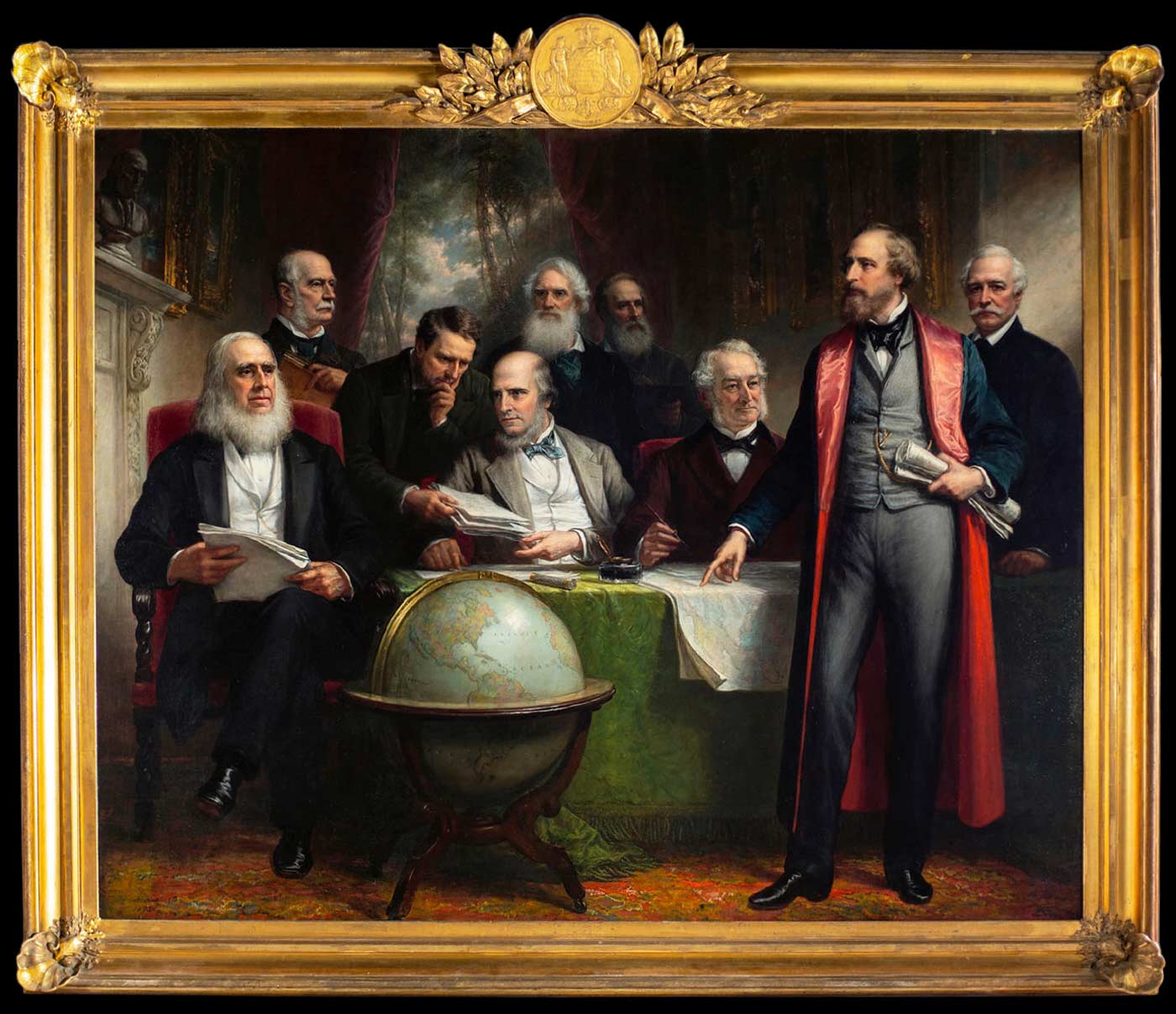
The work, which measures nearly 7 feet by 9 feet, is now on view in New York Hall. Notably, its ornate Tiffany & Company frame incorporates a segment of the Atlantic Cable itself.
Inset at the center top of the frame is one of the medals commissioned in 1858 by the Chamber of Commerce of the State of New-York from Tiffany & Co. to commemorate the successful completion of the 1858 Atlantic cable.
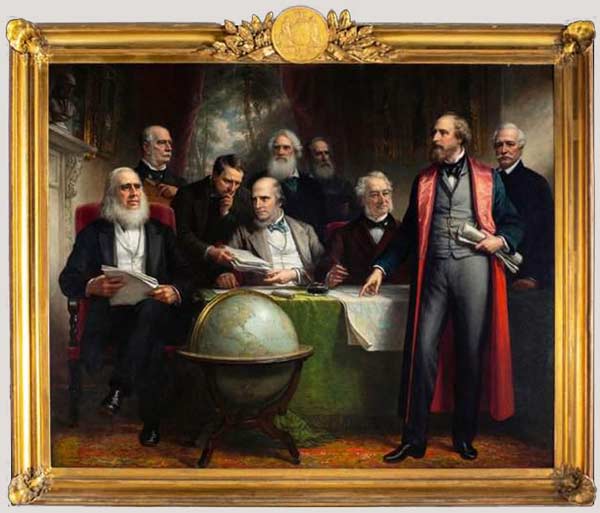
Image courtesy of the New York State Museum, History H-2003.41.3
This image from December 2023 also shows the original frame for the painting
The New York State Museum is at 222 Madison Avenue, Albany, NY 12230
The Artist
HUNTINGTON, Daniel, painter, was
born in New York city, Oct. 14, 1816; son of Benjamin and Faith Trumbull
(Huntington) Huntington; grandson of Benjamin (1736-1800) and Anne
(Huntington) Huntington and of Gen. Jedidiah (1743-1818) and Ann (Moore)
Huntington, and a descendant of Simon and Margaret (Baret) Huntington,
the Puritan immigrants who left Norwich, England, for America in 1633,
Simon dying at sea and Margaret and her children settling in Massachusetts
Bay colony.
He was graduated at Hamilton college
in 1836, and while an undergraduate he painted his first picture,
"Ichabod Crane Flogging a Scholar." He studied art under
Prof. S. F. B. Morse at the University of the City of New York and
at the National Academy of Design, 1835-36. He spent the summer of
1836 in the highlands of the Hudson; exhibited in the National Academy
of Design in 1837, and was made an associate academician in 1839 and
an academician in 1840.
He was married, June 16, 1840, to
Sophia Richards, of Brooklyn, N.Y. He studied in Paris, Florence and
Rome in 1839, and again in 1843-45.
He produced Sibyl, Christian Prisoners
and Shepherd Boy (1839); An Old Gentleman Reading, being a portrait
of his father, painted in 1837, exhibited at the Academy in 1838,
and which attracted much attention, and Mercy's Dream (1841). His
visit abroad in 1843-45 re-suited in The Sacred Lesson, The Communion
of the Sick, and other notable works in radical contrast to his earliest
boyhood efforts, which produced the Bar Room Politician and A Toper
Asleep. His visit along the Hudson in 1836 produced several Views
near Vetplanck's, and the Dunderburg Mountains. In 1837 he painted
the Rondout Creek at Twilight and the Shawangunk Mountain Lake. He
was president of the National Academy of Design, 1862-69, and 1877-91;
president of the Century association, 1879-95, and vice-president
of the Metropolitan Museum of Art. Hamilton college conferred on him
the degree of A.M. in 1850 and that of LL.D. in 1869. His more important
works not above mentioned include: the Roman Penitents (1844); Christiana
and Her Children; Queen Mary Signing the Death Warrant of Lady Jane
Grey; Lady Jane Grey and Feckenham in the Tower (18,50); Republican
Court (1861); Sowing the Word (1869); St. Jerome(1870); Juliet on
the Balcony (1870); The Narrows, Lake George (1871); Titian; Clement
VII and Charles V. at Bologna; Philosophy and Christian Art (1878);
The Goldsmith's Daughter (1884). His portraits include many of the
notable men of his time, including Presidents Van Buren, Lincoln,
Grant, Hayes and Arthur; Gen. John A. Dix, William Cullen Bryant,
Chancellor Ferris, James Lenox, Louis Agassiz, Robert C. Winthrop,
John Sherman, and Generals Sheridan and Sherman. His later works include
the American Projectors of the Atlantic Cable, a group for the Chamber
of Commerce; and portraits for the same collection.
From: The Twentieth
Century Biographical Dictionary of Notable Americans: Volume V, page
445
The Presentation
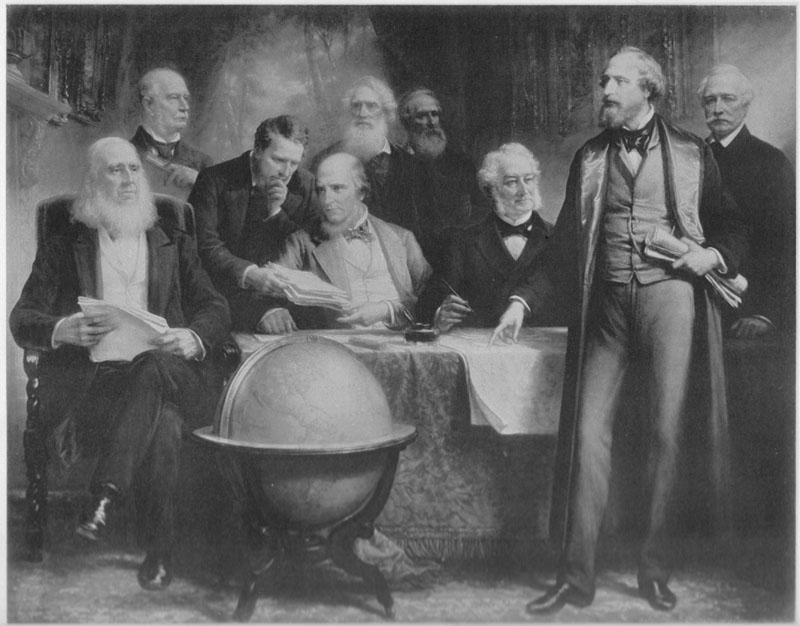
Early Atlantic Cable Men.—A special meeting of the New York Chamber of Commerce has been held to witness the ceremony of the presentation to the Chamber of the picture commemorative of the work of the late Cyrus W. Field and his associates in laying the first cable under the Atlantic Ocean. The presentation of the picture was made by Mr. Morris K. Jesup, one of the vice-presidents of the Chamber and chairman of the committee appointed to secure the memorial; his associates being Messrs. Abram S. Hewitt and W.E. Dodge.
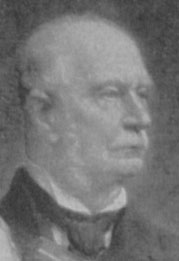
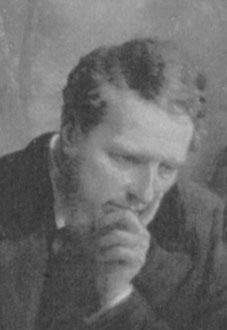
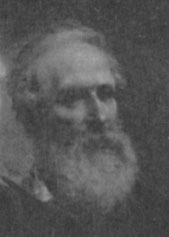
The picture represents a meeting of the Atlantic cable projectors at the residence of Mr. Cyrus W. Field in Gramercy Park. Mr. Peter Cooper is presiding. Mr. Field is calling attention to a chart of Trinity Bay, pointing to Heart’s Content as a safe harbour for landing the cable. Mr David Dudley Field stands by the president with a lawbook. Mr. Chandler White is handing estimates of expense to Mr. Marshall O. Roberts, next to whom, at the table, is Mr. Moses Taylor, listening to Mr. Field’s argument. Near Mr. Taylor, at the end of the table, stands Mr. Wilson G. Hunt, who, though he joined them some time after their first organisation, remained a staunch supporter of the project to the end. Prof. Samuel F.B. Morse is standing behind Mr. Roberts, and by his side is the artist, Mr. Daniel Huntington, sketching.
The picture is life-size, the canvas being 9ft. long by 7ft. in height. The list of donors includes the estates of Peter Cooper and W. G. Hunt, the Gould brothers, the Western Union Company, the Dodge family, Cornelius Vanderbilt, J.P. Morgan, and about 50 others.
From: The Electrical Engineer: 14 June 1895, page
675
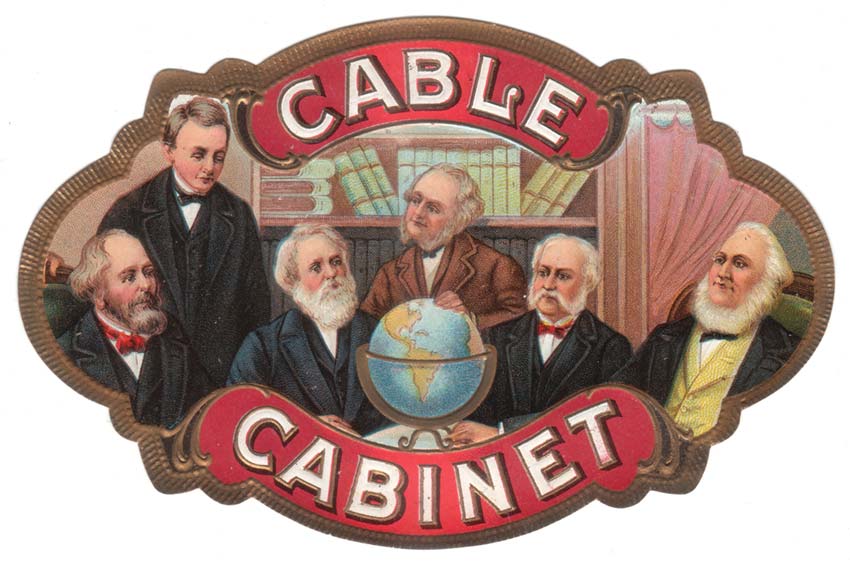
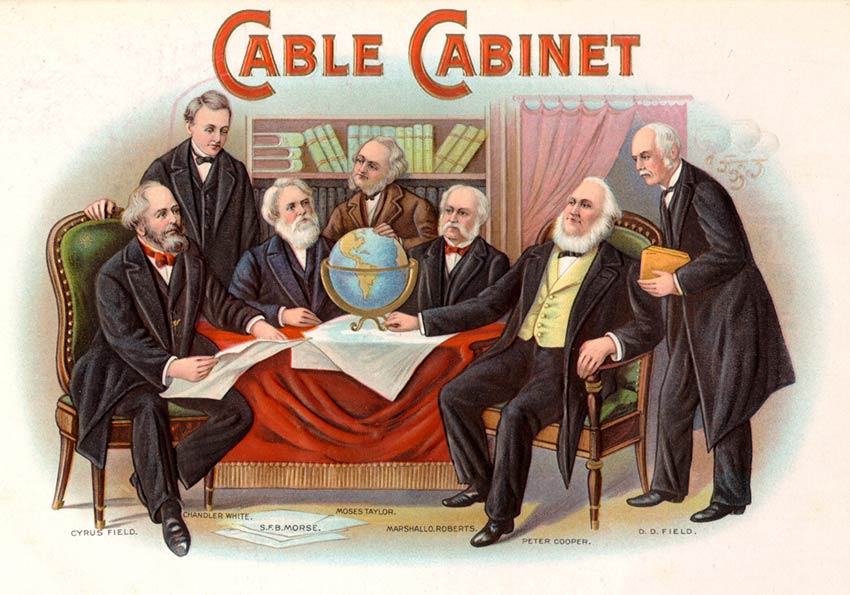
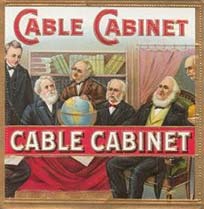
It's interesting to compare
the Huntington painting with this cigar box label from the same year.
Using artistic license, the cigar box artist excluded two of the partners,
but both artists included Morse for effect even though he was not at
the meeting. Huntington also included himself in the Projectors
painting as a shadowy figure in the background.
The labels show a re-creation of
the 10 March 1854 meeting at Cyrus Field's home in the Gramercy Park
district of Manhattan.
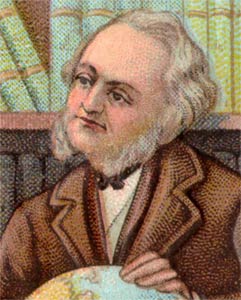
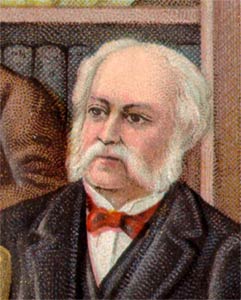
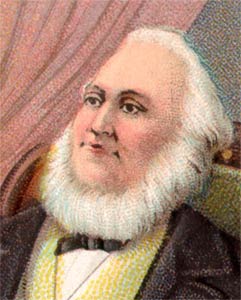
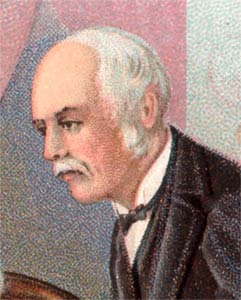
From left to right: Cyrus W. Field,
Chandler White, Samuel F.B. Morse, Moses Taylor, Marshall O. Roberts,
Peter Cooper, David Dudley Field (on inner label only).
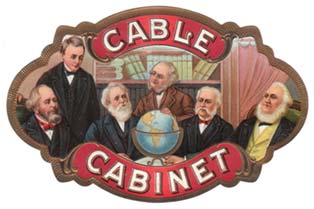
Top seal |

Backflap label |
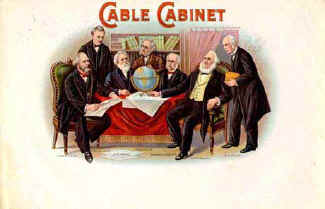
Inner label |
Outer label |
| |
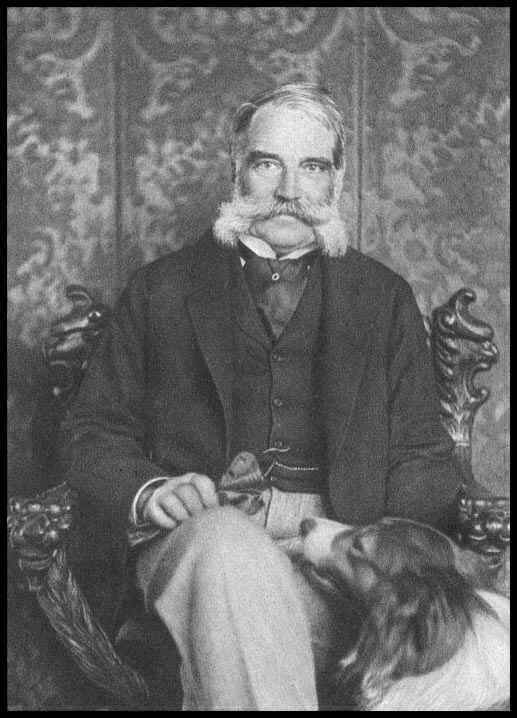
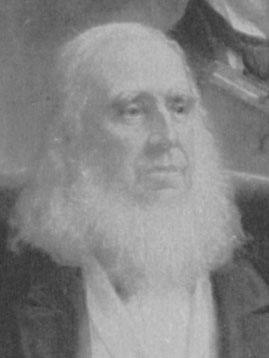
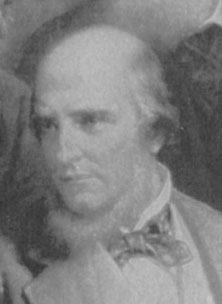
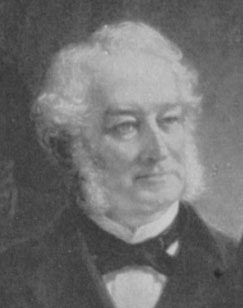
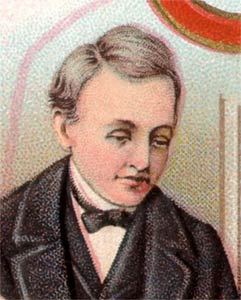
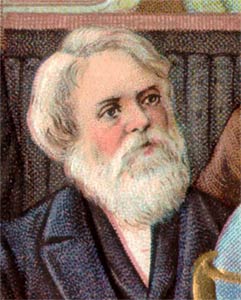
Portrait details
from the Cable Cabinet cigar box inner label
Artist unknown, circa 1895 |
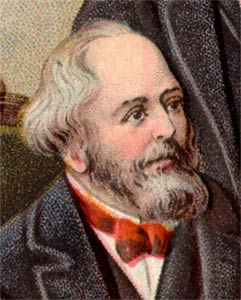 |
| Cyrus W. Field |
 |
 |
| Chandler White |
Samuel F.B. Morse |
 |
 |
| Moses Taylor |
Marshall O. Roberts |
 |
 |
| Peter Cooper |
David D. Field |
Cigar box inner label
courtesy of InStone, Inc.
Outer label courtesy of Chip Brooks,
Cigar
Label Junkie website.
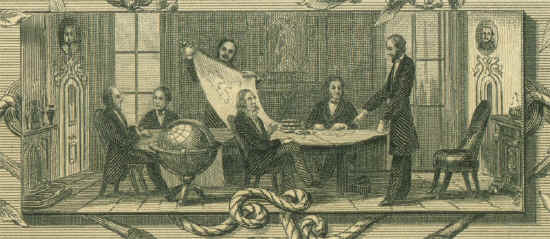
Another view of the 1854 meeting,
from the invitation engraved by
Tiffany & Company for Cyrus Field's
25th anniversary celebration,
held at Field's Gramercy Park residence on 10 March 1879.
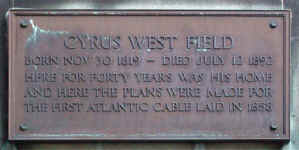
The historical marker on the building which now occupies
the site of Cyrus Field's Gramercy Park residence
Return to the Atlantic Cables index page |