Deep sea section |
In 1858 the Red Sea and India Telegraph Company was
formed to connect India to London, a concession having been obtained from
the Turkish Government to lay a cable across the Suez isthmus and down
the Red Sea.


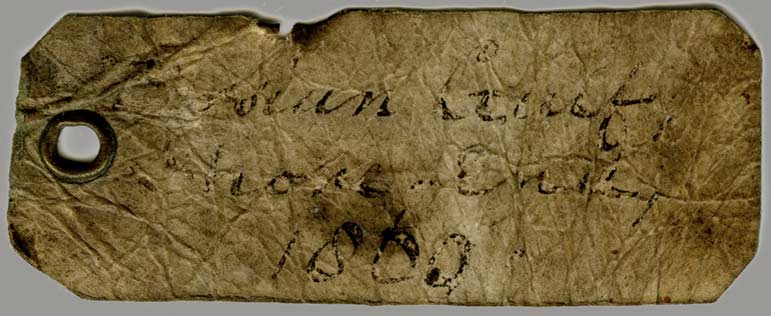
Cable sample with label:
Persian Gulf Shore End 1860 |
The cable was made by R.S. Newall & Company,
using core supplied by the Gutta Percha Company. Three ships were chartered; Imperador, Imperatriz, and Berwick, and the cable
was laid in two expeditions. Suez - Kossier - Suakin - Aden was completed
between 5 May and 28 May 1859 and Aden - Hallani - Muscat - Karachi between
17 January and 12 February 1860. Lengths were 255 + 474 + 627 + 718 +486
+ 481 nm.
The cable conductor used seven copper strands (six around one), weighing
180 lbs per nm; this was covered with four coatings of gutta percha to
Chatterton’s patent (212 lbs per nm.), hemp serving (1½ cwt per
nm.), and 18 armouring wires of best selected charcoal iron (16 cwt per
knot). Total weight of the cable was 21 cwt per nm.
The cable was lightly armoured, and the contract allowed
Newall’s to keep all surplus cable; consequently the cable was laid with
very little slack and soon failed. The 1859 section had already broken
down by the time the route was completed in 1860. Messages were passed
over individual sections, but the entire cable never worked as a unit.
All sections were abandoned by 1861, and communication
to India was not established until the 1864
Persian Gulf cable was laid.
Information from Haigh, cable drawing from
Schellen.
The Illustrated London News reported on the laying of the section from Suez to Aden in its issue of July 9th, 1859:
LANDING OF THE RED SEA TELEGRAPH CABLE AT ADEN
The Red Sea Telegraph has been laid, and Aden is now joined with Suez by means of Messrs. Newall and Co.’s submarine cable. This important enterprise was brought to a successful termination on Saturday, the 28th of May, at two p.m. The Rev. Mr. Badger, Chaplain at Aden, writing on the 31st of May, gives the following particulars of the laying of the cable:—
“Early on the morning of the 28th of May the Imperador and Imperatriz, accompanied by her Majesty’s ship Cyclops hove in sight from the westward, and were joined in a few hours by the Lady Canning steam sloop, which conveyed Brigadier Coghlan, our Political Resident, and a goodly number of the Aden community, on board the Imperatriz, to witness the process of paying out. A hearty welcome was exchanged between the visitors and the telegraphic staff, and the former then witnessed with interest and admiration the simple but perfect machinery which coiled and uncoiled the cable at the rate of eight knots an hour. Meanwhile the little fleet, gaily dressed out with flags, moved steadily on until the Imperatriz came to anchor in a snug little bay on the south side of the peninsula, of which I am able, through the courtesy of my worthy friend Dr. Welsh, to send you a photograph taken on the spot. The test was then applied to the wire, and, on being found in perfect order to Suez, Brigadier Coghlan had the honour of transmitting the first telegram. It was addressed to our gracious Queen, informing her Majesty that her possessions at Aden were now in telegraphic communication with Egypt; and a few minutes after a Royal salute from the fort on Ras Marbat announced that the message had reached its destination with more than lightning speed. Arrangements were then made to land the shore‑end; and, as the coil was in course of being deposited on the beach, the old Cyclops fired a salute, manned yards, and gave three hearty cheers, which wore as heartily responded to by all on board the Imperatriz. The cable was then buried in the sand but in a day or two the land line will be completed to the company’s office, which overlooks the great harbour.
“According to all accounts, the submergence of the cable from Suez to Cosseir, thence to Suakin, and finally to Aden, was accomplished with the greatest ease; and the highest praise is due to Mr. Lionel Gisborne, the energetic projector of the Red Sea Telegraph, and to Messrs. Newall and Co., the no less enterprising contractors (all of whom accompanied the expedition and supervised its arrangements), for the skill and perseverance which they have exhibited in carrying out this important scheme. The services of Captain Pullen, also, of the Cyclops, should not be forgotten. For the last year he has been engaged in the arduous task of surveying the Red Sea in order to test its capabilities for submarine telegraphic communication and the final decision of our Government to sanction and subsidise this line, in preference to any other, is mainly to be attributed to his able and favourable reports. It remains to be seen what reward the country will bestow upon the man who, after having distinguished himself in two Arctic expeditions, has added a fresh claim upon the national gratitude for his important labours in the Red Sea.
“The Aden and Suez line will not be open to the public for a month to come; but the contractors have generously and loyally offered to transmit any important public messages, during the interval, free of expense. The Imperatriz having still 250 miles of cable on board, will start in a few days to lay it between Aden and Maculla; the Lady Canning under the command of Lieutenant Peevor, of the Indian Navy, is to accompany her to render any assistance that may be required. This done, the Imperatriz and Imperador will pursue their homeward voyage, and we expect to see them return in November next with the remaining part of the cable for the extension of the line from Aden to India. The cable, we understand, is nearly ready for delivery in Messrs. Newall and Co.’s workshops at Birkenhead.
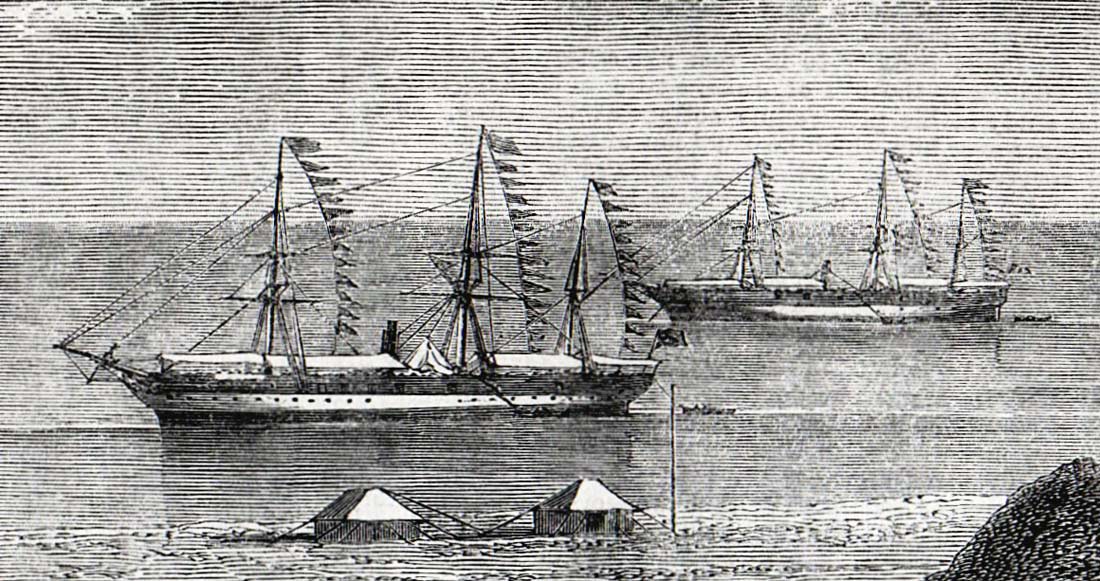
“The Sketch which I have the pleasure to send you represents Telegraph Bay, Aden; the ship nearest the shore is the Imperatriz and the two tents opposite were put up by Brigadier Coghlan for the convenience of the expedition on their first landing. The land line extends from the tents to the conical hill in the foreground, part of which is occupied by the summer mess‑bungalow of her Majesty’s 57th Regiment, and thence across the sandy plain to the company’s office a distance of about half a mile. The building on the point to the right is the European Female Hospital.

Landing of the Red Sea Telegraph cable at Aden.
From a photograph by Dr. James Walsh.
Detail of ships: Imperatriz is the ship nearest the shore |
“The photograph was taken by Dr. James Welsh, in charge of the European General Hospital at Steamer Point, at whose hands hundreds of our merchant seamen, for many years past, have experienced the skill of an accomplished physician, joined with the assiduous attention and, kindly sympathyof a man and a brother.”
Our thanks are likewise due to an officer of the Aden garrison for an excellent pen‑and‑ink sketch and full particulars of the landing of the Red Sea telegraph cable at Aden.
|