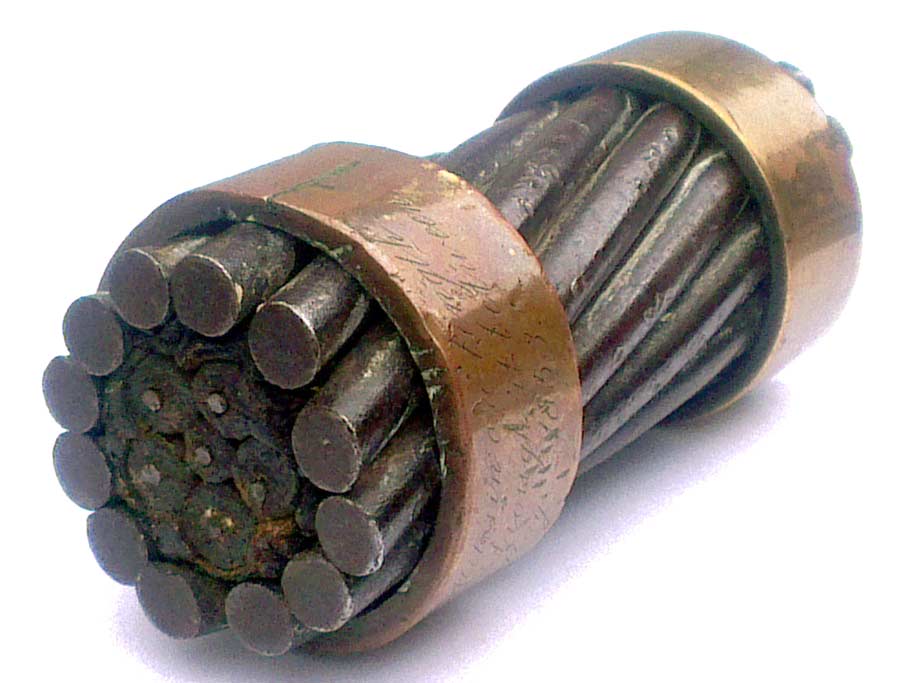
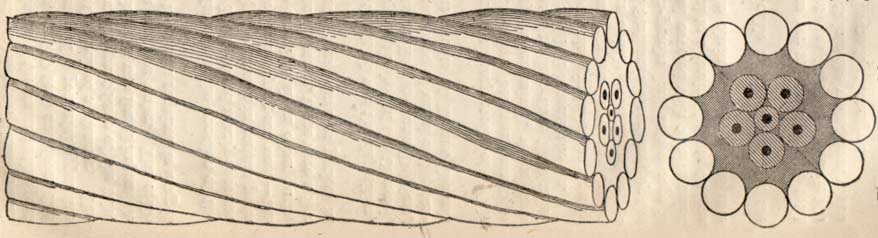
The core was manufactured by the Gutta Percha Company and consisted of six copper wires of No 16 BWG covered with two layers of gutta percha to No 2 BWG. The armouring was carried out at Newall’s factory in Sunderland. A wrapping of jute soaked in pitch was applied, then the armouring, consisting of 12 No 2 BWG iron wires, was added.
Manufacturing the cable took 100 days, and the cost including laying was £33,000. Prior to loading, the cable was stored in Newall’s yard in a coil measuring 51 ft on the outside, 28 ft on the inside and 4 ft 8 in. high. Loading into the William Hutt, a vessel chartered by Newall’s for the expedition, began on 26 April and took 70 hours.
The company asked the Admiralty for assistance in buoying the course and they supplied Captain John Washington to oversee the work, with HMS Lizard (Commander Ricketts) and HMP Vivid (Captain Smithett) to carry out the laying of the buoys. William Hutt arrived at Dover, with the cable crew on Sunday 30 April and on the following day attempts were made to start buoying the route, but after two buoys had been launched 10 and 20 miles out from St. Margaret’s the attempt was abandoned because of bad weather.
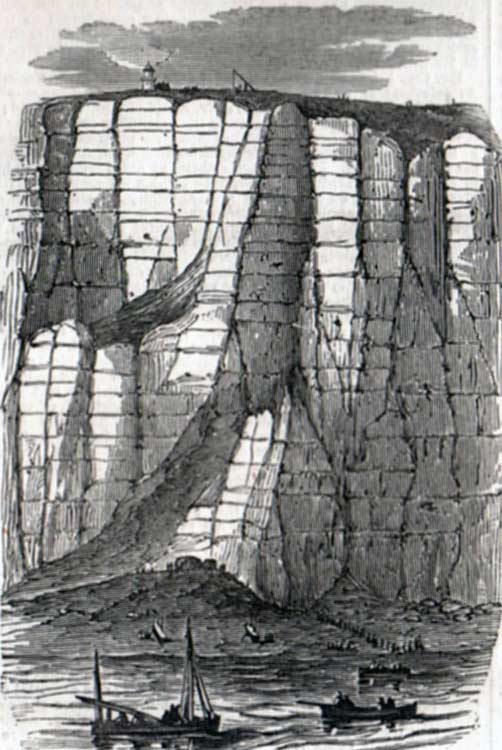
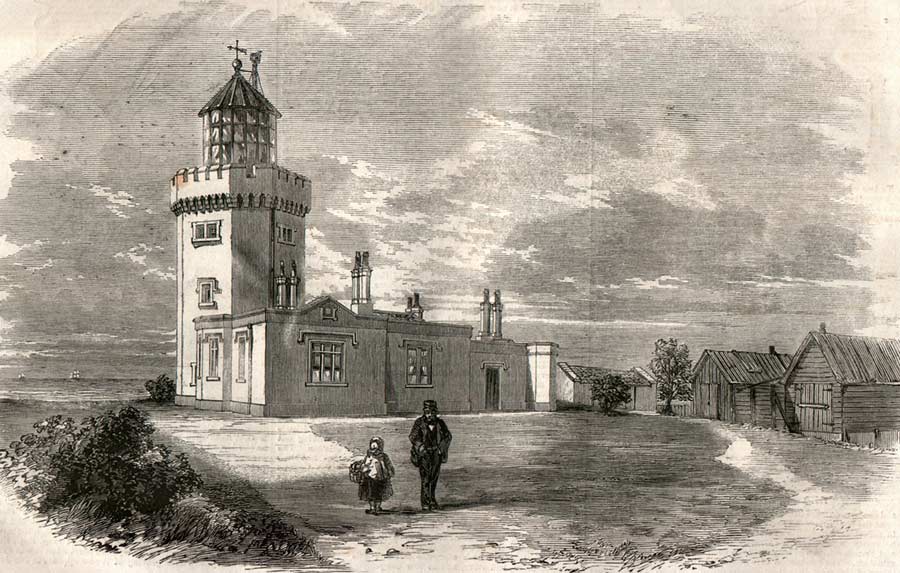
Preparations were made to start laying on the Tuesday but the weather was still rough during the morning. By the evening the weather and the state of the sea had improved and the crews were called to get the ship ready to sail at first light. Once the sea mist had cleared on the Wednesday morning William Hutt, Lord Warden, a steam tug based at Dover, and HMS Lizard came within 500 yards of the shore off the South Foreland lighthouse, where William Hutt offloaded 200 yards of cable into a large boat which then made its way to shore.
Cable from the ship was payed out and this was supported by a small flotilla of fishing boats which took up position as the cable was paid out. The 200 yards of cable was laid up to a cave at the foot of the cliffs where Telegraph Engineer, Mr. J. W. Reid Jnr., connected it to the telegraph instruments already in the cave. An assistant was left to look after the instruments, which would be used to keep in touch with the William Hutt during the laying.
Laying recommenced at first light and at 3.00 pm the flotilla was off the landing site. Rough weather once again intervened so the cable was buoyed and the squadron made for Ostend. The following morning the cable end was recovered and loaded into a boat which was towed ashore, where the cable was taken into the coastguard's hut. The telegraph equipment there was connected and just before 1.00 pm on Friday 6 May 1853 direct communication with England was established.
The following contemporary account of the laying of the cable is taken from telegraph pioneer W.B. O'Shaughnessy's 1853 book The Electric Telegraph in British India.
SUCCESSFUL LAYING OF THE SUBMARINE TELEGRAPH
CABLE BETWEEN DOVER AND OSTEND.
This important undertaking has just been completed with entire success. Through the extreme kindness of Sir James Carmichael, the writer has had the advantage of witnessing the whole operation, and is permitted to insert the annexed brief narrative of its successive stages.
The cable, manufactured by Messrs, Newall and Co., consists of six gutta-percha covered wires: five of No. 2 gauge, one of No. 4 ditto. These are served with a thick coating of hemp, spun-yarn, and tar, and enclosed in a spiral casing of twelve iron rods, 5/16-inch diameter, gauge No, 1, not galvanized, but well coated with Stockholm tar. The weight per mile is—
| |
|
Tons. |
cwt. |
qrs. |
lbs. |
| Gutta-percha coated copper wire |
|
0 |
9 |
3 |
21¾ |
| Hemp, yarn, and tar |
|
0 |
7 |
1 |
13 |
| Iron rods, No. 1 |
|
5 |
18 |
0 |
25 |
| |
|
— |
— |
— |
— |
| Total per mile |
Tons |
6 |
15 |
2 |
4 |
The length of the cable is 70 statute miles. Total weight, 474 tons, 7 cwt. 2 qrs.
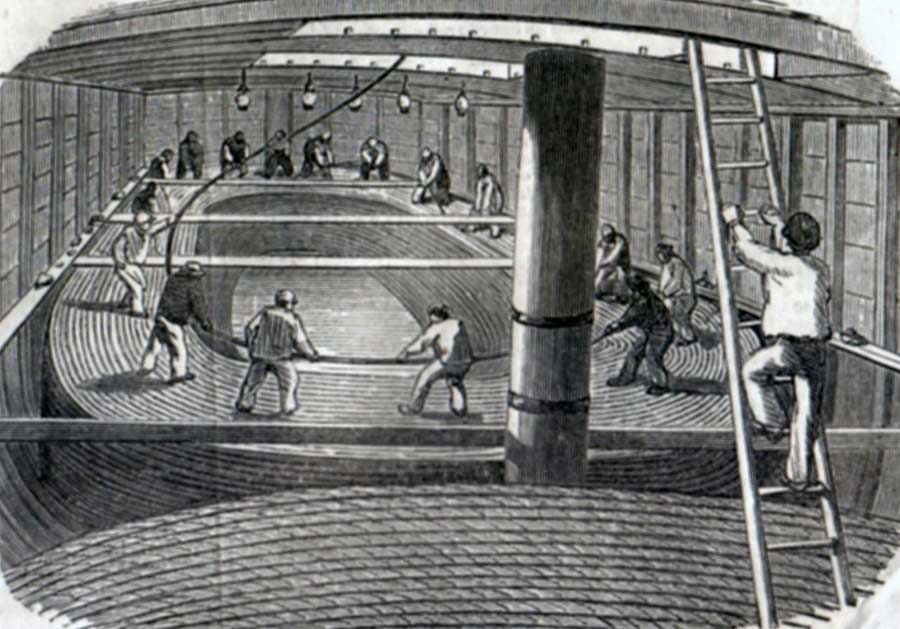
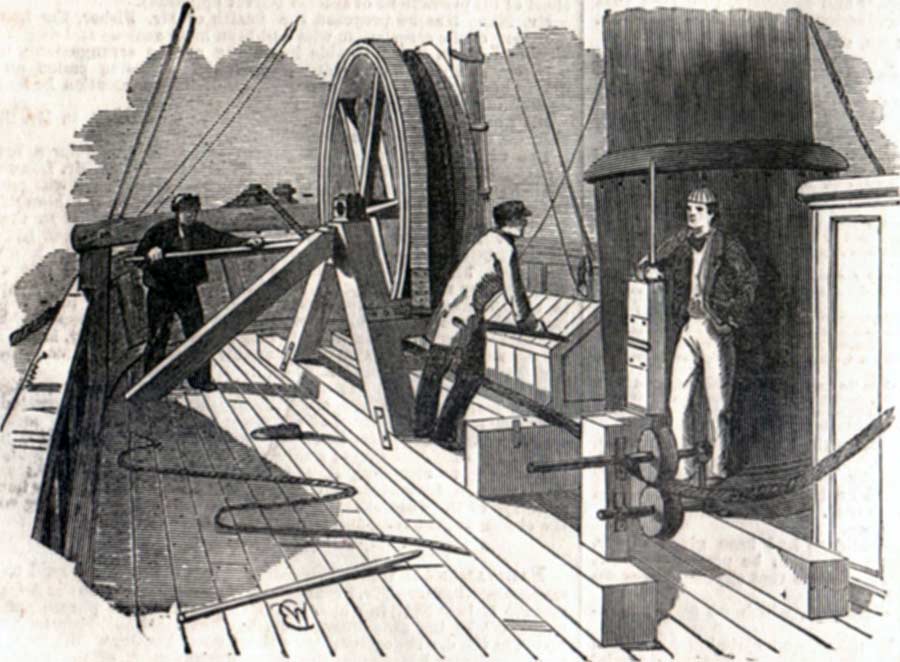
The cable was coiled, at Gateshead, on board the “William Hutt” iron screw steamer, all the lower decks, stanchions, fittings, &c., having been removed, so that the cable was arranged in three great coils, fore and aft. One end passing over a roller, was led to and over an iron saddle, erected on a frame about twelve feet high, attached to the mainmast; from this saddle it passed downwards to a cast-iron vertical drum, 7 feet 8 inches diameter, round which it took three turns, and then proceeded over the ship's stern, between two vertical rollers placed sufficiently apart to allow of free lateral play to the cable as delivered.
To the drum was attached a lever and friction break, by which its rotation could be checked or totally stopped; also a set of measuring wheels, with a dial, to denote the length of cable expended as the operation advanced.
The turns of the cable in the ship's hold were separately lashed together laterally by spun-yarn, and each tier also attached by similar lashings to the one below. The whole arrangement thus formed, as it were, a solid mass. Hand-ropes, firmly secured to the cross-beams at intervals of a few feet, enabled the men to hold on firmly with the left hand, while with the right each yarn lashing was cut in succession. The advantage of this prudent precaution was well proved in the rough weather which prevailed during a great part of the undertaking.
The “William Hutt” arrived off Dover on the 2nd of May. All being ready on the 3rd, the expedition started on the morning of the 4th, Captain Washington, R.N., on board the mail steamer “Vivid,” being in charge of the nautical arrangements; Mr. Newall directing the paying out of the cable from the “Hutt,” towed by the “Lord Warden” Dover steamer; H.M. reserve steamer “Lizard,” Captain Ricketts, R.N., accompanying close alongside. At 4.45 a.m. commenced landing the cable end for the cave at the South Foreland, with eight boats, the ship being about 1,000 feet off the shore. This was completed, and the end made fast ashore, at 6 a.m. The “William Hutt” started under her own steam, and towed by the “Lord Warden,” at 6.20 a.m. At 8.10 a.m. thick fog set in; passed close to the South Sand floating light ship, and, further progress being impracticable, the ships anchored at 1.45 p.m., 31 miles of cable having been given out.
The fog cleared off towards evening, and the squadron started again at 7.55 p.m., the “Vivid” with a light piloting ahead, and the “Lizard” burning blue-lights and rockets. At 2.30 a.m. anchored again in 14 fathoms, with a stiff breeze from N.E., and heavy, confused sea, The “William Hutt” now rolled violently, and her feed-pipes became so choked that her own steam was no longer available. Started again, in very rough weather, at 7.40 a.m, of the 5th of May. The “Lizard” parted her chain cable and lost an anchor just as signal was made to weigh. At 9.40 the “Lizard” took the “William Hutt” in tow, and the “Lord Warden” cast off. At 10.20 the “Lizard's” towing hawser snapped, but the telegraph ship was secured almost instantly by the Dover tug. At 11.15 a.m., off Dunkirk, weather more boisterous. Anchored off Middlekirk, five miles west of Ostend, in half a gale, at 1.30 p.m.
The paying out of the cable was thus effected at the rate of 4½ miles per hour. No accident occurred on board, and not a single “kink” or other casualty or derangement took place in the cable itself.
At 11.50 a.m. on the 6th of May, the remaining cable was removed from the “Hutt” on board a large Blankenburgh fishing smack, and attended by all the boats of the squadron. A warp rope was sent ashore and secured, and the smack, by under-running the warp, hauled in through the heavy breakers, on the beach. All was finished at 1 p.m. exactly; the Belgian end of the cable carried in triumph to the Coast Guard House, on the Sand Hill, and, the wires having been connected, messages were sent through the cable to Dover, Calais, and London at 2 p.m.
The cable was then formally delivered over by Messrs. Newall and Co., amidst the congratulations and applause of all present, to Sir James Carmichael and Mr. Brett, directors, and Messrs. Crompton and Wollaston, the engineers of the Submarine Telegraph Company,
On the 7th of May, Mr. Wollaston proceeded, in the writer's presence, to test the insulation of the lines, and made numerous experiments of extreme interest on their telegraphic capabilities.
To test the lines, a delicate vertical galvanometer was employed (which, with one sand battery couple, gave a deviation of 35.00), and a sand and acid battery of 72 couples. With this—
| Wire No. |
1 |
gave deviation or loss of |
1.50 |
| |
2 |
|
1.50 |
| |
3 |
|
1.50 |
| |
4 |
|
1.50 |
| |
5 |
|
1.50 |
| |
6 |
(centre wire) |
18 |
A single needle telegraph having been applied at each end to each wire in succession, the needles were moved distinctly by the current from a single pair of plates; three pairs gave decided beats, and with 12 plates signalling was carried on with ease.
The wires were now joined, so that the current passed six times to and fro in one length of 70 x 6 = 420 miles. Through this great distance, all submarine, the signals passed strongly from 48 plates. The Calais submarine line was now added without impairing the result.
These experiments demonstrated the perfect practicability of telegraphing through a submarine cable 500 miles in length, and left no doubt on the minds of the observers of double that distance being as completely within the range of very moderate electric power.
To conclude, no operation on any scale could have been performed in a more masterly or thoroughly successful manner. We have only to add our warm wishes that the enterprising company to whom England and Europe are indebted for so great a benefit may reap a full measure of reward in the profitable working of the line thus auspiciously opened.