|
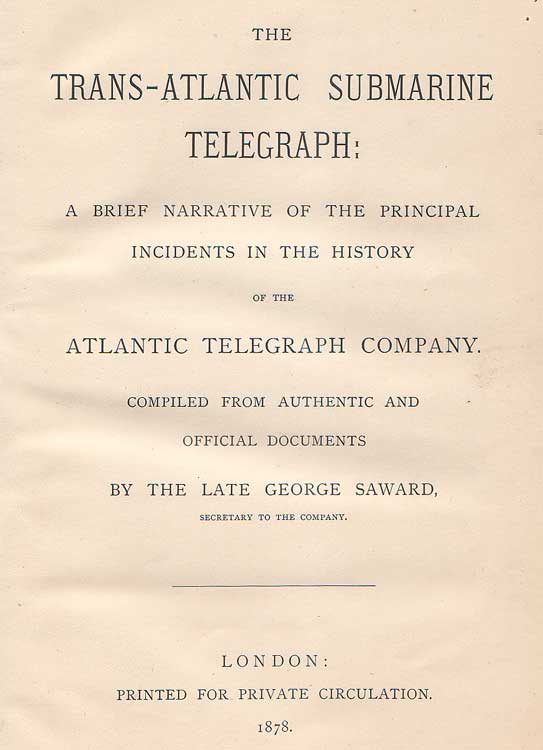
THE
TRANSATLANTIC SUBMARINE TELEGRAPH
CHAPTER
I.
In the
month of November, 1850, Bishop Mullock, at that time the head of the
Roman Catholic Church in Newfoundland, addressed to the Courier, an
American newspaper, a letter in which he advocated the establishment
of a line of telegraphic communication from Newfoundland to New York,
so that under proper arrangements the news of the mail steamers could
be intercepted in passing Newfoundland and sent forward by telegraph
to New York, while, on the other hand, news occurring in New York, subsequent
to the sailing of each mail, could be telegraphed on to Newfoundland,
and there sent out to meet the steamer passing on its way to Europe
—thus shortening the time of communication between the two countries
by several days.
The
Bishop suggested the construction of a land telegraph from St. John’s
to Cape Ray, to be continued by submarine cable to St. Paul’s Island,
and from the latter place to Cape North (Cape Breton), thence by the
best route to the mainland of America, there to unite with existing
telegraphs, and by these means to complete the communication to New
York. A year later the idea of carrying such a scheme into practice
appears to have occurred either as an original notion, or from the perusal
of the above-mentioned letter, to a Mr. F.N. Gisborne, an English telegraph
engineer, who, in 1851, was living in Nova Scotia.
Mr. Gisborne visited Newfoundland for the purpose of explaining his
plan to the Legislature of that colony, with a view to their possible
assistance in carrying it out.
His project was at once to erect an overland telegraph from St. John’s
to Cape Ray, and as there was at that period much doubt as to the practicability
of submarine cables he proposed to establish a temporary communication
from Cape Ray to Cape Breton by means of steamers and carrier pigeons,
until it should have been proved to be possible to lay a submarine cable
across the sea between those places.
It was hoped at the time that these important arrangements might ultimately
lead to the running of steamers from Galway to America, calling at St.
John’s. The establishment of these steamers had been mooted previously,
and the scheme having thus a local interest for Newfoundland Mr. Gisborne’s
plans were favourably received, and met with such assistance as enabled
him to survey a line from St. John’s to Carbonear. In 1852 the local
Legislature of Newfoundland gave further encouragement to the project
by granting to Mr. Gisborne an Act of Incorporation which conferred,
under certain conditions, upon a projected Company, important concessions
of land, and the exclusive right of erecting telegraphs in the colony
during a period of thirty years.
Furnished with this authority Mr. Gisborne proceeded to New York for
the purpose of introducing his plans and his Act of Parliament to the
notice of capitalists there. In this endeavour he was to some extent
successful, for he met with a Mr. Tebbits, through whom he obtained
some subscriptions, and promises of further help in the same direction.
Mr. Gisborne then set to work upon the line to Cape Ray, and, in spite
of formidable engineering difficulties, and great personal dangers and
privations, he bravely persevered in making a survey of the hitherto
unexplored country westward of St. John’s, and commenced the erection
of an electric telegraph by land in the direction of Cape Ray.
By this time several submarine cables had been laid in Europe, and the
idea of the steamer and the carrier pigeons was consequently now laid
aside. Mr. Gisborne now proceeded to England, where he purchased and
shipped a submarine cable, which he succeeded in submerging successfully
from Prince Edward’s Island to New Brunswick, this being the first cable
of any importance ever laid in America. Unfortunately this cable was
shortly afterwards broken, and, owing to the want of experience, could
not at that period be recovered.
Undaunted by this untoward circumstance Mr. Gisborne proceeded with
his land lines towards Cape Ray, and was pushing forward with great
energy when his progress was suddenly arrested, owing to the necessary
funds for the payment of wages and expenses not being forthcoming from
New York. This catastrophe involved Mr. Gisborne personally in great
pecuniary loss and liability for debts incurred in the Island of Newfoundland,
and it was not till January, 1854, that he was able again to take up
the matter.
He then
went to New York to see some of his American friends, in order to ascertain
if anything further could be done to resuscitate and complete the half-finished
project. He was long unsuccessful in this, and while meditating on the
best course to relieve him from his embarrassment he became acquainted
with Mr. Matthew D. Field, an engineer, by whom he was introduced to
Mr. Cyrus W. Field, whose name and exertions are so well known in connection
with this enterprise.
Mr. Cyrus
Field, having carefully considered the history of Mr. Gisborne’s proceedings,
decided at once not to attempt to complete Mr. Gisborne’s unfinished
enterprise, inasmuch as during his consideration of the matter the idea
of a much larger project had dawned upon his own mind. It had struck
him that if it were possible to succeed in establishing a submarine
telegraphic communication across the Atlantic Ocean a grand scheme of
international telegraph would be formed by combining this larger enterprise
with the original project of Mr. Gisborne.
The recent success of the cable between Dover and Calais in 1851, and
the consequent confidence thence arising in Europe as to the indefinite
extension of submarine telegraphy, gave great encouragement to this
idea. Mr. Field accordingly took measures for obtaining the opinions
of the highest scientific authorities in America: First, as to the possibility
of stretching a telegraphic cable across the bottom of the Atlantic
Ocean without mechanical injury; and, secondly, as to whether a submarine
cable could be so constituted electrically, having regard to its conductibility
and insulation, as to be capable of transmitting telegraphic signals
with speed and accuracy between Europe and America.
From Lieutenant Maury, of the National Observatory at Washington, he
received satisfactory assurances as to the mechanical question, and
the further information, founded upon the soundings of Lieutenant Berryman,
of the United States brig Dolphin, that between Ireland and Newfoundland
there existed a line of equable soundings and a character of sea bottom
admirably adapted for the purpose of receiving a telegraphic cable.
From Professor Morse he obtained equally encouraging assurances as to
the practicability of the electrical portion of the work, and, thus
supported by scientific opinions, Mr. Field decided upon making an attempt
to combine in one grand undertaking the project of Mr. Gisborne and
the important supplement to that project which had been conceived by
himself.
From that hour to the final consummation of the great work, during a
period of twelve years of wearing trial and disappointment, Mr. Field
never lost heart, but devoted himself with untiring energy to the work
of which he from thenceforth became the apostle.
The
object of these pages being to narrate in a plain way some of the principal
incidents in the history of a famous enterprise, without presuming to
adjust the various claims to praise among the many meritorious persons
who were concerned in bringing it to completion, it must not be supposed
that injustice is intended to Mr. Field, or other labourers in the work,
if their separate efforts are not dwelt upon as often or as fully as
some might think due to them.
As regards
Mr. Cyrus W. Field, his great services have fortunately found an eloquent
exponent in the person of the Rev. Henry Field, who, in a very interesting
work, entitled “The Atlantic Telegraph,“ has more particularly
dwelt upon the important part fulfilled by his distinguished relative.
Supported by the authority of Professor Morse, Captain Maury, and other
eminent authorities, Mr. Field agreed, on certain terms, to assist Mr.
Gisborne, and the better to carry out his views he, with his brother
Mr. Dudley Field, obtained the co-operation of certain capitalists,
viz., Mr. Peter Cooper, Mr. Moses Taylor, Mr. Marshall 0. Roberts, and
Mr. Chandler White, all of New York.
These gentlemen, in conjunction with the Messrs. Field, agreed, at their
mutual expense, to promote and carry out a certain Company, to be called “The New York, Newfoundland, and London Telegraph Company,“ provided that an Act of Incorporation could be obtained from the Legislature
of Newfoundland in its favour, conferring and confirming certain privileges
upon the shareholders in the event of their completion of various telegraphic
works, more especially of a cable across the Atlantic.
Mr. Cyrus Field and Mr. Dudley Field therefore proceeded to Newfoundland,
and having acquired a surrender of Mr. Gisborne’s charter they eventually
obtained from the Newfoundland Legislature a new and most important
Act of Parliament (which was duly confirmed by the Colonial Department
of the Home Government), incorporating their project, under the title
of “The New York, Newfoundland, and London Telegraph Company.“ This Act conferred upon the promoters, during a term of forty years,
the exclusive right of landing cables in Newfoundland and Labrador,
together with the fee simple of fifty square miles of unappropriated
land on completion of certain land telegraphs, and of a further fifty
square miles on the completion of the submarine cable to Europe.
The Act also confirmed a guarantee by the Newfoundland Government of
interest on £50,000 worth of the new Company’s Bonds, and took
upon itself the payment of £5,000 in cash towards the construction
of a bridle path along the line of the land telegraph.
This Colonial Act having been secured and confirmed, the promoters at
once discharged the debts of the old Newfoundland Company, the Act incorporating
which was repealed by that obtained by Mr. Field.
The
new Company soon completed the line from St. John’s to Cape Ray, with
a branch to Cape Race, and, after losing one cable, they finally succeeded
in establishing submarine communication between Cape Ray (Newfoundland)
and Ashpee Bay in Cape Breton, and also connected Nova Scotia with Cape
Breton by a cable across the Gut of Kanso.
During
the construction of the land lines some differences arose between the
new Company and Mr. F. Gisborne, in consequence of which the latter
gentleman thenceforward seceded from the undertaking.
Communication between New York and Newfoundland having thus been established,
the promoters proceeded to demonstrate to the public, experimentally,
the commercial advantages attainable, by at once shortening, via Newfoundland,
the intercommunication between New York and Queenstown to the extent
of two or three days, thus indicating the conveniences which would result
from the completion of entire telegraphic communication between Europe
and America, so that the public might be induced to come forward in
support of that more extensive project.
This they effected by stationing at Cape Race (a headland at the extreme
south-eastern point of Newfoundland) a small vessel, whose business
it was, in accordance with a previous arrangement effected with the
owners of the Cunard line of mail steamers, to intercept (weather permitting)
the regular steamers employed in the latter service, the captains of
which had orders to steer a course sufficiently north to enable them
to sight Cape Race as closely as possible both on the outward and homeward
voyage.
Agents were appointed in Europe and America to collect telegraphic messages
for transmission between the two countries by this new route, which
soon came into favour with the press and public, though too much trammelled
with working expenses to have been permanently kept open. The process
of transmission was as follows:—The messages from Europe, collected
up to the sailing of each mail, were placed in water-tight canisters
and taken out by the mail boat, which, on sighting Cape Race, began
to slacken speed, and continued to do so for a short distance, thus
enabling the local steamboat employed by the Telegraph Company to come
within hailing distance of her. The water-tight canisters containing
the messages collected up to the latest moment of leaving Europe were
then cast overboard, and as quickly as possible fished u p by the telegraph
steamer, which, having secured them, immediately hastened to St. John’s,
where the despatches were opened by the Superintendent of the office
and sent forward to New York by electric telegraph, in this way anticipating
by several days the European news which had been carried all the way
by steamboat.
On the
American side the same process was reversed:—The despatches for Europe,
collected by the Agency during the two to three days succeeding the
departure of each mail from New York, were telegraphed to St. John’s,
Newfoundland, where they were received up to the latest moment consistent
with due regard to the necessary allowance of time for the telegraph
boat to go out and meet the return steamer for Europe.
The water-tight
canisters again came into requisition, and being filled with news for
Europe and sealed down, the little telegraph steamer at once started
to meet the mail boat passing Cape Race on its way to Europe, which
slackened speed at that point and received the despatches as on the
inward journey.
On arriving at Queenstown (in Ireland) the despatch canisters were again
opened, and their contents sent by telegraph to their various destinations,
thus affording three days later American news than the letters brought
over in the same steamer.
At a later period a special land line was erected to Crookhaven (in
Ireland), six or seven private individuals having formed themselves
into an association for the purpose, and a steamer was put on to run
out to Cape Clear for the purpose of intercepting the mail at that point
on the European side, thus saving the time occupied in the voyage from
Cape Clear to Queenstown, and making two interceptions during each voyage.
These arrangements might have lasted u p to the laying of the Atlantic
Cable had not the cost of the requisite maintenance of the land lines
prevented the scheme from being remunerative.
The Newfoundland line, therefore, having got out of order, and its maintenance
being very expensive, the steamer at Cape Race was, after a considerable
trial, discontinued. In fact, some of the most wealthy of the members
of the Newfoundland Company, which continued to be numerically a very
small association, were completely discouraged by the repeated disappointments
of the Atlantic Telegraph Company in 1857 and 1858,and the continued
ill-success of their negotiations for additional capital. Seeing, therefore,
that the maintenance of their land line and cables would be too costly
to allow the scheme of interception at Cape Race to be independently
remunerative, they at length refrained from all expenditure in the matter,
pending the fate of the main project for crossing the Atlantic. The
Crookhaven line occasionally received despatches even so late as 1872.
Although the plan of intercepting the mails at Cape Race had practically
proved the advantage of complete telegraphic communication across the
Atlantic, the capitalists of New York and Boston could not be induced
to risk their money in an undertaking which seemed at that time, to
most persons except the promoters, of a very visionary character.
Mr. Field, however, nothing daunted by this circumstance, left America
for England in July, 1856, having for some time previous been in communication
upon the subject of submarine telegraphy with Mr. John W. Brett, of
London, so well known as one of the earliest practical originators of
submarine telegraphic communication in Europe.
Mr. Field brought with him full powers from his associates in America
to make arrangements to raise on this side of the Atlantic the necessary
money for carrying out this great experiment, either by obtaining subscriptions
for sufficient New Stock of the New York, Newfoundland, and London Telegraph
Company, for the completion of the entire project, or by the establishment
and subsidising of a special English Company, charged with the construction
and laying of the submarine cable across the Atlantic.
He found it necessary to adopt the latter course, and shortly after
his arrival in England he entered into an agreement with Mr. Brett and
subsequently with Mr. E.O.W. Whitehouse, a gentleman who had recently
abandoned the practice of medicine at Brighton for the pursuit of experimental
electricity, and with Mr. (afterwards Sir Charles) Bright, at that time
the Engineer of the Magnetic Telegraph Company.
By this agreement each of these promoters were mutually bound to push
on the undertaking in every possible way, and become sharers in the
ultimate profit to be derived therefrom.
Mr. Field also put himself in communication with the English Government,
and received, as the result of his application to Lord Clarendon, a
letter from Mr. James Wilson, then Financial Secretary to the Treasury,
agreeing, on the part of the British Cabinet, to furnish the aid of
national ships for the purpose of taking soundings across the Atlantic,
in the first instance, and of assisting in the ultimate work of laying
the cable.
The British Cabinet further undertook to enter into contract for the
payment during twenty-five years of £14,000 a year, as a subsidy
for the transmission of Government messages, until the Company, on the
establishment and during the continuance of communication, should be
able to declare a dividend of six per cent., and after that period a
fixed sum of £10,000 per annum, the understanding being that Government
messages were to be charged at the Company’s ordinary rates, and that
if the cable were used to an extent not covered by their amount of subsidy
the balance should be paid by the Treasury.
Mr. Field had set on foot measures for obtaining a subsidy from the
United States Government on a basis similar to the one just referred
to, and it may here be stated that immediately after the formation of
the English Company he left for Washington, where, in 1857, he obtained
the assent of Congress to a Bill entitled “A Bill to expedite Telegraphic
Communication for the Use of the Government in its Foreign Intercourse.“ This Bill empowered the Secretary of State, under the direction of the
President of the United States, to contract with any competent persons
or association for the aid of the United States in laying down a submarine
cable to connect existing telegraphs between the coast of Newfoundland
and the coast of Ireland, and for the use, by the United States’ Government,
of such submarine communication when established, the terms and conditions
of that use to be such as might seem to the President just and reasonable,
not exceeding 70,000 dollars per annum, until the net profits of such
persons or association shall be equal to a dividend of six per cent.
per annum upon the capital employed, and afterwards of an annual payment
not exceeding 50,000 dollars.
The duration of the contract was to be twenty-five years, and the Bill
further provided that before its powers should be exercised the Government
of Great Britain should enter into a similar contract; that the tariff
of prices should be fixed by the two Governments, who should both be
on an equality as regards the use of the cable.
The
following gentlemen, from whom Mr. Field received very great assistance,
were induced to unite with him in forming a Provisional Committee, and
in their names and that of Mr. Field the Atlantic Telegraph Company
were first registered under the Limited Liability Act:—Mr. G.B. Carr
(Chairman), Mr. J.W. Brett, Mr. Samuel Statham, Mr. J.S. Walker, Mr.
C.W. Tupper; and Mr. J.A.M. Pinniger acted as Solicitor to the Committee.
Upon this Committee, in connection with Mr. Field, devolved all the
preliminary arrangements. Their first act was to issue a private prospectus
addressed to commercial capitalists, and by dint of great personal exertions
in London, Manchester, and Glasgow, assisted in Liverpool by Messrs.
Charles and Edward Bright, they succeeded in raising the first capital,
which, contrary to the advice of Mr. Brunel and other scientific advisers
who had been consulted, was unfortunately fixed at the small amount
of only £350,000, in 350 shares of £1,000 each, under the
belief that to raise the large sums proposed would be impossible. Mr.
Brunel, foreseeing the difficulties before them, had wisely advocated
a subscription of £2,000,000.
His plans further included the construction of a ship of special form
and adequate capacity for storing the entire cable, and he insisted
on the necessity for a series of preliminary experiments before deciding
upon the “paying out “ machinery, or finally settling the
form of cable.
It is remarkable that Mr. Brunel’s original forecast of the work to
be done should have turned out to be so nearly correct. The ultimate
capital at the time of success was about the sum named by him, and the
wondrous ship, the Great Eastern steamship, the creation of his genius,
after vicissitudes as great as that of the cable itself, became a principal
in the establishment of telegraphic communication with America.
Of the first capital £88,000 was subscribed for by Mr. Cyrus Field
himself, who had, however, intended to dispose of the greater portion
of it in America, believing that his countrymen at home would like to
share in a great international enterprise which by this time had attained
such popularity in England. In this respect, however, he was greatly
disappointed, for the total amount subscribed by persons living in America
was only £27,000, the entire liability for deposits and calls
upon the remainder being left on Mr. Field’s hands.
This large amount, however, was duly paid in full by Mr. Field, who
was protected from undue pressure in the matter by the temporary aid
of Messrs. Peabody and Co., whose interest in the work was ever unceasingly
manifested.
In Great
Britain Messrs. George Peabody and Co., Messrs. Overend and Gurney,
Messrs. Schroeder, Messrs. C.M. Lampson and Co., and the Right Hon.
J. Stuart Wortley, of London; Mr. C.W. Pickering and Mr. Cropper, of
Liverpool; Mr. Richard Gardner and Mr. Robert Lees, of Manchester; Messrs.
Coats and Co., of Paisley; Mr. Crum Ewing and Mr. Walter Paterson, Glasgow,
were among the earliest and most liberal subscribers to this undertaking
at a time when the hope of profit from their venture was very remote,
and the undertaking rather partook of the character of a grand philosophical
experiment.
Previous
to their attempt to raise the capital the Provisional Committee had
discussed with great attention the various forms of cable proposed for
submersion across the Atlantic. In this part of the question they were
very much assisted by Mr. (now Sir R.A.) Glass, who, as the head of
the firm of Glass, Elliot, and Co., the telegraph cable makers, zealously
devoted his works and his own personal labour, in conjunction with Mr.
(now Sir Samuel) Canning and the late Mr. Samuel Statham, of the Gutta
Percha Company, towards the investigation of the subject.
A great many experiments were tried, and many different forms of cable
were constructed at the works of Messrs. Glass, Elliot, and Co., until
at length a cable was selected which, in the judgment of most persons
at that time, was deemed to be the best for the purpose.
Thousands of specimens of this well-known cable were made, and gratuitously
distributed among the mercantile public by Mr. Glass and Mr. Field,
with a view to interest them in the subject.
By this Committee also were settled the terms of the contract for manufacturing
the cable. This operation, so soon as the undertaking appeared likely
to obtain funds, became the subject of intrigues, so that in making
their final arrangements for that purpose they were unfortunately driven,
as an act of policy rather than of prudence, to the necessity of dividing
the work into two contracts, instead of entrusting the whole cable,
as at first intended, to the firm of Glass, Elliot, and Co., who had
from the outset evinced so deep an interest in its inauguration. Eventually,
therefore, one contract for 1,250 miles of cable was entrusted to Messrs.
Glass, Elliot, and Co., to be made and shipped at Greenwich; and the
remaining 1,250 miles was contracted for by Messrs. Newall and Co.,
of Newcastle, to be made and shipped at Birkenhead, thus entirely precluding
the testing of the cable in one length before shipment.
Previous
to their retirement the Provisional Committee also agreed, and finally
settled with the projectors Messrs. Cyrus W. Field, J.W. Brett, C.T.
Bright, and E.O.W. Whitehouse the remuneration to accrue to them for
their rights and for the surrender of the exclusive privilege of landing
cables in Newfoundland and elsewhere, which, having been acquired by
the New York, Newfoundland, and London Telegraph Company, had been ceded
to Mr. Field by the latter Company to be dealt with for his own advantage
in any manner he might deem expedient, so as to promote the subscription
of capital for the Atlantic Telegraph Company.
As the form of this remuneration was subsequently varied by the Permanent
Board it may be as well to state here the whole facts relating to it.
The first arrangement agreed upon among the promoters and the Provisional
Committee, and upon which the prospectus was based and the capital subscribed,
provided that, after the successful laying of the cable, and so soon
as, in addition to the payment of all working expenses, there should
be sufficient profit left, a dividend of more than ten per cent should
be paid to the shareholders, and that the surplus above ten per cent.
should be divided into two equal parts, one part to be the property
of the projectors, and the remaining half to be retained by the shareholders.
To secure this to the projectors a certain amount of supervision of,
and interference with, the accounts was stipulated for, which Mr. Lampson
and Mr. Brooking, the permanent Directors of the Company, to whom the
agreements and contracts were submitted, at once felt would operate
very inconveniently for the Company by injuriously interfering with
the Board in working the traffic.
From the earliest period, therefore, they advised their colleagues to
compromise the original arrangement for a fixed and final amount in
money or shares.
At first it was impossible to effect this, owing to the large amount
demanded by the promoters for capitalizing the objectionable conditions;
but, when the first expedition of 1857 had returned unsuccessful, the
pretensions of the projectors were somewhat lowered, and the Board then
succeeded in effecting the surrender of the ten per cent. arrangement
in exchange for a payment of £75,000 in ordinary fully paid-up
shares of the Company, to be delivered by the Company on the successful
laying of the cable.
This
agreement was ultimately carried out after the cable had been
laid, in 1858, by the following apportionments of Ordinary Stock of
the Atlantic Telegraph Company credited as fully paid-up, viz.:—
| To Mr. |
Cyrus
W. Field |
£28,120 |
| |
J.W.
Brett |
28,140 |
| |
E.O.W.
Whitehouse |
12,500 |
| |
Charles
T. Bright |
6,240 |
In completing
here the account of the work performed by the Provisional Committee
it should be mentioned that the terms of union between the Atlantic
Telegraph Company and the New York, Newfoundland, and London Telegraph
Company were preliminarily settled by those gentlemen, and a draft agreement
prepared by them for carrying out the arrangement was handed to the
Permanent Board, who subsequently remodelled the same, and caused it
to be executed after an ineffectual attempt to improve its somewhat
onerous provisions.
The general terms of this agreement were:—
First—That the two Companies should mutually aid and connect exclusively
with each other.
Second—That the exclusive rights belonging to the New York, Newfoundland,
and London Telegraph Company should become the property of the Atlantic
Telegraph Company conditional upon the cable being laid to Newfoundland
within a limited period.
Third—The revenue derived from messages between the Irish terminus
of the cable and the Western terminus of the Newfoundland Company’s
lines to be divided into three parts, of which two parts were to be
the property of the Atlantic Company, and the third to belong to the
Newfoundland Company.
The preliminary business having thus been settled the original capital
of the Company, consisting of 350 shares of £1,000 each, was allotted
to a constituency composed of merchants and others of the highest commercial
standing in London, Liverpool, Manchester, and Glasgow, and the first
deposit of £200 per share having been called up, a general meeting
of the shareholders was held on the 9th December, 1856, at which the
following gentlemen were elected Permanent Directors:—
|
LONDON |
| George Peabody,
Esq. |
| |
|
C.M. Lampson, Esq. |
| Samuel Gurney, Esq.
|
| |
|
Thomas H. Brooking,
Esq. |
| Thomas Alers Hankey,
Esq. |
| |
|
G.B. Carr, Esq. |
| J.W. Brett, Esq |
| |
|
LIVERPOOL |
| W. Brown, Esq.,
M.P. |
| |
|
Edward Johnston,
Esq. |
| G. Maxwell, Esq. |
| |
|
Henry Harrison,
Esq. |
| Robert Crosbie,
Esq. |
| |
|
C.W.H. Pickering,
Esq. |
| |
|
|
|
|
MANCHESTER. |
| John Pender, Esq.
|
| |
|
James Dugdale, Esq. |
| |
|
|
|
|
GLASGOW. |
| Sir James Anderson,
M.P. |
| |
|
W. Logie, Esq. |
|
Professor
W. Thomson. |
At their
first meeting on the 17th December, 1856, the Board so constituted appointed
as their Chairman William Brown, Esq., subsequently Sir William Brown,
Bart., of the firm of Brown, Shipley, and Co., of London, Liverpool,
and New York, and their Secretary Mr. George Saward, who had for many
years previously been the Secretary and Manager of the British Telegraph
Company.
The Provisional Committee had, before their resignation, become aware
that the Constitution conferred by the Limited Liability Act would be
insufficient for the extensive objects of the undertaking, and in order
to save a Session of Parliament had complied with the Standing Order
which requires the insertion of notices in the official Gazettes published
in the month of November by parties intending to promote Bills in the
Session of the year following.
They
gave notice in 1856 of an intended application to Parliament in the
Session of 1857 for a Special Act to incorporate the Atlantic Telegraph
Company, and to confer thereon various important and requisite powers
and privileges.
This Bill was now carried through Parliament by the Permanent Board,
and in the month of July, 1857, an Act of complete incorporation was
obtained, nearly all the powers applied for having been enacted, but
the borrowing powers which had been sought having been struck out in
the House of Lords at the instigation of Lord Redesdale, the Directors
considered it desirable to apply a second time to Parliament in order
to obtain their re-insertion.
To this latter Act Royal assent was given in 1858.
The Act of 1857 conferred upon the Atlantic Telegraph Company, among
other powers, those of entering into contracts with the British and
American Governments, the right to land cables on the shores of the
United Kingdom, and a confirmation of the agreement with the Newfoundland
Company. It also sanctioned the privilege of alternate priority in the
despatch of messages in favour of the Governments of Great Britain and
of the United States which had been already agreed to by the Company.
Further clauses made it lawful for the shareholders in England to elect
twelve Honorary Directors resident in the United States and Canada with
power to sit and vote at the ordinary Board in England.
This latter authority was exercised at the first ordinary annual meeting
of the Company. The following gentlemen were chosen the first Honorary
Directors of the Company:
The Hon. E.M. Archibald,
H.M. Consul, New York.
Auguste Belmont, Esq., banker, New York.
Peter Cooper, Esq., merchant, New York.
Francis P. Corbin, Esq., Paris.
Wilson G. Hunt, Esq., merchant, New York.
A.A. Low, Esq., merchant, New York.
Matthew Morgan, Esq., banker, New York.
Watts Sherman, Esq., banker, New York.
The Hon. Geo. E. Cartier, of Quebec, Lower Canada.
The Hon. John Ross, of Toronto, Upper Canada.
The Hon. John Young, of Montreal, Upper Canada.
The Hon. John Robertson, St. John’s, New Brunswick.
The seal
of the Company having been affixed by the newly-elected Board to the
two contracts previously entered into by the Provisional Committee for
the construction of 1,250 miles of cable under each contract, according
to the pattern originally determined upon, its manufacture was now commenced
at the works of Messrs. Glass, Elliot, and Co., at East Greenwich, in
the month of February, 1857.
Messrs. Newall, at Birkenhead, did not begin their portion until somewhat
later. Nevertheless, the entire length of 2,500 miles was completed
by the two firms before the end of the first week of July, 1857.
The manufacture of the cable being now fairly under way, the Directors
made the necessary arrangements for its shipment and submersion. These
operations had to be taken at the risk of the Company and by its own
appointed officers, as want of experience and the largeness of the undertaking
rendered it impossible at the time to contract for work of so uncertain
a character.
In assisting
to carry out the various and most important arrangements determined
on by the Board and rendered necessary by the arrangement of this responsible
undertaking, Mr. Brooking, the Vice-chairman, Mr. C.M. Lampson, and
Mr. Brett, with the Secretary, were the most active members of the Company.
Their first duty was to make applications to the Lords of the Admiralty
and to the United States Government for assistance from the Naval resources
respectively under the control of those authorities.
These
applications were most cordially responded to. Her Majesty’s ship Cyclops
was despatched during the month of May, 1857, under the command of Lieutenant
Dayman, to sound on the great circle arc between Valentia and Newfoundland.
Her Majesty’s ships Agamemnon and Leopard were also commissioned,
the former to receive on board at the Greenwich works of Messrs. Glass,
Elliot, and Co., and when received to proceed to pay out into the Atlantic,
under the instructions of the engineer, one-half of the main cable,
and the latter to assist in any emergency that might arise.
The
United States, on their part, sent over their finest frigate, the Niagara,with
instructions to take on board, and assist in paying out, one half of
the cable. On account of her great draught of water, which rendered
it unsuitable for her to lie at Greenwich, she was appointed to the
service of shipping the cable made by Messrs. Newall and Co., at Birkenhead.
She was under the command of Captain Hudson, and was attended by the
United States steamer Susquehanna, under the command of Captain
Sands.
On the recommendation of the Liverpool section of the Board of Directors,
Mr. (now Sir Charles) Bright was about this time appointed Engineer
in charge of the entire expedition.
Mr. Bright, who was at that time Engineer to the Magnetic Telegraph
Company, had previously been Superintendent to the British Telegraph
Company, after several years’ service as instrument clerk under the
Electric Telegraph Company. Thus upon this gentleman at once devolved
the responsibility of designing the paying-out machinery and other mechanical
appliances required for the submergence of the cable.
With
Mr. Bright were associated four other engineers, namely, Mr. (now Sir
Samuel) Canning and Mr. H. Woodhouse (now deceased) on board the Niagara,
and Mr. H. Clifford and Mr. F.C. Webb on board the Agamemnon.
Mr. E.O.W.
Whitehouse had been appointed by the Provisional Committee, in 1856,
Electrician to the Company, and superintended the testing of the cable
throughout its manufacture, but being prevented by the state of his
health from accompanying the expedition, he remained in charge of the
apparatus at Valentia, his place on board being fulfilled by Professor
(now Sir William) Thomson, of Glasgow, who not only devoted himself
with great ardour to the enterprise, but whose services, like those
of all the rest of the Board, were from first to last gratuitous.
It is to him and to his researches on the first Atlantic Cable that
telegraphic science owes the exquisitely delicate and simple instrument
which, as perfected by the Professor, is now constantly in use under
the name of the “Marine Reflecting Galvanometer.” It receives
messages through the Atlantic and other cables (deep-sea) with unrivalled
speed and accuracy, and its value is probably even greater still as
a certain and most searching instrument for testing the insulating qualities
of gutta percha and other non-conductors.
Had this instrument been invented when the first cable was manufactured
for the Atlantic Telegraph Company it is not too much to say that the
result would in all probability have been a complete success.
The United States steamer Niagara arrived in the Thames on the
14th May, 1857, and cast anchor near Gravesend, as her commander supposed
that she would now take on board the cable manufactured at the works
of Messrs. Glass, Elliot, and Co., but this, however, as mentioned above,
was found impossible, without great difficulty, in consequence of her
extreme length and draught of water, which prevented her from lying
sufficiently near to the manufacturers’ wharf.
The Niagara, therefore (at the request of the Directors), was
sent round to Liverpool, but she was detained a fortnight at Portsmouth
Dockyard for the internal alterations required to enable her to ship
the cable.
She
arrived in the Mersey on the 22nd June, followed by the Susquehanna,
and on the 24th July all the details connected with the manufacture
and stowage of the cable were completed, not only in Liverpool but at
Greenwich also, where the Agamemnon had been moored to receive
and stow away her valuable freight.
The completion
and shipment of the cable were celebrated by a magnificent banquet,
given by Messrs. Glass, Elliot, and Co. to the officers of both ships
and to the sailors of the Agamemnon at Belvedere House, near
Erith, at that time the residence of Sir Culling Eardley, Bart., who
had from the first taken great interest in the undertaking, and who
now opened his beautiful house and park for this entertainment.
The two portions of cable having been coiled on board their respective
ships, these took their departure, the one from the Mersey and the other
from the Thames, in order to meet at Queenstown, in Ireland, where they
arrived in due course, the Niagara on the 29th and the Agamemnon
on the 30th July.
Owing
to the impolitic division of the contract for its manufacture between
two distant contractors, no scientific man, up to this period, had been
able to prove by actual experiment the possibility of telegraphing through
2,500 continuous miles of submarine telegraph cable, but on the arrival
of the vessels at Queenstown they were laid alongside each other and
the ends of the two cables were brought together and joined into one
unbroken line.
A number
of electric currents were then sent through the conductor, and the insulation
was reported to be perfect,—perfect so far as the comparatively crude
means of testing were then capable of showing.
The following Directors were at Queenstown at this time in attendance
upon the squadron: Mr. Brooking, Mr. Lampson, Mr. Crosbie, Mr. Pickering,
Mr. Logie, Mr. Brett, and Mr. Cyrus W. Field.
The power of the instruments devised by the electrician for working
the line when laid was stated to the Board to be ample for the length
of 2,500 miles, but the time required to charge the cable electrically
and again discharge it necessitated long intervals between signal and
signal to avoid the blending of electric waves, and consequent unintelligible
transmission.
As the chief electrician remained on shore, an extemporised arrangement
between Professor Thomson and himself enabled them to send and receive
intelligible despatches at Queenstown, and subsequently between Valentia
and the paying-out ship;but it was evident to all who witnessed the
first experiment that more time and attention were required in order
to attain such a satisfactory rate of electric communication as would
be commercially remunerative.
On Monday,
August 3, at the conclusion of the tests, which were not, however, entirely
satisfactory, the telegraphic squadron left Queenstown for Valentia
Bay.
The expedition
consisted of the following ships, viz.:—
The
United States’ steam frigate Niagara, to lay the half of the
cable from Valentia Bay, Ireland.
The United
States’ steam frigate Susquehanna, in attendance upon the Niagara
Her Majesty’s
steamer Agamemnon, to lay the half of the cable on the American
side.
Her Majesty’s
steamer Leopard, in attendance upon the Agamemnon.
Her Majesty’s steamer Cyclops, to go ahead of the steamers and
keep the course.
The steamers Advice and Willing Mind, to assist in landing
the thicker shore end of the cable in Valentia.
In Trinity Bay the United States’ steamer Arctic, and the Telegraph
Company’s steamer Victoria, were to await the arrival of the
fleet and to assist in landing the cable there.
While the cable was in course of being received on board the two ships,
important meetings of the Directors and officers of the Atlantic Telegraph
Company, attended by the chief officers of the American and English
ships employed, had been held at the offices in London.
It was clear that no one ship could at that time be found which could
coil away the entire cable, so it was necessary to employ two vessels,
and it became a question of deep interest and of earnest debate at these
meetings-first, whether the commencement of the laying of the cable
should take place in the Atlantic Ocean, midway between Valentia and
Newfoundland, by joining the two ends of the cable, and sinking the
portion so joined at that spot, so as to enable the ships to sail away
and pay-out in opposite directions, until the one should arrive in England
and the other in America; or, whether the Niagara should lay
the first half from Ireland to the middle of the Atlantic, there to
unite the end of its cable with the other half on board the Agamemnon,
which latter ship would then take u p the work and complete the connection
with Newfoundland.
The
engineers were in favour of the former course, but they were overruled
by the electricians, who advocated the latter plan, in which advocacy
they were supported by some members of the Board. It was, therefore,
decided that the cable should be attached to the, shore at Ballycarberry
Strand in Valentia Bay, and payed out across the ocean to Newfoundland
direct.
According to the plan thus finally adopted the Niagara was to
pay out her portion of the cable first, and then to splice the end to
that on board the Agamemnon, which was to lay the remaining half,
and land her end in Trinity Bay, the point of connection on the American
side.
Events, however, prevented the Agamemnon from taking part in
the paying out on this occasion, so that the possibility of the two
ships being able to meet and connect their cables in mid-ocean was never
put to the test.
Whatever doubts may at that time have existed as to the greater advantages
of the mid-ocean plan there certainly can be none at present.
The successful employment of the Great Eastern steamship in the
laying of long cables has shown that the difficulties attendant upon
either course may now be happily overcome.
CHAPTER
II.
ON the 5th August, 1857,
the work of laying the first Submarine Telegraph Cable ever attempted
to be stretched across the Atlantic Ocean was fairly commenced.
The Eastern end of the
cable was carried on shore from the Niagara, at Ballycarberry
Strand, by American sailors, in the presence of the Earl of Carlisle,
at that time Lord-Lieutenant of Ireland, who made a special journey
from Dublin in order to evince his interest in the undertaking.
At a short distance from
Valentia an accident happened to the shore end of the cable, which occasioned
some delay in starting, but on the 7th August the squadron fairly bore
away for the West.
The following extract
from the Engineer’s report will supply the facts relating to this expedition:—.
“The machinery for
regulating the egress of the cable from the paying-out vessels was constructed
with regard to the great depth of water to be passed over, the constant
strain, and the number of days during which the operation must unceasingly
be in progress.
“The cable was passed
over and under a series of sheaves, having the bearings of their axles
fixed to a framework composed of cast-iron girders bolted down to the
ship’s beams.
“The sheaves were
geared to each other, and to a pinion fixed to a central shaft revolving
at a rate three times faster than that of the sheaves; two friction
drums upon this shaft regulated the speed of paying-out, and the grooves
of the sheaves (which were fixed to their axles outside the framework
and bearings) were fitted to the semi-circumference of the cable, so
as to grasp it firmly, without any pressure by which it could be injured.
For three days everything
proceeded as satisfactorily as could be wished; the paying-out machinery
worked perfectly in shallow as well as in the deepest water, and in
rapid transition from one to the other.
“By noon of the
8th we had payed-out forty miles of cable, including the heavy shore
end. Up to four P.M. on that day the egress of the cable had been sufficiently
retarded by the power necessary to keep the machinery in motion at a
rate of a little faster than the rate of the ship; but as the water
deepened it was necessary to place some further restraint upon it by
applying pressure to the friction drums in connection with the paying-out
sheaves. By midnight eighty-five miles had been safely laid, the depth
of water being then a little more than 200 fathoms.
“At eight o’clock
in the morning of the 9th we had finished the deck coil in the after
part of the ship, having paid out 120 miles;the change to the coil
between decks forward was safely made. By noon we had laid 136 miles
of cable, the depth of the water having increased to 410 fathoms. In
the evening the speed of the vessel was raised to five knots per hour.
I had previously kept down the rate at from three to four knots per
hour for the small cable, and two for the heavy end next the shore,
wishing to get the men and machinery well at work prior to attaining
the speed which I had anticipated making. By midnight 189 miles of cable
had been laid.
“At four o’clock
in the morning of the 10th the depth of water began to increase rapidly,
from 550 to 1,750 fathoms in a distance of eight miles. Up to this time
7 cwt. strain sufficed to keep the rate of the cable near enough to
that of the ship; but as the water deepened the proportionate speed
of the cable advanced, and it was necessary to augment the pressure
by degrees until, in the depth of 1,700 fathoms, the indicator showed
a strain of 15 cwt., while the cable and ship were running 5½ and
5 knots respectively.
“At noon on the
10th we had payed out 255 miles of cable, the vessel having made 214
miles from the shore. From this period, having reached 2,000 fathoms
of water, it was necessary to increase the strain to a ton, by which
the rate of the cable was maintained in due proportion to that of the
ship. At six o’clock in the evening some difficulty arose through the
cable getting out of the sheaves of the paying-out machine, owing to
the tar and pitch hardening in the groove and a splice of large dimensions
passing over them. This was rectified by fixing additional guards, and
softening the tar with oil.
“It was necessary
to bring up the ship, holding the cable by stoppers, until it was again
properly disposed around the pulleys.
“Some importance
is due to this event, as showing that it is possible to ‘lay to’ in
deep water without continuing to pay out the cable, a point upon which
doubts have frequently been expressed.
“Shortly after this
the speed of the cable gained considerably upon that of the ship and
up to nine o’clock, while the rate of the latter was about three knots,
by the log, the cable was running out from five-and-a-half to five-and-three-quarters
knots per hour.
The strain was thus raised
to 25 cwt.; but the wind and sea increasing, and a current at the same
time carrying the cable at an angle from the direct line of the ship’s
course, it was found insufficient to check the cable, which was at midnight
making two-and-a-half knots above the speed of the ship, and sometimes
imperilling the safe uncoiling in the hold.
“The retarding force
was therefore increased at two o’clock to an amount equivalent to 30
cwt., and then again, in consequence of the speed continuing to be more
than it would have been prudent to permit, to 35 cwt.
“By this the rate
of the cable was brought to a little short of five knots, at which it
continued steadily until 3.45, when it parted, the length payed-out
at that time being 380 statute miles.
“Up to this time
I had attended personally to the regulation of the brakes, but finding
that all was going on well, and it being necessary that I should be
temporarily away from the machine to ascertain the rate of the ship,
and to see how the cable was coming out of the hold, and also to visit
the electrician’s room, the machine was for the moment left in charge
of a mechanic who had been engaged from the first in its construction
and fitting, and was acquainted with its operation.
“I was proceeding
towards the fore part of the ship when I heard the machine stop, but
when I reached the spot the cable was broken. On examining the machine,
which was otherwise in perfect order, I found that the brakes had not
been released, and to this, or to the handwheel of the brake being turned
the wrong way, may be attributed the stoppage and the consequent fracture
of the cable when the rate of the wheels grew slower.”
Upwards of 380 miles
of cable was thus totally lost, for although several attempts to recover
it were subsequently made, the experience in such operations being
at that time very limited, they did not succeed.
Immediately on the failure
of the expedition the entire squadron returned—the Cyclops
to Valentia, to give information of the accident, and the other ships
to Plymouth to await further orders.
On the 19th of August
the Directors met in London, and having discussed the reports of the
engineer and of the electrician, they appointed a Committee, consisting
of Mr. Lampson, Mr. Brett, Mr. Pender, Mr. Pickering, and Mr. Johnston,
to investigate and report upon the causes which had led to the accident,
the efficiency of the paying-out machinery, and the electrical department
of the Company.
Mr. Lampson, Mr. Carr,
and Mr. Cyrus W. Field were also nominated as a Committee to negotiate
with the Lords of the Admiralty for the use of the Government vessels
during the year 1858, with a view to another attempt to lay down the
cable.
On the 20th the Board
again assembled to meet all the commanding officers of the Telegraphic
Squadron.
These gentlemen having
afforded information additional to that contained in the reports of
the Company’s officers, the following resolutions were unanimously agreed
to:—
1. “That the cable
is suited for the object in view, and that no alteration in the construction
therein is expedient.
2. “That the cause
of the accident arose from an application of the brake at a time when
the ship was stern down in the sea.
3. “That considerable
change and modification will be required in portions of the paying-out
machinery before making another attempt to lay the cable.
4. “That an attempt
to lay the cable during the month of October would be attended with
hazard.
5. “That although
on the present occasion the commencement of operations at the coast
has been attended with some advantage it will in future be desirable
to begin paying-out the cable in mid-ocean.
6. “That the shore
ends should be laid by separate vessels, irrespective of those containing
the portions of main cable.”
During the progress of
the work in 1857 the attention of the Board had been directed to the
mechanical talent and experience of Mr. W.E. Everett, the chief engineer
of the United States’ ship Niagara, and they now resolved to
consult him with reference to the alterations and improvements required
in the future paying-out machinery. They, therefore, nominated a Committee,
consisting of Mr. Penn of Greenwich, Mr. Field of the firm of Maudslay,
Son, and Field, and Mr. Lloyd the chief of the Steam Department of Her
Majesty’s Navy, to act with Mr. Everett, and at once to proceed to Plymouth
to examine the machinery and mechanical appliances in use by the Company,
and to report thereon to the Board.
On the 14th of September
the above Committee reported as follows:
“London,
Sept. 17, 1857.
GENTLEMEN,—
“Having examined,
agreeably to your request, the apparatus and arrangements on board the Niagara for paying-out the Atlantic Telegraph Cable, and given
the whole subject our careful consideration, we beg to lay before you
the conclusions at which we have arrived.
“We consider the
paying-out sheaves require no alterations, except those suggested by
Mr. Bright in a memorandum which he was good enough to place in our
hands, a copy of which we append, namely:
“To have one groove
only in each of the sheaves; to make the groove deeper and wider at
the periphery, and fit the sheaves with guards to prevent the cable
coming off; to apply scrapers for removing the tar from the grooves,
and to make the circumference of each successive sheave which the cable
passes over as much larger than the preceding one as the cable is found
to stretch by the application of the increasing strain which it has
to bear in passing round the several sheaves when it is being paid out
with the maximum strain, and thus greatly diminish, or perhaps entirely
obviate, the slipping of the cable on all the sheaves.’
“We may add that
we see no reason why this apparatus should not also be used for hauling
in the cable when necessary, if sufficient engine power be provided
for that purpose.
“The most important
consideration, however, to which we have directed our attention, is
how to guard against the strain being brought on the cable, while paying-out,
greater than it is considered capable of bearing without risk or damage-that
is, after having determined the maximum strain, how to counteract the
numerous causes which have a tendency to increase it; and which, especially
when brought into operation simultaneously, would otherwise endanger
or destroy the cable.
“The means which
we recommend for this purpose are the substitution for the present brakes
of two others moving with the same regular velocity, but of twice the
diameter, and having their rubbing surface of gun metal about 12 inches
wide, each brake to be capable of doing the whole work, but both may
be in operation together if found convenient.
“They should be
constructed on the plan patented some years ago by Mr. Appold.
“Their rims should
be lined with slips of lignum vitae about 3 inches broad and half-an-inch
apart, and immersed about one-third of their diameter in cisterns of
salt water, it being found by experience that under great pressure brass
and lignum vitae work together with no appreciable wear.
“Mr. Appold’s brake
has the advantage of insuring a uniform holding power, so long as the
pressure on the lever remains unaltered, capable of being increased
or diminished to any required degree with certainty.
“A light moveable
sheave of the same size as those on the paying-out apparatus should
be introduced, and be arranged to move horizontally on the deck through
a space of about twenty feet by the action of strong springs of vulcanised
india-rubber.
“The cable, by passing
over that apparatus on the stern of the ship, would be relieved from
the great inequalities of strain to which it would otherwise be subject,
and the position of this sheave would at all times be the surest indication
of the maximum strain on the cable, a matter of the utmost importance
to be known, as upon it should depend the adjustment of the brakes and
other operations for ensuring the safety of the cable itself.
“The importance
of carrying this principle into operation is enhanced in our minds by
our conviction that any injury sustained by the cable in.deep water
would in all probability be irreparable, it being exceedingly doubtful
whether the cable could by any contrivance be safely arrested if broken
while running out, or raised from the bottom of the sea.
“As an additional
means of obviating the danger of breaking the cable we recommend the
adoption of some kind of compensating arrangement to allow for the rise
and fall of the stern of the ship in a sea way, which may be controlled
either by springs or weights. We have seen at Mr. Hodges’, of Southampton
Row, vulcanised springs which we feel satisfied would answer perfectly.
“We think with these
additions and alterations the apparatus would be greatly improved, and
might be confidently expected to answer the intended purpose.
“We now beg to offer
some observations on matters which, although of comparatively minor
importance, ought in our opinion to be attended to in order to ensure,
as far as may be practicable, the success of an undertaking so novel,
great, and difficult. Correct instruments should be provided for indicating
the speed of the ship and the distance run, as well as the rate at which
the cable may be running out and the whole quantity expended.
“By means of these
instruments and the adjustment of the paying-out apparatus the rate
of the cable above that of the ship may, we think, be regulated with
considerable exactness, and the excess, we may venture to suggest, should
not be less than one-third.
“This appears to
be the only means of allowing the cable to sink into the hollow at the
bottom of the sea, instead of hanging as it might otherwise do in some
places in long loops, supported only at their ends, and consequently
having to bear the strains which, if not at first, might ultimately
produce fracture when the strength of the iron wire became impaired
by oxidation.
“All the machinery
should be covered by a kind of house on deck, to protect the attendants
from the weather.
“It should be well
lighted at night, and proper accommodation provided for the men when
off duty.
“An adequate number
of efficient attendants should be hired to superintend the machinery,
who should relieve each other at short intervals; the greatest care
should be taken to keep all the indicators and other instruments in
good working order.
“In conclusion,
we beg to say that we think no practical difficulty would be found in
carrying out all the mechanical arrangements we have suggested, and
we also think that they should be carried out under the special superintendence
of the officer entrusted by the Company with the important duty of laying
the cable, assisted by the most able practical machinist who may be
willing to undertake the execution of the works, who should make an
experiment ashore on the proposed brake as soon as one can be finished,
and such other experiments as he may deem necessary to enable him to
arrange the details in the most effectual manner.
| |
“We
are, Gentlemen, |
|
| |
“Your
very humble servants, |
| |
“T.
LLOYD.
“JOHN PENN.
“JOSHUA FIELD.
“W.E. EVERETT.” |
Upon this report the
Directors determined to act, and as the consent of the United States’
Government was necessary, prior to Mr. Everett’s being able to devote
his attention to the Company’s service, an application to the Government
at Washington was made by the Directors to allow Mr. Everett to return
to England early in 1858, for the purpose of superintending and carrying
out the manufacture of machinery in the form suggested by himself and
the Committee.
The Board next turned
their attention to the provision of the requisite cable to supply the
length lost, and after full discussion it was deemed advisable to manufacture
a larger quantity, so that the length to be taken out in 1858 should
not be less than 3,000 miles, in place of 2,500 shipped in 1857.
To this end an appeal
to the shareholders for more money was necessary.
This appeal was made
and heartily responded to, and an order was at once given to Messrs.
Glass, Elliot, and Co., for the additional length of cable.
Perhaps it was an unfortunate
necessity that the Niagara and the Agamemnon should be
compelled to unship their valuable freight, in obedience to the order
of their respective Governments; the former had peremptory instructions
to return to the United States, and the latter was obliged to undergo
complete refitment and alteration.
After much negotiation
the Board obtained the permission of the Admiralty to erect a wooden
tank on ground attached to the Keyham Docks at Plymouth, and there the
entire cable from both ships was coiled, and stored during the winter.
It was passed through tar to prevent oxydation of the thin iron wires
by which it was surrounded.
The Niagara first
discharged her cable into this extemporised storehouse, and on the 5th
of November, 1857, left on her way to carry to the American people her
story of loss and disappointment.
The Agamemnon,
having next uncoiled and discharged her load, was taken into dock, and
so ends the history of the first attempts to connect Europe and America
by Electric Telegraph.
CHAPTER III.
THE thoughts of all concerned were now hopefully turned towards the preparations for the new Expedition.
The manufacture and shipping to Plymouth of the new length of cable was contracted for by Messrs. Glass, Elliot, and Co., whose works at East Greenwich soon became the scene of renewed activity.
Favourable replies were received from the Lords of the Admiralty, and from the United States’ Government, respectively, to the applications for the appropriation of their ships to the service of the undertaking, and arrangements having been made for the work necessary to be done on board the Niagara and the Agamemnon, preparatory to their reception of the cable, the attention of the Board was directed to the reconstruction on an improved plan of the machinery for paying-out the cable, upon the perfection of which it was now perceived that the ultimate success of every enterprise of this nature must to a large extent depend.
They called to their aid, in conjunction with the engineer-in-chief, the services of a committee of eminent machinists, consisting of Mr. Field (of Maudslay and Field), Mr. Penn (of Greenwich), Mr. Amos (of Easton and Amos), and Mr. Lloyd (Chief of the Steam Department of Her Majesty’s Navy).
These gentlemen came forward in the most handsome manner, and continued their aid and supervision during the whole period of the construction and fixing of the machinery, and they refused to receive any remuneration for their services.
The Board also obtained from the American Government the advice of Mr. W. E. Everett, the chief engineer of the United States’ frigate Niagara, whose mechanical skill had attracted such attention during the expedition of 1857. He arrived in England in company with Mr. Cyrus W. Field on the 16th January, 1858.
On the 27th of the same month Mr. Cyrus W. Field received an unanimous invitation from the Board to undertake the general management and supervision, subject to the control of the Directors, of all the multifarious commercial and other non-scientific arrangements required before the sailing of the expedition.
This office he not only undertook, but he declined to receive any remuneration for his services.
Mr. Everett was at the same time appointed to prepare, in consultation with Messrs. Lloyd, Penn, and Field, and assisted by Mr. Henry Clifford, an experimental set of paying-out machinery for the purpose of determining upon the changes in construction that might (in consultation with the Scientific Committee) be deemed advisable to remedy the defects of the former apparatus.
One of the large machine shops of Messrs. Easton and Amos, in Southwark, was appropriated to his use, and under his supervision a new machine was constructed in about three months, on the principle indicated by the experience of the previous year. Mr. Bright and the other engineers of the Company, as well as a number of eminent scientific persons, were then invited by the Board to inspect its operation, and gave it their almost unanimous approval.
The new apparatus was much smaller than its predecessor; it occupied only one-third as much room on the deck, and its weight was one-fourth of that of the former machine.
Instead of four heavy wheels it had but two, and these were made to revolve with great ease, and all danger of sudden check in regulating the speed of paying-out was removed by adapting as a restraint upon the issue the principle of the self-releasing brakes invented by Mr. Appold, of London.
These brakes were so adjusted as to release themselves immediately upon a measured definite strain being exerted against them. They could thus, by means of a, dynamometer, be made to indicate by weight the exact amount of check or resistance borne from time to time by the cable during the paying-out, and thus they rendered possible the regulation of this force to a point within which the cable could not be injured.
To the application of these brakes Mr. Appold not only gave his consent, but added his hearty and gratuitous assistance in their application. -
The breaking strain of the cable was over three tons, and the machinery was so adjusted that when the half of that strain was exerted against it the brakes relaxed their grasp, and the wheels revolved easily so as to allow the cable to run out without restraint.
The machine being now perfected, a final convocation of scientific men assembled at the works of Messrs. Easton and Amos on the 21st April, 1858, where they met the Directors and such of the commanding officers of the ships as could attend.
The complete paying-out apparatus was kept running during the day, and accomplished all that was desired of it; the verdict of those present being unanimous in its favour.
Mr. Everett was accordingly requested to superintend the construction, on the same plan, of the two machines required for use on board the
Niagara and the Agamemnon respectively, and it was determined that on the. sailing of the ships a series of experiments, to illustrate their practical working, should be tried in deep water before commencing the serious business of the expedition.
The Niagara, having been again devoted to the service of the undertaking, arrived at Plymouth on the 23rd March, and proceeded to take on board the cable, which, as before stated, had been preserved during the winter in Keyham Dockyard, as well as 700 miles of new cable and 39 miles of the cable of the year before which had been recovered by the Company.
The whole of these proceedings occupied until the middle of May.
On the 29th May the squadron sailed from Plymouth on the experimental trip to the Bay of Biscay, and commenced their operations in latitude 47° 12' N., longitude 9° 32' W., and (as subsequently shown by the soundings of the Gorgon) in 2,500 fathoms of water.
Here the Niagara approached the Agamemnon within a convenient distance, and the vessels being fastened stem to stern by a hawser 700 feet apart, the end of the telegraph cable was passed from the Niagara to the Agamemnon, where it was spliced to the cable on board the latter; the spliced portion was then lowered into the sea, and sufficient cable followed it from the Agamemnon to allow of its hanging in the centre between the two ships.
Both ships then began to pay-out at an equal rate until the splice hart reached the bottom of the ocean.
This was effected with perfect success.
The reverse operation was then attempted—namely, that of hauling in again the submerged portion.
This, however, was not attended with the same success, partly perhaps in consequence of: the fact that the cable experimented upon was not new.
Some further experiments and rehearsals in buoying the cable having been made, the squadron returned to Plymouth, where it arrived on the 3rd June.
The following extract from Mr. Everett’s report of that date will summarise the results gained by this trip:—
“The result of this experimental trip has demonstrated that we have the capability of hauling in the cable to a greater extent than I had expected. Not that I believe any great distance could be recovered, but in the general depth of water where the cable is to be laid, in good weather, should a fault go overboard before the ship could be stopped, I am of the opinion sufficient of the cable may be hauled in to remedy the fault.
“The operation of the machinery generally is certainly satisfactory, and there is no alteration I can suggest other than the tar scrapers, which will require modification.
“The amount of tar accumulating is so much beyond what could have been expected from last year’s experience, owing to the repeated coatings it has received since it was unloaded from this vessel last October, that extraordinary provision will be required.
“As regards the attaching of buoys, we can attach them, but at a great risk of breaking the cable, and they should not be used in deep water except as a last resort.”
On arriving at Plymouth the condition of the Electrical Department was found to be such as to cause great anxiety to the Directors.
They had given instructions to the electrician during the winter to .employ the Company’s operators in constant practice upon the instruments which were supposed to be in preparation for final use in working through the cable, and as the whole of the latter was coiled in one building at Keyham, it was supposed that they would have the opportunity of sending and receiving messages through its whole length during several months, and be thus prepared for all the peculiarities of a conductor so long and special in its character.
The Directors were, therefore, greatly disappointed to find that not only had this not been done, but they found, on their assembling at Plymouth, that the instruments were not in a state nor of a nature calculated to work the cable to a commercial profit, and further that the chief electrician would be for a second time prevented by indisposition from accompanying the expedition to America.
Under these circumstances they again turned to their colleague, Sir W. Thomson, who once more consented to accompany the expedition; he made all the necessary arrangements for intercommunication during the voyage.
The Company’s own electrician remained, as before, at Valentia.
During the experimental trip which preceded the expedition of this year a few exchanges of signals had been effected between the two ships. These were sufficient to show the continuity of the cable, but it subsequently came to the knowledge of the Board that even at this period the electrical operators displayed a want of perfection in the insulation.
The Directors having decided that the paying-out of the cable should commence in mid-ocean, and be carried on simultaneously by both ships as previously described, the Telegraph Squadron, having coaled at Plymouth, started for the mid-Atlantic on the l0th June, 1858.
Mr. Everett had the management of the engineering department on board the Niagara, while that on board the Agamemnon was entrusted to Mr. Bright.
The place of rendezvous was fixed in lat. 52° 0.2'—long. 33° 18'.
The Niagara and the Agamemnon had each about 1,500 statute miles of cable; an allowance of a little more by 50 per cent. than the distance to be traversed.
A continuance of fearful gales prevented the meeting of the ships at the appointed rendezvous until Friday, the 25th of June, when it was found that the Agamemnon had been in great danger, owing to the strain to which she was exposed by the great weight and peculiar nature of her cargo. The upper part of the main coil, which contained nearly a thousand miles, had shifted during the violent weather, which made it necessary to re-coil about a tenth part of the entire coil.
This was accomplished on the 26th June. The joining of the Niagara’s cable with that of the Agamemnon occupied about two hours, and, when completed, the process of paying-out proceeded, but when about two miles and a-half of the cable had been payed out, it broke on the Niagara’s machine, having been allowed to run too slack, so that the leading-on part got into the wrong groove, and the endeavour to put it back into its proper position threw it off the wheels altogether, and in falling down on the tar scraper it was broken.
A new splice was at once made, and about five o’clock in the evening of the 2 6th, the paying-out again commenced, and continued till ten minutes to one on the morning of the 27th, at which hour thirty-one miles had been payed-out, when suddenly, and without any apparent reason, the electrical continuity ceased, the test showing every appearance of a broken cable.
The cause of this accident was never discovered, but it was believed that a breakage took place in the deep water.
It was two o’clock on the afternoon of the 28th before the Niagara and Agamemnon again met, and by half-past seven the third splice was made, and the process of paying-out once more commenced.
Before starting on this occasion it was agreed between the engineers of the two paying-out ships that if by accident the cable were broken when less than one hundred miles had been run from the place of rendezvous each ship should return to that spot, and there wait during a period not exceeding eight days for the arrival of the other ship.
In case the latter should not arrive within the time specified the waiting steamer was to return to Queenstown.
It was also agreed that if the Niagara and Agamemnon met under these circumstances at the rendezvous they would proceed to make the splice and pay-out, without waiting for the attendant ships.
These preliminaries being settled the work of paying-out was resumed for the third time, and the submersion of the cable proceeded at first in a highly satisfactory manner.
At ten o’clock on the 29th the whole amount submerged between the two ships was upwards of 160 miles, and all was going on well when suddenly, about six o’clock on the morning of the 30th June, the cable broke a few feet from the stern of the Agamemnon, and disappeared into the sea.
A further length of 200 miles of cable was thus sacrificed, and the length of useful cable on board the two ships had by this last stroke of ill fortune been reduced to about 2,200 miles.
From some reason not dearly explained the ships failed to meet each other at the rendezvous as agreed, and hence proceeded separately on their way homeward to Queenstown, at which place the Niagara arrived on the 5th July, and the Agamemnon a week later.
Mr. Field, the General Manager, at once proceeded to London, the Board was called together, and all concerned were greatly dispirited at the repeated failures which had taken place.
Sir William Brown, the Chairman of the Company, was now so convinced of the impracticability of the undertaking that he recommended his co-Directors to abandon all future efforts, and recommended a sale of the unsubmerged cable which remained on board the ships, and a distribution of the proceeds rateably amongst the shareholders.
Other members of the Board took the same view, and some, while dissenting from such extreme measures, were opposed to the further prosecution of the work during the autumn of 1858, partly on account of a desire for further investigation, and partly from misgivings as to the suitability of the cable, and also from a conviction that the season of the year was too advanced to justify the renewal of operations.
But bolder counsels were destined to prevail, and a firm stand against delay was at this period made by Mr. Lampson, in conjunction with Mr. Cyrus W. Field and Professor William Thomson.
It was clear to those gentlemen that unless the utmost possible effort were made to complete the laying of the cable in 1858 all hope of a cable being extended from Europe to America by the Atlantic Telegraph Company must be abandoned.
The Governments would certainly require the cable ships to again unload their delicate freights, already much damaged by repeated coilings and uncoilings, and the deterioration of the Niagara and Agamemnon as ships of war, and the cost of repairs arising from their employment in this peculiar service, had beets such as to make it most improbable that they would be again allowed to renew operations in 1859.
Even with that assistance the balance of capital would not have been anything like sufficient for recoiling the cable and refitting a new Expedition; and the cable itself would, it was feared, have suffered so seriously from exposure to atmospheric influence during a second winter, and other causes, as just stated, as to render it practically useless.
This position of affairs was strongly urged upon the Board by the gentlemen referred to, and, mainly by the persistence and energy of Mr. Lampson, who at this crisis exerted himself most strenuously in supporting the flagging spirits of his less hopeful colleagues, he and the other friends of progress at length succeeded in carrying an order for the immediate sailing of the Expedition for a final effort, which effort resulted in proving to the world the possibility of telegraphing from one hemisphere to the other, and which lacked nothing but a more perfectly tested cable (then almost an impossibility) to have made the enterprise a great commercial and scientific triumph.
The question as to further proceedings to lay the cable during the present season having been fully discussed, it was moved by Mr. Lampson, seconded by Mr. Brett, and resolved (Mr. T. H. Brooking dissentient)—“That it is desirable that a renewed attempt to lay the cable between Ireland and Newfoundland be made during the present season, and that in pursuance of this object the Commanders of the ships composing the squadron, and the Engineers of the Company, should be requested to proceed to sea on Saturday, the r 7th instant.”
This period was indeed the darkest and most ominous in the history of the undertaking, for, if the perseverance and energy of Mr. Lampson and his friends had not then prevailed, there is little doubt that the establishment of telegraphic communication with America would have been delayed for several years.
There had been so much to discourage, and on every department failure complete and ruinous had been so stamped, that nothing would have been left on which to found an expectation of future success, or encourage the expenditure of further capital upon an adventure so completely visionary.
Mr. Brooking, the Vice-Chairman of the Company, had remained to the last unconvinced of the wisdom of the course decided upon, and his feeling against it was so strong, and at the same time so conscientious, that on the next day after the Board had come to a decision to proceed, he sent in his resignation, to the great regret of every one associated with him. Mr. Lampson succeeded him as Deputy Chairman.
The order to advance having been given, the ships immediately took in coal and other necessaries. Mr. Field resumed his post as general manager, and Professor Thomson again took charge of the electrical department.
On the 17th July, 1858, the ships again left Queenstown, and proceeded to the place of rendezvous in mid-ocean, which was reached on the evening of the 28th, and at one P.M. in the morning of the 29th in lat. 52° 9' N., long 32° 27' W., the two ends of the cable were spliced together and let down into the deep, in soundings of 1,500 fathoms; the distance to the entrance of Valentia Harbour being eight hundred and thirteen nautical miles, and the distance to the entrance of Trinity Bay, Newfoundland, being eight hundred and eighty-two nautical miles.
On the same evening the electrical tests showed, at 7.45 P.M., a cessation of signals through the cable on board of each ship—there being apparently a want of continuity in the conductor, although the insulation was unaffected. This state of the line continued till past 9 P.M., at which time both ships, which had never ceased to payc0ut, commenced receiving once more the electric signals as perfectly as ever.
The cause of these defective indications was never ascertained, but they may possibly have arisen from some temporary and undetected disarrangement of the batteries on board.
From this time the ships continued to pay-out the cable successfully, and the remainder of their course had happily no other incident, until at 1.45 on Thursday, the 5th August, the Niagara anchored at Trinity Bay, at the western terminus of the Atlantic Cable, which on that occasion was not, as at present, Heart’s Content, but Bull Arm, some forty miles to the N.W.
The Agamemnon arrived at Valentia at daylight on the same morning, and in the course of the day the communication between Europe and America was completed.
The news of success was received with great enthusiasm by all parties in England; and Mr. Charles Bright, the Engineer of the Atlantic Telegraph Company, was summoned to Dublin, to receive the honour of Knighthood from the Lord Lieutenant.
In America the excitement was very great. New York was illuminated, and the success of the cable was inaugurated by magnificent entertainments in honour of the event.
The report of the Agamemnon’s arrival at Valentia having been received in London, the Board was summoned for the 9th August, for the purpose of receiving the reports of the scientific officers.
Meanwhile, as there seemed to be some difficulty in arranging the electrical instruments for working the cable, and as, after the completion of the cable, no messages came through at once, as had been expected, a telegram was sent to Mr. Whitehouse, the Company’s electrician at Valentia, requesting him to report fully.
The Board met on the 9th, 10th, and 11th of August, but no report was received from the electrician, nor any information except some telegrams stating that signals were highly satisfactory, and that the adjustment of instruments was progressing; but in the mean while no messages were received through the cable, and the Directors learnt incidentally that the electrician, contrary to the advice of Professor Thomson, was taking steps to under-run the cable upon his own unconfirmed belief that a fault existed at a short distance from land.
This the Directors forbade by telegraph, but not in time to prevent the cable from being cut and buoyed at Doulas Head.
Mr. Whitehouse, the electrician, on receiving the telegram from the Board, resisted, and became insubordinate; and having subsequently refused the assistance of practical and scientific persons of eminence, who were sent to him, or even to allow them access to the cable, the Board were under the painful necessity of ordering his recall to London.
[Editor's Note: The full text of Whitehouse's rebuttal of the Board's actions may be read here.]
Mr. Varley and others were then employed to report upon the facts, and their experiments showed that there had been no defect in that portion of the cable lying in Valentia Harbour, as had been supposed by the electrician, but that a fault of great magnitude did exist about 300 miles from Valentia.
Mr. Varley was further of opinion, from data shown to him, that a piece of faulty cable had been payed-out from the Niagara about 56o miles from Valentia, and he stated that it was probable that the powerful electric currents which had been sent into the cable through the large induction coil had still further impaired the insulation, but that had more moderate power been used the cable might have been able to transmit messages at a slow rate for a very considerable period.
A similar opinion was expressed by Mr. Henley, who made a careful examination of the cable.
At length, however, by the aid of Professor Thomson, some instruments were got to work through the line; but the first clear message from America was not received until the 13th August, just eight days after the cable had been successfully laid.
This and all the other messages transmitted by the Cable of 1858 were read by means of the Marine Galvanometer Apparatus of Professor Thomson, previously referred to.
Among the services accomplished by this cable during the short time it was in operation may be mentioned a message of peace and congratulation between Her Majesty and the President of the United States, and similar messages between the Corporations of London and New York.
Intelligence was also conveyed of the collision of two steamers of the Cunard line, the Europa and the Arabia, and the same message conveyed to the relatives of the passengers the assurance of the safety of all on board.
Directions were also despatched to the American Colonies on behalf of Her Majesty’s Government, which saved large sums of money to the country by countermanding orders which could not have been arrested in time in any other way.
In all some two hundred and seventy-one communications passed through this cable. Messages, and portions of messages; half-formed words; letters, and fragments of letters, with unintelligible signals, make up the curious and interesting contents of the Newfoundland and Valentia diaries.
The despatch of ninety-eight words from the Queen to President Buchanan occupied sixteen hours in transmission. The same message could now be sent in less than eight minutes, while the President’s reply of 149 words, which through the present cable would take about ten minutes, required more than ten hours to transmit.
All these utterances, however, were but the result of stimulating doses of battery power upon a cable in a state of dissolution. They became more and more indistinct as the fault enlarged, and at length, on the 18th September, 1858, this great historical and experimental telegraph subsided into entire silence, effacing all those hopes of commercial success in which directors and shareholders had begun to indulge; but leaving behind it, for the benefit of the world at large, a mass of valuable and practical experience in the mechanical and electrical departments of submarine telegraphy, and in the laws of electricity itself.
CHAPTER IV.
AT the present day, when several telegraphic cables are in full operation between England and America, constructed and laid by powerful associations at a great commercial profit, the question of, success may be considered as satisfactorily settled; but at the time of which we are writing all that could be offered to the capitalist was a concession of the right of way over a favourable route to the United States, and the fact that the cable laid down had had a temporary success.
These inducements were insufficient to attract investors, and it became apparent to the Board that, owing to the novelty of the subject and the brief period during which electrical communication had existed, there were many important details which still required full and expensive investigation. These and other serious questions would need to be settled before the enterprise could again be presented to commercial men, with any prospect of the further very large amount of money necessary for the completion of a work innately difficult being obtained, even under better-known conditions of success.
A long and uncertain way, therefore, still remained to be traversed by those to whom the destinies of Transatlantic Telegraphy were at that time committed, and it became necessary, before deciding to recommence their labours, carefully to review the position of affairs.
It was true that a victory had been achieved more startling perhaps than any of the gigantic struggles between man and the elements which the present century has witnessed.
A period of two years had comprehended its entire career.
The raising the capital, the manufacture, shipment, and submersion of three thousand four hundred miles of telegraph cable, the transmission across the Atlantic of some twenty thousand words, and the final silence and total loss of the cable, were all included within that brief space of time.
Its popularity was no less brief; it soon became quite clear that the catastrophe to the cable was without present remedy, the public interest had begun to slacken, and almost to die out, and the telegraph to America, which a few months before had been a favourite theme of discussion, and an object of wonder to all the civilised world, came to be regarded by the public as a question settled in the negative, while, even to the more thoughtful, the experiment, though brilliant, and even scientifically successful, appeared far too costly and hazardous to promise any practical or profitable results.
Waning popularity and incredulity were no shelter from inevitable criticisms as to the management of such an undertaking as the Atlantic Telegraph.
It is true that, from all those whose eminence in scientific knowledge most entitled them to assume the office of critics, the greatest forbearance was now, as ever, experienced by the Directors. From the first they had eagerly sought and readily obtained the generous and mostly gratuitous help of these distinguished men, and had acted upon their advice in all points of difficulty. But by the mass of individuals whose vanity might have been wounded, or whose pecuniary schemes had been interfered with, by the fate of the original cable, every portion of the management was very freely handled, and, for the most part, ignorantly taken to pieces, in an ill-natured and disparaging spirit.
It is easy to be wise after the event, and there were plenty of individuals whose pet plans or patents had been deemed unsuitable, and had been rejected accordingly. These persons were greatly comforted by the opportunity of recalling their own imaginary warnings, and of proving inferentially that the loss of the cable was due to culpable rejection of their advice, and the neglect of their genius and skill. There were also several rival undertakings which were now again brought forward, and their promoters (th0ugh with no ultimate advantage to themselves) became unsparing in their strictures as to the route selected, and upon the whole of the plans and proceedings adopted in carrying out the expedition; they vainly hoped to attract an attention to their own schemes, up to that time only enjoyed by the first originators of Transatlantic Telegraphy.
Thus scanty justice was done, and no generosity was shown, to those who had worked so hard in a great cause, while the amount of useful, or even available, information derivable from such criticisms was as nothing beside the persistent misrepresentation, and even personal feeling, that were for the most part exhibited.
In illustration of this we may refer to the fact that in the month of August, 1858, certain highly important political and commercial intelligence, and of a special nature, appeared in the newspapers of Europe and America on the day of its arrival by telegraph in England, it having been sent to America through the cable.
This was only one of many equally striking evidences that electric communication had existed between the two worlds, but this well-known fact was ignored, and a report was industriously circulated in certain newspapers, and adhered to in spite of its being officially contradicted, that no messages of any kind were ever sent through the cable of 1857, and that all official statements to the contrary were untrue, and were reiterated by the projectors to inflate the price of their shares. Many persons believed that this was the fact, for the number of those capable of forming a judgment upon electrical matters is small, and equally small are those who would for truth’s sake honestly investigate disputed statements.
It could not but happen therefore that the public mind should be further influenced by the calumnies which gradually converted apathy into distrust, but probably the enduring prejudice which at this time set in against submarine telegraphy, and retarded its establishment during many years, was caused even more by the many and serious losses of cables in the Mediterranean and other parts of the world, where success had been confidently looked for and justly expected, than by any of the circumstances connected with the Atlantic Expedition, which had been confessedly an experiment.
In spite, however, of these criticisms and calumnies the Directors, fully earnest in their purpose, and fortified by the great fact that the cable had been laid, and that messages had been sent through it, felt no great depression as to the final result of their work.
It was clear that many mistakes had been made. The Board—necessarily inexperienced at the outset—were not then firm enough in resisting the enthusiasm of the hour—which, notwithstanding the counsels of some cooler spirits, had hurried on the preparations for the first expedition in order that it might start in 1857, and there can be no doubt that the attempt to compress the execution of a work so large and untried into a period so limited was a very grave error, especially as it was attended by the usual concomitants of imperfect work, indiscreet arrangements, and an absence of that presiding care and devotion indispensably needed in the prosecution of a project so new and so peculiar.
On the whole, the Board were fairly entitled to conclude that the failure was mainly, if not altogether, brought about by circumstances capable of being controlled, and not by any insurmountable obstacle, either natural or scientific.
But whatever comfort might be derived from a review of the scientific side of the question, there was little satisfaction or hope to be obtained from a contemplation of the pecuniary position.
The hope of profit, at one time almost within grasp, by its sudden disappearance had rapidly diminished the confidence of the shareholders, who, with the public, seemed to think that energetic efforts and a large capital had been expended and lost upon a scientifically interesting but commercially impracticable experiment, and one far too costly to be repeated by means of private capital; although even then there were not wanting some far-sighted people ready to hail the undertaking as one certain of accomplishment in some better-instructed future. Even these were restrained by prudence from advancing money for any such undertaking.
A great many proprietors of the £1,000 shares had never from the first considered their contributions as investments, but had regarded them as a tribute paid by Wealth to Science to enable her to put to the proof one of those grand conceptions which mark an era in the world’s progress; and this having been, though imperfectly, accomplished, certainly justified, and to some extent rewarded, the philanthropic spirit in which those individuals had acted, but having once done this they did not see sufficient to induce them to incur the further risk of working out the commercial problem, which at that time showed no prospect of the enormous reward which has since attended its solution.
On this account the original proprietors were not available as a source from whence further capital could be derived, and thus, no money being attainable from that or any other quarter for the pursuance of large operations, the Directors were obliged, in 1858, to confine their attention to endeavouring to raise the silent cable, in the forlorn hope of repairing and restoring to it some power of transmission, however feeble.
They were encouraged to hope that a great length of cable might be under-run, and the more serious injuries repaired, so as to make it workable; but more careful experiments and tests gave convincing proof that, besides the fault in less deep water through which it had been thought possible to work at a slow though useful rate by means of special arrangements, there existed several other faults equally fatal, with the further disadvantage of the cable at these points being laid in deeper water.
The storage of the cable during the winter in the tanks at Keyham, and the repeated coilings and uncoilings to which it was subjected after the breakage in 1857, were circumstances highly unfavourable to it, and had probably been the means of causing minute faults of insulation, and which, though almost imperceptible at first, and undetected by the most delicate means at that time available, would, under the pressure of the deep water, and under the subsequent severe application of battery power, develop into large and fatal defects.
This view was confirmed by the fact that, after the final return of the Expedition of 1858, the Directors learned for the first time that some private scientific tests of the cable, made with improved instruments, even before the Expedition sailed, had disclosed to the electricians a condition so imperfect that, if the Board had at . the time been told the truth, their plans would in all probability have been modified, and a large amount of property saved; but, however this might be, the independent electrical examinations, after the cable ceased working, laid open the additional fact that, whatever the conductivity might have been at the period of submersion, the application of great shocks of electricity had made matters much worse by enlarging faults in the gutta percha, —faults not originally fatal, but possibly capable of being lessened by the special treatment before mentioned so as to have permitted the useful if slow transmission of intelligence through the cable for a long time.
The possibility of lifting cables from a depth of nearly two miles, for the purpose of repair and completion, has now been practically demonstrated, but this was not the case in 1858.
All hopes of restoring electrical communication with America having come to an end, the Directors determined to try to recover and sell the useless cable.
These efforts, however, were attended with very moderate success, owing to the general inexperience in picking up cables, and to want of the requisite ships and fittings, which they had not the means of procuring; besides, the delicate and in some places deeply oxidised condition of the exterior covering of the cable very much diminished the chance of lifting it. All these circumstances combined to discourage extensive salvage operations.
Thus the cable of 1858 became a total loss, and the original capital of £460,000 appeared to have been swept away for ever, being merely represented by a broken and irrecoverable mass of telegraphic material. But as in all labour there is profit to some one, so in the present case the interests of science generally, and of Submarine Telegraphy in particular, were powerfully’ served by the disastrous experiences of the Atlantic Telegraph Company.
These experiences had established beyond all question many facts of the first importance, which had previously been doubted or denied; and had taught important lessons, accessible to practice alone, in regard to the making and laying of submarine cables.
They had proved the perfect practicability of laying a continuous line of submarine cable 2,000 miles in length across and at the bottom of the Atlantic Ocean.
They had practically demonstrated that the electric current c0uld be transmitted through an insulated conductor even when extended beneath the sea, and that intelligible communications could thereby be sent and received, at a fair rate of speed, between Europe and America.
They had taught the electrician the vast difference in the conductibility of different kinds of copper wire, and also how to measure these differences so as to secure the best conductor.
They had not only disclosed the laws of resistance and induction as affecting the speed of transmission in working submarine cables of great length, but had pointed out the best means of reducing to a minimum the effect of retardation of signals due to those laws by a mathematical adjustment of the conducting and insulating constituents of a cable in a given ratio to themselves, and relatively to the length of line to be constructed.
They had shown the great necessity for a more searching and rigid system of testing the gutta-percha-covered cores of long cables, so that the minutest flaw in the gutta percha, or other insulator, might be instantly detected, as is now continually done.
They had shown the absolute necessity for testing all submarine telegraph cables under water, and of keeping them constantly submerged until fairly payed-out into the sea.
They had taught the mechanical principles upon which the paying-out of submarine cables in deep water should be conducted.
They were directly instrumental to the invention, by Sir W. Thomson, whose experiments for the purpose were all derived from the cable, of the simple and delicate apparatus for the testing and commercial working of cables known as “Thomson’s Marine” and “Mirror” galvanometers, by which a wave of electric force is rendered available for the production of mechanical motion so slight as to be inappreciable by any other test; thus laying to rest all the evil omens that had been uttered as to the slow and unprofitable working of long submarine telegraphs.
This invention also shortened the delay necessitated by having to wait for each signal until the electric wave arriving from the distant end of the conductor had risen to a force capable of moving the indicating apparatus.
This fact will be appreciated when it is stated that the best instrument contemporary with the “Mirror” galvanometer could scarcely receive two words per minute, whereas the working rate of the “Mirror” was ten to twelve words, and by subsequent improvement this was increased to a capability of twenty per minute.
And, finally they created a school of telegraphic electricians whose experiments and practice on the cable of 1858 have been a source of fame and fortune to themselves, and a great and valuable boon to the world of science.
A calm examination, therefore, sufficed to show the Directors that after all considerable progress had been gained, and they were convinced that a great and beneficent discovery once ushered into the world, and proved to be possible of execution, can never die; and this soon determined the more active among them to persevere, notwithstanding the secession at this trying moment of many of their most influential colleagues.
Sir Curtis M. Lampson, Mr. Cyrus W. Field, Mr. J.W. Brett, Mr. Peabody, and some others, retained their faith in the future. An entire break-up of the enterprise was at this time solely prevented by the determination of these gentlemen to make a final stand in defence of the progress acquired at the cost of so much labour and expense, and to continue their efforts to restore the financial fortunes of the Company. But, in order fully to appreciate their courage, it is necessary to understand the gloom which surrounded them, and the entire indifference of the public.
As a commencement of this arduous task their first resolve was to look around them for the means of strengthening the Board by the election of new and influential members—a task of no small difficulty at a time when all the glory of the undertaking seemed to have departed, and with it any chance of either profit or distinction being gained by supporting it. The Board had never sought for remuneration, nor did any member of it accept pay or profit of any kind for his services during the existence of the Company.
It will be seen, therefore, that the Directors had only public spirit, and sympathy with a noble object, to induce them to continue labouring at the hopeless and thankless problem of raising capital to be expended in bringing to an issue the great engineering and electrical undertaking of which, when completed, the chief credit would pass away from themselves to the scientific workers, for whose mistakes they would be answerable to their own constituents in the event of failure.
Their first endeavour to strengthen the Company was to elect the Right Hon. James Stuart Wortley as Chairman, which post he cordially undertook at this hour of its need, and fulfilled the duties with great energy.
Mr. Francis Le Breton and Captain A. T. Hamilton were added to the Board, and throughout all the gloomy period of the Company’s history these gentlemen unsparingly devoted their time and attention to its interests. Sir Curtis M. Lampson, who, in conjunction with Mr. Brooking, had from its commencement and up to this period borne the chief burden of the multifarious concerns of the enterprise, was advanced to the post of Vice-Chairman; and, the Board being thus reconstituted, a Bill in Parliament, repealing the capital clauses of an Act which had been obtained in 1858, but was now inapplicable, was actively prosecuted. This Bill became an Act on the 1st July, 1859, and gave the Company power to raise a total capital of Two Millions. This sum included the original capital.
It also gave power to issue £600,000 of the new capital as Preferential Shares of .4.5 each, bearing dividend at the rate of 8 per cent. per annum, with a right to participate equally pro rata in further profits after the payment of 4 per cent. to the original capital.
An Extraordinary Meeting of the Atlantic Telegraph Company, in anticipation of the passing of this latter Act, had been held in June, 1859, at which meeting authority had been given for the issue of the £600,000 in Preference Shares, subject to the obtaining of the requisite Parliamentary power; and a prospectus was now sent out inviting subscriptions to this capital. The Directors and staff applied themselves vigorously to obtaining subscriptions to this capital, with the design of appropriating some £20,000 of it to an experimental attempt to lift and repair the original cable, and the remainder was to be devoted to the construction of a new one on improved principles.
But between the original introduction of the Atlantic project and the middle of the year 1859 there had been other failures in submarine telegraphy besides that of the cable to America.
The beds of the Mediterranean and of the Red Sea were strewn with the wires of defunct submarine cables; and the very large aggregate of loss and disappointment thus caused had made Submarine Telegraphy generally a very unpopular enterprise with the public.
Consequently it was soon discovered that there would be no chance for a long time to come of raising any capital for a cable to America, not even by means of Preferential Shares at 8 per cent., without some greater attraction than the simple merits of the concern, and its prospects after completion. There was still one measure, however, an extension of which in a very small degree would have enabled the Directors, even at this difficult period, to obtain the subscription of a new capital. For this measure moreover there was a precedent, and it was deemed that looking to the national character of the work, to the heavy pecuniary sacrifices which had been made in proving its practicability, to the services rendered to science, and to the administrative department of the nation itself, by means of those sacrifices, it would be sound policy of the Government to recognise the Company’s claims to support.
Therefore the Board determined to make an application for a small, but absolute, guarantee. Such a guarantee had been extended to the Red Sea Company, but a much smaller amount would suffice in the present case; and, although the Red Sea Guarantee ultimately became a claim upon the country, that circumstance could be clearly traced to the laxity of its conditions, and the consequent absence of proper control and supervision by the guarantors.
The Directors, therefore, at once commenced negotiations with the Prime Minister and the Chancellor of the Exchequer. These negotiations were followed up with great assiduity by the Right Hon. James Stuart Wortley and Sir Curtis M. Lampson, who for many months were in constant correspondence with the Government, and incessant in urging upon them, and upon the public, the national claims of the undertaking, and the private sacrifices that had already been made in its behalf. The Secretary was also deputed to proceed to the large commercial towns of England and Scotland to bring the undertaking before the mercantile public, and to solicit its support in favour of the required guarantee. The result was that petitions in its favour, signed by the leading merchants in the principal towns of Great Britain, poured in upon the Government, sustained by memorials from the most eminent scientific associations, including the Royal Society, the British Association, and the Geographical Society.
Further, a large number of scientific persons of the very highest position memorialised the Government, urging upon it the national character of the work and the necessity for substantial aid in its favour. But the former experience of the Government, in the case of the Red Sea Company’s Guarantee, had been so unsatisfactory, and its conviction of its impolicy was so deeply seated, that it turned a deaf ear to all these solicitations, and ultimately the Cabinet not only refused the applications of the Atlantic Telegraph Company, but resolved to oppose the concession of any further unconditional guarantees, under any circumstances whatever.
Disappointed in their attempt to obtain a guarantee, the Directors still continued their efforts to move the Government to some more substantial recognition of their enterprise than that of mere conditional assistance.
They proposed that the Government should itself become a share-holder, to some encouraging extent, in the new 8 per cent. capital, that they should be given privileges, and also a proper representation at the Board, which would thereby enable them to control the management.
This proposition was also rejected. The Directors then suggested that a grant of smaller amount should be voted to the Company by way of bonus, or payment, in consideration of the great facilities rendered, and the very large sum saved, to the country, by means of the messages transmitted for the War Office in 1858; but these proposals, and all others with the object of extracting anything substantial from the Government, were equally unavailing.
Finding this to be the case, the Board determined to try their fortune with a conditional guarantee, and accordingly made a further application in the forlorn hope that even a conditional guarantee, if of large percentage, added to the prestige of connection with the Government, might still subserve the attempt to raise further capital. At length, after protracted negotiations, Her Majesty’s Government were induced to yield so far as to undertake a guarantee of 8 per cent. per annum upon a capital of £600,000, the guarantee to be strictly conditional upon success, and to continue during the working of the cable only; they also agreed that £20,000 of the capital might be applied to an attempt to recover and make use of the old cable.
If these enterprises should succeed, the Government agreed to pay £20,000 a year for twenty-five years as a subvention, the amount of which should be reduced to £14,000 a year if the latter operation were unsuccessful. These amounts were to be applied, so far as they would go, in payment for Government messages, any excess of work done for the Government to be paid for. This arrangement, added to the American subvention of £14,000 a year on the same terms, would have given, in case of success, a maximum guaranteed income, in the way of subvention, amounting to £34,000 per annum, or a minimum of £28,000 per annum, in addition to the guarantee of 8 per cent. referred to; while the guarantee, though otherwise no protection at all, would at least have secured the undertaking from the severest effects of possible competition.
The Government further consented to incur the expense of taking a new line of soundings from Valentia westward, into the deep water, to verify those already taken.
They also agreed to make a number of other soundings in different directions within the same distance, with a view to ascertain whether the descent into deep water was equable, or intersected by chasms, as had been suggested. These soundings were subsequently made by Captain Hoskin, R.N., and it may be stated that they dearly showed the fallacy of any such theory. The most important service, however, that was rendered by Her Majesty’s Government to the cause of submarine telegraphy was their determination to refer the whole subject of deep-sea telegraphy to a Special Commission under the Board of Trade, who were instructed to investigate it, with a view to ascertain the best mode of constructing, testing, insulating, and submerging cables.
A sum of about £3,000 was apportioned to this Commission to conduct experiments necessary to determine unknown questions, and the following gentlemen were named members of the Commission:—
The Right Hon. James Stuart Wortley.
Captain Douglas Galton, R.E., F.R.S.
Professor Charles Wheatstone, D.C.L., F.R.S.
Mr. William Fairbairn, C.E., F.R.S.
Mr. Robert Stephenson, F.R.S.
Mr. George Parker Bidder, C.E.
Mr. C.F. Varley, C.E.
Mr. Latimer Clark, C.E.
Mr. Edwin Clark, C.E.
Mr. George Saward, Secretary of the Atlantic Telegraph Company.
The lamented death of Mr. Robert Stephenson and the serious illness of Mr. Stuart Wortley at this crisis deprived the Commission of their valuable co-operation.
The subject was very warmly taken up by the remainder of the Commission, and their investigations were spread over eighteen months.
Their Report was issued in April, 1861, and it was accompanied by details of evidence taken, and of the numerous experiments, conducted under their instructions, in every department of Submarine Telegraphy.
Among these were included tests for ascertaining the penetrability of gutta-percha by water and under pressure; also an inquiry respecting the best form and the specific gravity for submarine cables, their strength in relation to weight and size; and especially a series of careful and elaborate examinations, conducted by Mr. Latimer Clark, into the power of the electric current to traverse great lengths of insulated wire, and into the laws affecting the speed of transmitting messages through long cables.
Besides these and many other equally important experiments, the viva voce evidence of every available scientific person whose experience entitled him to give any opinions upon the subject of Submarine Telegraphy was sought for, and, in almost every instance, willingly obtained.
The detailed particulars of the various measures adopted by the C0mmission, in fulfilment of the task allotted to them, were published in a large volume, together with an ably drawn report upon the whole question as prepared by Captain Galton, the Chairman of the Commission. It is signed by himself and his colleagues, and embodied and summed up the man of evidence and experiment.
This volume subsequently became a most valuable text-book on the construction of submarine cables, and has led the way to many important improvements.
The negotiations for the guarantee being concluded, the Directors hoped that, in the absence of better terms, a fixed minimum revenue of £34,000, in combination with a conditional guarantee of 8 per cent., might have raised the amount that would be necessary for the prosecution of the enterprise, inasmuch as in the lapse of time a great improvement in all departments of Submarine Telegraphy had been steadily going on, and most of the doubts and difficulties had been removed.
They therefore issued a prospectus, offering to the shareholders and the public a new capital, £600,000 of 8 per cent. preference shares.
Simultaneously with the issue of the prospectus, great exertions were made, both in private and in public, by the Directors and officers of the company; Liverpool, Manchester, and Glasgow were successively visited by Mr. Stuart Wortley, the Chairman, and Mr. Saward, the Secretary, when the position and expectations of the Company were explained to large meetings of shareholders and others, and an active canvass afterwards took place to test the feeling of the commercial community in those cities.
But the times were unpropitious for any new projects, especially for such as involved more than ordinary risks.
Political disturbances on the Continent, and other influences operating throughout the commercial world, had caused a general disinclination on the part of the public to enter upon any great work; and the absence in the Government terms of any provision against total loss of the property of the shareholders, and the continuance of the guarantee during the working of the cable, proved insuperable obstacles to the obtaining of subscriptions to any encouraging amount.
The entire amount of promised subscriptions for the proposed new cable reached at this time to only £72,000.
Under ordinary circumstances, therefore, the only course would now have been to wind up the affairs of the Company and abandon the undertaking altogether, considering that the proprietors, in their character of pioneers of Atlantic Telegraphy, had at this time lost their entire capital, with the exception of a small balance of about £1 50, remaining to them at their meeting in February, 1860. But such a course was most repugnant to all concerned in the management, and Messrs. Peabody and Co., whose premises were then occupied by the Company, handsomely offered to forego their claims for rent, until the Company should be again in funds.
The Directors considering that their connection with the undertaking was in some sense a public, as well as a private trust, and entertaining a high opinion of the ultimate value of the enterprise, resolved to advance out of their own pockets the necessary funds for current expenses of the Company, until better times should arrive for again bringing it forward. They were the more inclined to that course as just at this time the Government inquiry into Submarine Telegraphs was nearly completed, and such undertakings were favourably spoken of.
The Directors having failed to raise the proposed capital, a long pause ensued, and except the encouragement derived from the success of new cables in the Mediterranean and the Persian Gulf; all progress in Transatlantic Telegraphy ceased until the spring of 1862.
At this time Mr. Cyrus Field, who had been working with great energy to induce the Government of the United States to aid the undertaking, arrived once more in this country. His efforts had met with cordial sympathy from the American Cabinet, and shortly before his arrival, the following letter was addressed by Mr. Seward, the Secretary of State at Washington, to Mr. Adams, the American Minister in England.
”You may say to Earl Russell that the President entertains the most favourable views of the great enterprise in question, and would be happy to co-operate with the British Government in securing its successful execution, and such arrangements as would guarantee to both nations reciprocal benefits for the use of the telegraph, not only in times of peace, but even in times of war; if, contrary to our desire and expectation, and to the great detriment of both nations, war should ever rise between them.”
In aid of this handsome proposal Mr. Field procured, in conjunction with the Secretary, a proposal from the firm of Messrs. Glass, Elliot, and Co., to make and lay the cable on the following terms:—
“First: That they should be paid each week the actual disbursements for labour and material;
“Second: That when the cable was laid and in working order they should receive for time, services, and profit, 20 per cent. on the actual cost of the line, to be paid in shares of the Company, in twelve equal monthly instalments, to be paid at the end of each successive month, but such payments to cease if the cable should not be in working order.
“Third: The firm agreed to subscribe in cash £25,000 in the ordinary capital of the Company.”
The British Government was not, however, at that time prepared to take any steps in the matter, and on renewed application it was found that no further assistance was likely to be obtained from it beyond the 8 per cent guarantee already conceded, although the most zealous efforts were then and afterwards made by the Chairman and Sir Curtis Lampson to induce Her Majesty’s Ministers to assist in any form that might be deemed less objectionable than a guarantee.
The Board’s success had been very slight, and they had exhausted all their efforts to bring the project into such a form as to be acceptable to the monetary public; but they determined to make one more appeal, and proceeded, towards the end of 1862, to collect and concentrate such forces as were at their disposal. At length their persistent and persevering efforts met with reward. They were so far successful that they were enabled, with the assistance of the Telegraph Construction and Maintenance Company as their contractors, to construct, and send to sea, a new and most admirable cable, which at the present moment is in perfect working order, under the name of “The Cable of 1865.”
CHAPTER VII.
THE History of the Transatlantic Telegraph had now arrived at a period when by means of continuous and persevering watchfulness (notwithstanding one or two false starts) it had become possible once more to bring the enterprise before the public, and this time under circumstances which seemed to promise a successful issue.
The failures and losses which attended the early attempts in Deep Sea Telegraphy had left behind their moral and scientific teachings; and the Directors again took heart, and called the shareholders together, at an Extraordinary Meeting, on the 2nd December, 1862, where they brought forward the following resolutions
“That a prospectus be issued stating the present position and prospects of the Company, and inviting subscriptions to the amount of £600,000 on the following terms, viz.:—
“‘1.Shares to be preferential shares, bearing 8 per cent. interest, guaranteed by the British Government on completion and working.
“‘2. Any further profits to be appropriated, in the first instance, to paying a dividend of 4 per cent. on the old capital.
“‘3. And any profits beyond these amounts of 8 per cent. and 4 per cent., to an equal division between the old and new Shareholders, and the formation of a Reserve Fund.”
Under the authority of these resolutions a Prospectus was accordingly issued, embodying also the liberal tender of Messrs. Glass, Elliot, and Co., already referred to.
The Directors further obtained the assistance of five gentlemen of the highest scientific eminence as a consulting Committee, to investigate and advise upon the electrical and mechanical questions involved in the work. They were—
Captain Douglas Galton, R.E., F.R.S.
Sir William Fairbairn, F.R.S.
Sir Charles Wheatstone, F.R.S.
(Members of the Government Committee of the Board
of Trade, which has already been mentioned),
to whom were added,
Sir Joseph Whitworth, F.R.S., of Manchester, and
Professor Sir William Thomson, F.R.S., of Glasgow.
This Consulting Committee gave zealous and gratuitous assistance to the Board, and their aid was of very great value in experimenting, and deciding upon the form and character of cable best adapted to meet the difficulties and peculiarities of the undertaking.
The Directors had determined upon asking for promises of subscription, on the understanding that allotments should be made, and a deposit paid, so soon only as these promises should reach the sum of £300,000. They had reason to believe that, if that sum in cash were forthcoming, arrangements might be made, with contractors or others, for advancing the remainder if required. The raising of £300,000 for such a purpose was at that time a sufficiently toilsome task, but the Board addressed themselves to it in earnest. The Chairman personally attended meetings in Liverpool, Manchester, and Sheffield, to explain to capitalists the circumstances attendant upon the scientific success of the Cable of 1857, the causes of its subsequent failure, and the reasons which had gradually convinced the Directors that a proper and well-manufactured cable could now be permanently laid.
Mr. Field, aided by a gentleman of the firm of Messrs. C. M. Lampson and Co., undertook to do the same duty for America, and the Secretary, Mr. Saward, followed up these meetings by a personal canvass in the several towns; Mr. Field also, both in England and America, exerted himself very earnestly; and the firm of Messrs. Glass, Elliot, and Co. increased their subscription to £40,000.
By these various agencies a subscription list for £300,535 was completed by the end of May, 1863, and on the 29th of that month, in accordance with the terms of the subscription, the allotment letters were issued to the subscribers of that portion of the 8 per cent. Preferential Capital, requiring payment of the first call.
It was then determined to advertise for tenders, in order if possible to develop anything useful that might otherwise have escaped the notice of the Board.
Advertisements were therefore shortly afterwards inserted in all the leading journals of Great Britain, inviting tenders for the construction of a cable and laying it to America, or for the design and construction of a suitable form of cable separately.
In response to these invitations, there had been received up to the 5th of August (to which day the period for receiving tenders had been limited) a variety of specimens and definite tenders from eleven different firms.
In a contest like this Messrs. Glass, Elliot, and Co. naturally were found to stand far ahead of all competitors, owing to their having .devoted their works and their staff during several months to the production of different forms of cable based upon their own knowledge, and upon the facts brought to light by the Government Commission.
The Board were determined, however, not to be led astray by the prestige of even this important firm, and they therefore at once set about obtaining an independent judgment upon the whole question.
With the sanction of the Scientific Committee, about sixty of the specimens supplied by Messrs. Glass, Elliot, and Co. were handed over, along. with those accompanying the tenders from other parties, to the custody of Mr. Fairbairn, of Manchester, and deposited at his works in that city.
At these works, in conformity with special instructions from Mr. Fairbairn and Mr. Whitworth, they all underwent a rigid scientific examination.
The weight, breaking strain, and specific gravity of each cable, together with the separate strength and elongation of the iron, and the strength of the other component parts of each cable, were tested under these instructions by Mr. Jacob, Mr. Fairbairn’s assistant, in the presence of Mr. Saward, the Secretary of the Company.
These results were tabulated and submitted by Mr. Fairbairn to the rest of the Scientific Committee, with his report thereon; and finally, in October, the whole Committee, after the question had been discussed in all its bearings, unanimously agreed to the following statement, which was presented to the Board:—
“REPORT OF THE SCIENTIFIC COMMITTEE APPOINTED TO CONSIDER THE BEST FORM OF CABLE FOR SUBMERSION BETWEEN EUROPE AND AMERICA:—
“With a view to determine the most eligible cable for submersion across the Atlantic, we have considered and discussed the results of the numerous experiments that have been made upon the samples of cable supplied to the Atlantic Telegraph Company in answer to their advertisement, and upon improved specimens prepared subsequently for our examination by Messrs. Glass, Elliot, and Co.
“We consider the cable (No. 46) prepared by Messrs. Glass, Elliot, and Co. to be the one most calculated to ensure success in the present state of our experimental knowledge respecting deep-sea cables, and we accordingly recommend the Directors to adopt that cable as described in the specification thereof.
“We further recommend that the following precautions be adopted during its manufacture by the Gutta Percha Company and by Messrs. Glass, Elliot, and Co., respectively:—
“‘1. That the conductivity of the wire should be determined by the specification at a high standard to be fixed by the electrical advisers of the Company, but at not less than 85 per cent.
“‘2. That the electrical perfection of the core be determined by the unit system of measurement, and that the standard of the cable should certainly not be below that of the best cable hitherto made.
“‘3. That the core of the cable be tested under hydraulic pressure, and at the highest pressure attainable in Reid’s tanks now at the Gutta Percha Works.
“‘4. That after submission to this pressure the core be carefully examined, and before it be transferred to Messrs. Glass, Elliot, and Co. it be required to pass the full electrical test under water.
“‘5. That all the tests of the core be made in water of a temperature of 7o° Fahrenheit, and after twenty-four hours’ submersion therein.
“‘6. That the Company, as well as Messrs. Glass and Co., employ proper persons at the Gutta Percha Works to check the electrical tests, and it is desirable that they should arrive at these results by a different process to that employed by the Gutta Percha Company.
“‘7. That the completed cable be continuously tested under water at such temperature as the electrical advisers of the Company from time to time decide on, and that the Company check the tests.
“‘8. That the joints be tested separately, and that no joint be passed which shows a leakage twice as great as that of a corresponding length of the core.
“‘9. That careful and frequent mechanical tests be made upon the iron wire and hemp, and that the Company, as well as the contractors, be required to keep properly paid and respectable persons on the wire-drawers’ premises, as well as at Messrs. Glass, Elliot, and Co.’s Works, to check the strength and elongation of these materials.
| |
(Signed) |
“DOUGLAS GALTON.
“WM. FAIRBAIRN.
“WM. THOMSON.
“C. WHEATSTONE.
“JOSEPH WHITWORTH. |
| “London, 31st October, 1863.” |
The foregoing Report, and the details of experiments on which it was founded, having been carefully considered by the Board, it was unanimously decided to adopt the exact form of cable recommended by the Committee, and that the contract of Messrs. Glass, Elliot, and Co. for its manufacture should be accepted.
At this crisis, however, the monetary difficulty again presented itself, arising out of the improvements introduced into the new cable.
The original Cable of 1857 differed from that approved of by the Committee as follows:—
The original cable was formed of a copper strand of seven wires, 107 lbs. in weight to each mile (nautical); this was covered with three layers of gutta percha, weighing in all 261 lbs. per mile of that material. External to this was a padding of hemp saturated with tar, and outside of all a spiral covering composed of eighteen separate strands, each strand being made of seven charcoal iron wires of the 225 gauge.
The weight of the finished cable entire was 20 cwt. per nautical mile.
The cable specified by the Scientific Committee, and adopted by the Board in 1864, now usually spoken of as the Cable of 1865, was made as follows:—
The copper strand, or conductor, consisted of seven wires, and weighed 300 lbs. per nautical mile; it was imbedded in a viscid compound of tar and gutta percha, to ensure its perfect cohesion with the insulator; the latter weighed 400 lbs. per nautical mile, and was composed of four layers of gutta percha alternately laid on between four layers of the viscid composition already mentioned.
The external protection consisted of ten solid wires of No. 13 gauge, drawn from Webster and Horsfall’s Homogeneous Iron, each wire surrounded separately with five strands of Manilla yarn, saturated with a preservative compound, and the whole laid spirally around the core, which latter was padded with ordinary hemp that had been previously saturated with tar and another antiseptic materials. The weight of the new cable, in air, was 35¾ cwt. per nautical mile; its breaking strain was 7 tons 15 cwt, against 3 tons 5 cwt., which was the breaking strain of the original cable.
The specific gravity of the new cable was so lightened by the principle of its construction as to enable it to bear its own weight vertically suspended in 11 miles depth of water, the original cable having only been able to bear its own weight in little less than 5 miles.
The diameter of the new cable was nearly double that of the first one.
It will thus be seen that the new cable contained nearly three times the quantity of copper and about a third more of gutta percha than had been used on the previous occasion.
This, and the more careful methods of construction and testing the new cable, largely increased the amount of capital required beyond that contemplated by Messrs. Glass, Elliot, and Co. in their tender of September, 1863.
It became necessary, therefore, to make a new arrangement with that firm, so negotiations were at once proceeded with by the Board, but these occupied several months, for the Directors had now pretty nearly exhausted their ability to raise further capital from the public, and the contractors were averse from incurring further liability. Failures and losses in submarine cables up to this period had been so numerous that it had become a point of great importance in order to the successful development of these respective branches of cable manufacture both to the Gutta Percha Company, and to the firm of Messrs. Glass, Elliot, and Co., that by their united efforts a substantial cable should be laid across the Atlantic to testify to the perfect practicability and commercial success of such enterprises, and also to testify to their skill and perseverance as contractors, and to encourage the extension of submarine telegraphic communication, and ensure them their construction and submersion. But this demanded increased means.
At this crisis, then, and with this specific object in view, a new and powerful corporation was brought into existence, being the result of a combination of the interests of the Gutta Percha Company with those of Messrs. Glass, Elliot, and Co. in the form of a joint stock enterprise. The success of this important move was greatly owing to the exertions of Mr. Chatterton, Sir Richard Glass, and Mr. G. Elliot, aided by Mr. Cyrus Field, Mr. Brassey, Mr. Pender, Sir Daniel Gooch, and others; by them that important undertaking, the Telegraph Construction and Maintenance Company, with a capital of a million sterling, was successfully launched, and fully subscribed, for the purpose of buying up the entire interest, stock, and property of the two firms above referred to, and a large working capital was left, over and above the purchase money.
Mr. John Pender, to whose exertions the new company was largely indebted for its existence, was appointed its Chairman, and Sir Richard Glass Its Managing Director. This organisation provided the means not only for carrying out all the new and expensive improvements introduced into telegraphy, but also of fostering such remunerative enterprises as needed help beyond what they could get from the public, whose confidence was of gradual growth, and likely to increase from witnessing the willingness of contractors for sea cables to stake a considerable proportion of their own money upon the skill and efficiency of their arrangements, and especially when they saw that the latter were usually large gainers by such ventures. By this time thy question of stowing and paying out the new cable had been very fully attended to and discussed. It was generally admitted that no combinations of ships having to meet each other and make splices of the cable in the middle of the Atlantic would be so likely to succeed as the plan of carrying the entire cable in one single ship, from whence it could be paid out under an undivided management and responsibility, without delay also, and with diminished risk of interference from weather.
Attention was consequently directed to the Great Eastern steamship, the only vessel in the world by means of which this plan of operations could be accomplished.
Most fortunately, the Telegraph Construction and Maintenance Company had at an early date confirmed an arrangement previously made by Sir Richard Glass with the Great Eastern Steamship Company, which secured the use of that vessel to lay the Atlantic Cable if it should ultimately be desired to employ her, and Sir Daniel Gooch, the Chairman of the Great Ship Company, had, in consequence, become an influential member of the Board of the Telegraph Construction Company.
The course, therefore, was perfectly clear on this important point. A new contract was entered into by the Telegraph Construction and Maintenance Company for the manufacture, on behalf the Atlantic Telegraph Company, of a cable approved by the Scientific Committee, and for laying it across the Atlantic from Ireland to Newfoundland.
The following were the pecuniary conditions of the contract, viz.:—
| A |
payment in cash of |
£350, 000 |
| |
Ditto. In 8 per cent. Preference Shares |
250,000 |
| |
Ditto. In Mortgages of the Company,
issued under their Act |
100,000 |
| |
Ditto. In original Stock of the A.T.C.
Co. (when successful) |
137,140 |
| |
|
|
| |
|
£837,140 |
The last-named payment of original stock was only to be made in case of success, and was arranged to be divided into twelve payments—one to be made at the end of each month after the success of the cable—provided it continued in good working order at the time of such instalment falling due.
The large amount thus representing the price of the cable of 1865 was, of course, far in excess of any reasonable terms upon which the same services could have been procured had the Directors been able to pay the contractors in cash, but the utmost efforts of the Directors in England, and of Mr. Field in America, had failed to raise more than £315,000, and the Company had to pay for the risk incurred by the contractors in accepting their shares and bonds.
Owing to various delays the contract was not sealed until the 5th of May, 1864, but the machines had been put in motion as early as the 4th of the preceding month, on which day, after five years and a half of protracted efforts, the construction of the new cable was commenced, and the fortunes of the undertaking seemed now to be again in the ascendant.
A banquet was given by Mr. Cyrus Field, in celebration of these events, at which there assembled many persons of eminence,—electricians, directors, engineers, and contractors, the proceedings at which were very enthusiastic, and the anticipations of success for the renewed enterprise were universal.
At the shareholders’ meeting on the following day, the exertions and perseverance of Mr. Field were thus gracefully alluded to by the Right Hon. James Stuart Wortley, the Chairman of the Atlantic Telegraph Company:—
“Without saying anything to detract from my deep sense of gratitude to the other Directors, I cannot help especially alluding to Mr. Cyrus Field, who is present to-day, and who has crossed the Atlantic thirty-one times in the service of this Company, having celebrated at his table yesterday the anniversary of the tenth year of the day when he first left Boston in the service of the Company. Collected round his table last night was a company of distinguished men—Members of Parliament, great capitalists, distinguished merchants and manufacturers, engineers and men of science—such as is rarely found together even in the highest houses in this great metropolis. It was very agreeable to see an American citizen thus surrounded. To me it was so personally, as it would have been to you, and it was still more gratifying, inasmuch as we were there to celebrate the approaching accomplishment of the Atlantic Telegraph.”
At a subsequent meeting of the Board Mr. Lampson proposed, and Mr. Le Bret0n seconded, the following vote (a repetition of several similar previous recognitions of his services) in acknowledgment of his energy and merit in the prosecution of the enterprise:—
RESOLVED—
“That the sincere thanks of this Board be given to Mr. Cyrus W. Field, for his untiring energy in promoting the general interests of the Atlantic Telegraph Company, and especially for his valuable and successful exertions during his present visit to Great Britain, in reference to the restoration of its financial position, and prospects of complete success.”
The new cable, tested and guarded at every point against flaw or injury, now seeming to be fairly launched on the way to success, another matter of the greatest consequence engaged the attention of the Board and the contractors. This was to see that the command of the Great Eastern steamship should be committed to a seaman possessing the greatest professional skill and ability in combination with the highest integrity.
This inquiry was undertaken by Mr. Lampson, who, after consultation with Sir Samuel Cunard, and after receiving his approval, recommended the appointment of Captain (now Sir James) Anderson, one of the ablest commanders in the Royal Mail Steam Service.
The Board and all concerned unanimously concurred in this choice, and Captain Anderson was accordingly appointed.
The Great Eastern was brought round from Liverpool to Sheerness on the 13th July, and the construction of three huge watertight tanks in her interior, each 59 feet in diameter, and 20 feet deep, for the reception of the cable, was at once put in hand. This, and the fixing of the paying-out machinery, and the loading of coal and other stores, converted every portion of the huge vessel, during several months, into a busy scene of industry.
Sir Samuel Canning’s and Mr. Clifford’s paying-out machinery was a still further improvement upon that constructed under Mr. Everett’s charge in 1858. Appold’s brake, however, was still retained.
The cable, after receiving its external and final coating at the works of the contractors at East Greenwich, was coiled into iron tanks, in which it was kept continually covered with water, in order to protect it from injury, and for the more ready discovery of a flaw in the insulation should such occur from accident or design.
In January, 1864, upwards of a thousand miles of cable had been constructed and coiled into these tanks, and now began a series of voyages to and from the Great Eastern at Sheerness by the Iris and Amethyst, two large hulks which had been lent by Her Majesty’s G0vernment, as the Great Eastern could not be moored at East Greenwich.
On the 24th of May H.R.H. the Prince of Wales, accompanied by a distinguished party, were received at Sheerness by Mr. Pender, the Chairman, and Mr. Glass, the Managing Director of the Telegraph Construction and Maintenance Company. His Royal Highness was conducted over the ship, and witnessed the sending of a message through the coils of the cable.
On Wednesday, the 14th of June, 1865, the Amethyst commenced coiling her last coil of cable on board the Great Eastern, and on the 24th the Great Eastern commenced her voyage t0 Ireland, having on board Mr. Gooch, Chairman of the Great Eastern Company, and a Director of the Telegraph Construction Company, and Mr. Cyrus W. Field, representing the Atlantic Telegraph C0mpany, both of whom accompanied the expedition to Newfoundland.
Sir Samuel Canning was in charge as principal engineer, and Mr. Henry Clifford presided over the machinery.
The Great Eastern, having arrived off the Western coast of Ireland, steamed into Bantry Bay to await the laying of the shore end, which latter operation had to be performed by a small ship. During three days, therefore, she lay at Berehaven, while the Caroline was engaged in connecting the heavy cable with the shore in Foilhummerum Bay, on the opposite side of the Island of Valentia to that selected for the Cable of 1857.
During this time Her Majesty’s ships Terrible and Sphynx had arrived at Valentia, having been lent by the Admiralty to assist the Great Eastern, especially on the Newfoundland side, in Trinity Bay.
At length, at 7.15 P.M. on Sunday, the 23rd of July, 1865, the Great Eastern once more stood out to sea, and the splice between the main cable and the shore end was completed, and let down into the ocean.
The Terrible and the Sphynx went ahead in company with the Great Eastern, and on a beautiful summer evening this second cable of the Atlantic Telegraph Company commenced its career acr0ss the Atlantic, transmitting regular communications from the electrical office on board to the watches at Valentia by means of Sir William Thomson’s galvanometer. It informed them of the length of cable payed out, and of the distance run by the ship, recording the electrical condition of the submerged cable, and receiving from the shore signals confirming the accuracy of the tests and observations made on board as to the state of the cable.
The paying-out of the cable proceeded very satisfactorily for a few hours, but at 3.45 on Monday morning the signal gun was fired, the ship was stopped, and a reference to the electrical department discovered that the galvanometer had shown the cable to be injured. At this time eighty-four miles of cable had been payed-out, and the indications showed the fault to be in the submerged cable about ten miles from the ship, in water 500 fathoms deep. There was nothing for it but to haul this ten miles on board, and restore the insulation. The Great Eastern, accordingly, turned her head again towards Ireland, and began to pull in the cable by means of apparatus, which had been provided for such a contingency.
At seven o’clock on Tuesday morning, when, as nearly as possible, ten miles of cable had been brought on board, the cause of all this anxiety and trouble was discovered. It was found that a small piece of iron wire about two inches in length had been forced through the cable and brought in contact with the copper conductor in the centre; this caused the electric fluid from the batteries to pass into the sea instead of to the distant end.
At four o’clock in the afternoon of the 25th, the cutting out of the faulty piece and the resplicing of the cable had been completed.
Once more the Great Eastern continued her westward voyage, and during the next four days the hopes of all were raised to almost a certainty of success, so admirably did the work proceed.
The insulation was found to improve steadily as more and more of the cable became submerged in the deep cool water, and everybody’s confidence increased in the admirable qualities of the ship.
She had now reached a distance of 634 miles from Valentia, and had payed-out 715 miles of the cable up to 3 P.M. on Saturday, the 29th July; about this time it was, announced from the electrical room that another and more serious fault than the former one had occurred to the insulation, and that the injured part had been payed-out into the sea, though not so far from the ship as the previous fault. Again the Great Eastern reversed her course, and commenced hauling in, which, on this occasion, was more difficult than before, the depth of water being 2,000 fathoms.
After about eight hours’ work the fault was got on board, and a length containing it cut out, and reserved for future examination.
The two perfect parts of the cable were then spliced, but on Sunday, the 30th, as the engineers were engaged in passing the cable from the picking-up gear at the bow to the paying-out wheel at the stern, it flew off the drum, and became entangled with the wheels before the machinery could be stopped. In consequence, several fathoms had to be cut out, and a new splice made. In course of time, however, this was accomplished, and at J0 A.M. the westward course was again resumed by the Great Eastern.
On Monday morning, the portion of cable, which had been cut out, was carefully overhauled and examined by the engineers and electricians. The following is the statement of an eyewitness as t0 the result:—
“In the forenoon Mr. Canning brought to trial the coils in which the peccant part that had wrought so much mischief existed. The Court was held at the do0r of the Testing Room. Mr. de Sauty acted as judge. The jury consisted of cells, wires, and galvanometers. The accused cable, cut in junks, was subjected to a silent examination, and many fathoms were pr0nounced ’ N0t guilty’ flake by flake, till at last the criminal was detected, and at once carried off by Mr. Canning. The process of examination was conducted in Mr. Clifford’s cabin, to which a few anxious spectators were admitted.
“The cord was laid bare by untwisting the strands of Manilla, covered with iron, and before a foot of it was uncovered an exclamation literally of horror escaped our. lips. There, driven right thr0ugh the centre of the coil, so as to touch the inner wires, was a piece of iron wire, bright as if cut with nippers at one end, and broken off short at the other. It was tried with the gauge, and found to be of the same thickness as the wire used in making the protecting cover of the cable. On examining the strands a mark of a cut was perceived on the Manilla where the wire had entered, but it did not come through on the other side. In fact, it corresponded in length exactly with the diameter of the cable, so that the ends did not project beyond the outer surface of the covering. Now here was at once, we thought, demonstration of a villainous design. No man who saw it could doubt that the wire had been driven in by a skilful hand. And as that was so, was it not likely that the former fault had been caused in a similar manner, and that it was not the result of accident? Then, again, it was a coincidence that the former fault occurred when the same gang of men were at work in the tank.
“It was known there were enemies to the manufacturers of the cable; whispers went abroad that one of the cablemen had expressed gratification when the first fault occurred. It was a very anxious moment, and Mr. Canning felt a great responsibility. He could not tell who was guilty, and, in trying to punish them or him, he might disgust the good men on whom so much depended.
“He at once accepted an offer made by the gentlemen on board the ship to take turn about in doing duty in the tank, and superintending the men engaged in paying out the cable. Then he caused the cable-men to be summoned at the bows, and showed them the coil and the wire. After they had examined it curiously he asked the men what they thought of the injury, and they one and all, without hesitation, expressed their opinion that it must have been done on purpose by some one in the tanks.
“The men who were engaged in the tank at the time of the occurrence were transferred to other duties, and the volunteer inspectors established a roster, and began their course of duty, one going on for two hours at a time, and being relieved in order, so that night and day the men engaged in paying out the cable were under the eyes of very vigilant watchmen.
“It was a painful thing to have to do, but the men admitted it was not only justifiable but necessary, and declared they were very glad the measure was adopted. It was fondly hoped that this surveillance would save us from a recurrence of the delay to which the expedition had been subjected, and ulterior steps were postponed till the shore was reached, when it was intended to institute a rigid inquiry.”
The crowd of events that followed each other after the final catastrophe of the cable have prevented this matter from being further investigated, but, in the absence of any clue that might lead to a different supposition, there is great reason to fear that both this present and the final injury were due either to malicious or interested villainy.
For two more days after the recovery from this accident, that is to say, up to Wednesday, the 2nd August, everything went so well with the cable that its friends on board became sanguine that at last all difficulty was past. In two days more the shallows off Newfoundland would commence. Already three-fourths of the whole work had been accomplished, the condition of the submerged cable improved daily, and a happy end seemed fairly in view. But such was not the destiny of this ill-starred expedition. So often does it happen that the originators of those great and startling projects by which the whole world is benefited are doomed to labour profitless and fall exhausted on the way, leaving others to step in at the moment when success is in full view, and carry off the rewards of victory.
Twelve hundred miles of cable had been payed-out up to Wednesday morning, the and of August, when with that startling suddenness which characterises all telegraphic phenomena it was announced that another fault had been payed-out. Again the engineers prepared to haul in the line, and had the apparatus provided for this purpose been efficiently constructed, and if the engine had possessed enough strength for the work, it is probable that this third fault might, like the previous ones, have been hauled in and repaired, in which case the History of the Atlantic Telegraph Company would have had a very different and much more satisfactory termination. But this was far from being the case. It is distinctly stated by Mr. Russell, who was on board, that the small engine refused to work, from deficiency of steam, and while this deficiency was in course of being remedied the wind shifted so as to render it more difficult to keep the head of the ship up to the cable, which at length caught against one of her large hawse pipes, and soon began to chafe and strain against the bow so as to be in momentary danger of parting. To prevent this a shackle chain and rope were passed over the bows and fastened to the cable below the hawse pipe; by this means the cable and the rope together were brought in and lifted into the deep groove of the V wheel used in connection with the hauling-in machinery.
The first portion of the chafed cable had been brought on board, and the sound cable was running through the sheave, when a sudden jerk occurred, probably due to the heaving of the vessel. This caused the cable to snap, and away it rushed through the stoppers into the sea.
Thus, notwithstanding the general perfection in the arrangements on board the Great Eastern, an oversight in this particular, and other deficiencies afterwards encountered in the bad quality of the shackles and lifting gear, were the unhappy instruments for putting an end for ever to the prospect of any fair remuneration for the capital and sacrifices of the original promoters of this noble undertaking.
The energy of those in charge was not, however, to be extinguished even by this rude shock, for there were circumstances that even yet gave reason for hope; there lay twelve hundred miles of cable, all in perfect order, at the bottom of the Atlantic. If the end could but be grappled and recovered all might yet be well.
This seemed, it is true, only, a forlorn hope, seeing that two miles of water now intervened between the cable and the Great Eastern. But there were large grapnels on board, and five miles of wire buoy rope, capable of bearing a strain of ten tons, and it was determined to expend these stores in an attempt to recover the cable, seeing that the memory existed of a similar operation successfully performed in water seven hundred fathoms deep in the Mediterranean.
The manager took counsel, therefore, and resolved on making the attempt; a grapnel was accordingly lowered, and at 7.45, on the 2nd of August, when 2,30o fathoms of rope were payed-out, it reached the bottom, and the Great Eastern, which had meanwhile steamed to windward and eastward of the position in which she was when the cable broke, was now allowed to drift down across the track in which the cable was lying.
Early in the morning of August 3rd, the indications of the dynamometer showed that something heavy had been caught by the grapnel, and as the rope began to be hauled in the strain increased to a long steady pull of 83 cwt., and there was now no doubt that the cable had been hooked.
About five hundred fathoms of rope had been hauled in when the driving spur wheel of the machinery broke, and snapped the wire rope; this time, however, the stoppers caught one of the shackles of the lifting rope, and the damage was made good.
The rope was then transferred to the capstan, and the picking up continued till 2 P.M. At this time the grapnel had lifted the cable a mile from the bottom, when just as the eleventh shackle and swivel of the wire rope were passing the machinery, the head of the swivel pin was wrung off by the strain, and the 1,400 fathoms of rope, with the grapnel and the cable, rushed down to the bottom of the Atlantic, and were seen no more.
At this time the ships were enveloped in a dense fog, and the engineer at once commenced the preparation of a buoy to mark the spot where the grapnel was lost, and the staff without delay proceeded to attach to another grapnel a second length of 2,500 fathoms of the iron wire lifting rope that still remained. At 10 P.M. on August 4th, the buoy was lowered—a mushroom anchor attached to 2,400 fathoms of strained cable having been previously made fast to it, and sunk to secure it in its position. The Great Eastern then took up a new position for the purpose of enabling it to drag once more across the line of the lost cable with the new grapnel, but the fog being still as dense as ever,, the vessel continued to drift, and got away from the buoy. The difficulty of taking observations, and the consequent uncertainty as to the relative position of the ship to the cable, caused a delay of several days, and it was not until r 11.10 A.M. on Monday, the 7th August, that the second grapnel was lowered, attached to 2,500 fathoms of wire rope.
The Great Eastern then, with a favourable wind, drifted down upon the course of the submerged cable, and in six hours afterwards the new grapnel had firm hold of it, and once more the contest between human and material nature commenced.
The engineers this time conducted the drawing-in by means of the capstan and its steam power. At 8.10 one of the wheels was broken, but the grapnel rope continued to be hauled in by the capstan. All through the night the lifting went on satisfactorily, and by 7.30 A.M. on the 8th of August, 1,000 fathoms of the grapnel rope had been recovered, and assuming the soundness of the appliances at work there can be no doubt that the cable would have been got on board. But this was not verified as to the lifting gear, and after the prize was again almost within their grasp their hopes were dashed to the ground, for the end of a length of wire rope came over the bow, and had been wound three times round the capstan, when the end of the swivel bolt “drew” exactly as the swivel before it had done, and the grapnel rope broke, and rushed out to sea, carrying with it the grapnel and the partially lifted cable.
Another buoy which had been prepared with a view to such contingency was at once let go, with a mooring rope 2,500 fathoms long, made fast to a broken span wheel. Mr. Canning and Mr. Gooch having then consulted what was to be done, it was resolved that a third and last attempt should be made to raise the cable before returning to England; and preparations were immediately set on foot to secure the shackles on the remaining rope, and to prepare the apparatus for a final trial.
Meanwhile the weather came on to blow and rain, and it was not until 10.30 A.M. on the 10th August that the grapnel was again thrown over, and with it 2,460 fathoms of wire rope and hawser. On this occasion the Great Eastern drifted over the cable without catching it. It became necessary therefore to haul in the grapnel, and make another cast. A new and improved grapnel was then substituted for the one that had been sent down, and the grappling rope was overhauled, and made as strong as possible, but this time it was a poor patchwork affair, consisting of 1,600 fathoms of wire, 220 fathoms of hemp, and 510 fathoms of Manilla hawser.
The ship again took an advantageous bearing, for drifting down on the cable, and at 1.56 P.M. on the 11th, the grapnel was again let go.
The index of the dynamometer rose. The Atlantic cable had been for the third time hooked, and was coming up.
Hope was once more in the ascendant, but there was little this time on which to sustain it, for at 9.40 P.M., when 765 fathoms had been got in, a shackle came in and passed through the machinery, and at the same instant the hawser snapped as it was drawn to the capstan, and flew hissing back to the Atlantic, carrying to the bottom nearly two miles more of iron coils and wire rope.
All was now over, and Captain Anderson directed the chief engineer to get up steam, and prepare for an immediate return to Ireland, which he reached on the 17th of August, the incidents of her eventful voyage having once for all solved experimentally the pr0blem of deep-sea telegraphy by its valuable, though costly, teachings. From that time the task of laying deep-sea cables became a comparatively easy business, and the facility with which they could be recovered and repaired in case of damage became so established that a new and prosperous era began to open out for these enterprises.
CHAPTER VI.
THE first shock of disappointment over, the Directors at once addressed themselves to the serious matters requiring their attention.
Their earliest duty was to ascertain the Company’s legal position with reference to the contractors for the cable.
The contract of 1865 had placed upon the Telegraph Construction and Maintenance Company the entire responsibility of making and coiling it on board the Great Eastern steamship in accordance with the specification, but their liability in connection with the submersion was limited by the following conditions:—
“The contractors shall not be responsible for any damage or breakage occurring to the said cable arising from any cause except the neglect or default of the contractors or their agents, the true interest and meaning of these presents being that the contractors shall be bound to take all proper precautions and use their best endeavours, and to make every reasonable effort to lay the said cable in good working order, so that the same shall give perfect electrical connection between the two countries.”
How far the conditions of this clause requiring the absence of neglect and the employment of proper precautions had been complied with or otherwise by the contractors, became the subject of anxious inquiry and discussion by the Directors immediately on the return of the Great Eastern to England.
The further question also arose whether, even assuming the absence of neglect, the making of “every reasonable effort” did not involve the taking out of the Great Eastern to sea again provided with efficient apparatus for raising and recovering the lost cable; this latter operation having now been shown to be a practical undertaking.
Professor Thomson and Mr. Varley were the only representatives of the Atlantic Telegraph Company on board the Great Eastern, and these gentlemen had both expressed their opinion against the efficiency of the hauling-in apparatus, and they also, to some extent, disapproved of the electrical arrangements adopted by the contractors for testing the cable during the voyage, and for signalling between the ship and the shore.
The contractors, on their part, denied any further liability, contending that they had efficiently performed their duties, and that their contract was now at an end, the cable having been lost by circumstances beyond their control.
The directors, however, took an opposite view of the case, in which they were to a great extent supported by legal opinion, and, indeed, matters had advanced very far in the direction of a lawsuit. At this crisis, however, the further discussion of this unpleasant question was happily rendered unnecessary by a proposal which was at length tendered to the Board on behalf of the contractors as a final settlement of all matters in dispute, and after much discussion it was accepted as such by the Directors.
This arrangement provided that for the sum of five hundred thousand pounds, with a bonus of another one hundred thousand pounds to be added thereto in case of success, the contractors should, during the year 1866, not only make and lay a new and efficient cable, but should attempt, by means of efficient machinery, the recovery and completion of the cable of 1865.
It was felt by the Directors that it would be better for the Company to accept this offer than to go to law, inasmuch as effective legal evidence of inefficiency and neglect would have been very difficult to procure, and as after all an action at law would open up an inquiry of a very long and arduous character, very expensive in its nature and very uncertain as to its result; besides which, as regarded the most serious of the issues to be tried, that of neglect, it was not pretended that this charge could have been applied, except as to the state of the hauling-in engine and machinery; in answer to which it might have been contended that the recovery of a submarine cable from water two miles in depth had up to that time never been thought of in a serious sense, and had been attempted as a last resource only with ropes and machinery constructed for an entirely different purpose.
Peace having been thus restored, it became the task of the Directors again to attempt the raising of new capital.
In a happier period, during the progress of the Great Eastern, and when there appeared every indication leading to a hope of the successful laying of the cable, they had called a meeting of the shareholders for the purpose of obtaining their sanction to the raising of such additional capital as would have enabled them to purchase and lay a second cable, in order that by doubling the means of communication with America the Company might be protected against any immediate injury from competition.
It had been proposed to raise this capital in 8 per cent preference shares, but inasmuch as under the altered circumstances it was clear that this rate would not offer sufficient inducement to capitalists, another meeting was now called for the 14th September, at which the resolutions creating the 8 per cent capital were rescinded, and others substituted for them authorising a new issue at 12 per cent.
A prospectus offering this capital to the public was immediately issued, and by means of public subscriptions, aided by arrangements with the contractors and other financial expedients, the whole amount required for carrying out the contract could have been provided.
Up to that time the Board believed, and had been so advised, that an Extraordinary Meeting of the Company had possessed the power to confer a first preference upon the z2 per cent. capital, but before sealing the contract with the Telegraph Construction and Maintenance Company, a further statement of the case was submitted to eminent counsel, who stated that such a course was not authorised by the Company’s Acts of Parliament.
The Directors were, therefore, compelled to abandon this method of raising the capital, and consequently returned to all subscribers for the 12 per cent. shares the deposits which they had paid upon their applications.
Subsequent negotiations with the contractors, in conjunction with the best legal advice, appeared to show that the only way in which the undertaking could be completed in 1866 was by the creation of a new Company, to act as the agents of the Atlantic Telegraph Company.
Accordingly, the Anglo-American Telegraph Company, Limited, was brought out, with a capital of £600,000, supported by a powerful Direction, embracing some of the most eminent members of the Board of the Telegraph Construction Company, whose friends also• introduced into it a very large amount of capital. Among the members of the Board the names of Captain A. T. Hamilton and Mr. Edward Cropper appeared as representatives of the original Atlantic Telegraph Company.
The new undertaking was successfully introduced to the public by Messrs. J. S. Morgan and Co., by whom, in conjunction with the contractors, a considerable amount of the subscription was guaranteed.
As the conditions granted to the Anglo-American Telegraph Company have influenced in so large a degree the later history of the Atlantic Telegraph Company they will be best stated in the following extracts from the prospectus of the Company:—
“The 1,070 nautical miles of cable, which has remained on board the Great Eastern since August last (1865), is certified to be in as perfect condition as when it was shipped.
“It has, therefore, been decided that, for the purpose of aiding in the completion of this important undertaking, an entirely distinct Company shall be formed, and the Anglo-American Company is accordingly formed with valuable privileges hereinafter specified, secured to them by agreements with the Atlantic Telegraph Company, and the New York, Newfoundland, and London Telegraph Company.
“The effect of the agreement entered into between the Atlantic Telegraph Company and the Anglo-American Company is, that the latter undertake the construction for the former Company of 1,600 nautical miles of new cable to be added to that now on board the Great Eastern, and for its submersion, from that vessel, between Ireland and Newfoundland during the ensuing summer, and for the adoption of suitable measures for raising and completing the broken cable of last year.
“The Anglo-American Company also engage to work both cables, or either, as the case may be, as the agents and on behalf of the Atlantic Telegraph Company during the continuance of the agreement, and the agreement further provides that in consideration of the engagements so contracted by this Company, there shall be an annual payment by the Atlantic Telegraph Company to the Anglo-American Company out of the earnings from the working of the cables of 125,0001., the arrangements being that the receipts in each year from all the Atlantic Telegraph Company’s lines are, after paying expenses of repairs, management, working, and direction, and interest (not exceeding £5,000 per annum) on the debentures of the Atlantic Telegraph Company, to be appropriated thus:—
“First. In paying to the Anglo-American Company £125,000 per annum.
“Second. In paying £72,000 per annum (representing 8 per cent. on the Atlantic Company’s existing Preference Stock and 4 per cent on their Ordinary Stock) to the Atlantic Telegraph Company; and
“Third. The entire balance of each year’s receipts is to be divided between the Anglo-American Company and the Atlantic Telegraph Company in equal shares; but no deficiency in respect of the above annual payments in any one year is to be carried forward to another year.
“The right is reserved to the Atlantic Telegraph Company of terminating the agreement on or before the 1st January, 1869 (on giving three months’ notice to that effect), by payment to this Company of the sum of £1,200,000, being double the amount of its capital.
“In the event of the Atlantic Telegraph Company exercising their right of redemption by payment of the above-named sum of £1,200,000, the Anglo-American Company will be forthwith dissolved, and the funds distributed amongst the shareholders.
“The New York, Newfoundland, and London Telegraph Company, with a view of securing the completion of telegraphic communication between Ireland and Newfoundland during the present year, have by their Deputy-Chairman now in London agreed to contribute £25,000 per annum to the Anglo-American Company out of their share of the receipts, for through messages between Ireland and America, and passing over their lines.
“To sum up the financial arrangements the effect will be as follows:—
“The shareholders in the Anglo-American Company will be entitled to £125,000 a year out of the earnings of the Atlantic Telegraph Company’s lines, and £25,000 a year out of those of the Newfoundland Company for through business, together £150,000 a year upon a capital of £600,000, making 25 per cent. per annum.”
The privileges accorded to the Anglo-American Company will seem large to those who were not acquainted with the state of submarine telegraphy at the time, but it should be recorded that, after all, nearly the whole of the capital of the Anglo-American Telegraph Company had to be raised by the private subscriptions of the Telegraph Construction Company and their friends, aided by a very small contribution from the Atlantic Telegraph shareholders, now thoroughly disheartened, and completed by the guarantee of Messrs. J. S. Morgan and Co., the attraction of even 25 per cent. per annum being then insufficient to induce the public to contribute.
The whole capital, in fact, was thus provided, and the manufacture of the cable of 1866 was commenced in the early part of March.
Its materials and construction were the same as that of 1865, except that the iron forming the external protection was of a softer character, and that the spiral covering of hemp which surrounded the external iron wires of the 1865 cable was saturated with a preservative tar mixture which was not applied to the cable of 1866.
The Great Eastern was again engaged for the work, and again Sir James Anderson was appointed to command her, Sir Samuel Canning being again the chief engineer.
Two of Her Majesty’s ships, the Terrible and Albany, were again appointed to aid the Great Eastern, and the new and old cable having been coiled safely into her immense tanks, and proved to be electrically perfect, the expedition sailed for America to achieve what turned out to be a great and triumphant success.
Captain Hamilton, one of the Directors, was on board the Great Eastern, and the following is his account of the proceedings:—
“The day settled for the Great Eastern to leave her moorings at Sheerness was kept to, and after a prosperous voyage to Beerhaven, the vessels which had been ordered round there with coal were all found ready for us.
“Advantage was taken of one fine day, between many rough ones, and the shore end was successfully laid at Valentia, and from the 13th July, when the splice was made, till the 27th, when the cable was successfully landed at Heart’s Content, there was but one interruption, which lasted for about three hours.
“This was on the night of Tuesday, July 17, when the cable, which was being paid out from the after tank, came up foul, bringing with it two bights, which, being stopped by the paying-out machinery, shortly got into an apparently hopeless tangle. The ship was, however, stopped in less than a minute; one of the paddles was disconnected, and Captain Anderson contrived, with great skill, so to handle his vessel as to prevent too great a strain coming on the cable, which was hanging from her stern. The night at this time was very dark, with a strong wind and heavy rain, notwithstanding which, in a little more than two hours, Messrs. Canning and Halpin had contrived, with the assistance of the cable hands and crew, to reduce the tangled mass to order, and we were soon under weigh again, without any injury to the cable, the testing of which had not been in the least interfered with. The cable on this occasion was, undoubtedly, for a short time in imminent peril, but the galvanised wire employed on the cable of 1866 is much tougher than that used last year, and, though it was in many places bent to a very acute angle, it did not, as far as I could see, break at any.
“One great element of safety in paying out both cables this year was the reduced speed of the ship, which scarcely ever exceeded five miles per hour, at which speed she can be brought to a standstill in little over her own length.
“The first part of our work was thus successfully accomplished; a most perfect cable had been laid between Valentia and Newfoundland, and the Old and New World had been a second time brought into electrical connection, with every prospect of permanently continuing so.
“Arrived at Heart’s Content we found the coal vessels all ready to come alongside, and at once commenced coaling, and shifting to the Great Eastern from the Medway several hundred miles of cable, which the latter had taken out; this was a very tedious operation, and was not completed till Thursday, the 9th August, when we again started for the second and far more difficult operation of recovering the end of the cable of 1863, lost on the 2nd August last year.
“H.M. ships Terrible and Albany had preceded us by about one week, and the latter had already hooked and buoyed the cable before we got out to the ground, on the 12th August; but, owing to a defective weld in a link of one of the buoy chains, she lost it again, with two miles of new grappling rope.
“We continued grappling within a length of fifteen miles from the end of the cable till the 29th August; but although the cable was hooked several times by us and the attendant ships, we did not succeed in getting the right end, on board.
“On the 17th August we got a bight of the cable above water, but after five minutes, during which efforts were ineffectually made from boats to secure it with stoppers, it parted at the grapnel, half-way between the surface of the water and the bow sheave. But although we did not succeed on this occasion in recovering the cable, we had brought it above the surface of the water, and had actually seen again what many sceptics had assured us was lost for ever. Our hopes were now increased, and we felt that all that was wanting to ensure success was a favourable combination of calm weather with a set of the ocean across the line of the cable, either from the north or south. But were we to be favoured with these conditions?
“The season was advancing, and the time fast approaching when it would be unreasonable to expect any continuance of calm weather; we had, however, at this time an ample stock of grappling rope, coal, and provisions, and all connected with the enterprise were determined that it should not be for want of perseverance that we should fail.
“On the morning of the 27th August, the Albany got a bight of the cable on board, and buoyed it, after which the Great Eastern picked it up from the buoy; but, when the end was taken to the testing-room, it was found that we had got hold of a short length of less than two miles, which had probably been broken in our previous attempts to recover the cable.
“We had by this time worked our way about fifteen miles to the eastward of our first operations, and our last attempt to grapple on the 29th proved that we were getting rapidly into much deeper water, so much so that with 2,500 fathoms of rope out the grapnel was not supposed to have touched the bottom.
“The season was advancing rapidly; our stock of grappling rope was was getting short. The Terrible was getting short of coal and provisions, the Albany was also getting short of provisions, and altogether our prospects looked more gloomy than they had done at any other previous period.
“Those brave men, however, who were entrusted with the control of the expedition did not lose heart. Having failed to recover the cable at one place, they at once determined to start for another, eighty miles to the eastward, where the chart showed that the soundings were less deep. The ship’s head was turned to the eastward on the evening of the 29th, and the Terrible parted company, and made for St. John’s, Newfoundland.
“On the morning of the 30th we were on our new fishing-ground, but the wind was too high for anything but placing a buoy.
“On the 31st, however, the weather had very much moderated, and our grapnel was lowered, but it was not till 11.50 P.M. that we found that the cable had been hooked.
“On Saturday, the 1st September, the water was very smooth; at 4.50 A.M. we had raised the bight of the cable to within 800 fathoms of the surface, when it was buoyed. At 8.50 A.M. we commenced to lower another grapnel three miles to the west of the buoy we had just left with the bight attached to it.
“At five P.M. we commenced hauling in, having hooked the cable, and continued doing so till we had the bight within 800 fathoms of the surface, when we stopped, as the Medway reported that she also had hold of the cable two miles to the west of us. She was ordered to continue hauling up, which she did till the cable parted at her grapnel, 300 fathoms below the surface.
“We were now in the most favourable position that can be imagined for recovering the cable. Three miles to the eastward a bight was suspended at 800 fathoms from the surface, while two miles to the west of us there was a broken end; the night was very calm; the sea as smooth as one can expect to find it in the middle of the Atlantic, and the moon, which occasionally showed itself, gave sufficient light for the men who would have to secure the bight to see what they were about.
“We immediately commenced hauling-in again slowly, and at ten minutes to 1 A.M. on Sunday, September and, the grapnel made its appearance above the water, with the long-wished-for cable firmly secured on three of its flukes.
“The cable was not got over the bow sheave till ten minutes past two o’clock, and it was near three o’clock before the end was taken into the testing-room; then there were a few minutes of breathless suspense before it could be known whether the end we had got on board was in electrical connection with Valentia, but we had not long to wait before the little spot of light on the scale gave the welcome signal, and we knew that our labour had not been in vain.
“The joint and splice were then made, the cable was slipped from bow to stern, and by ten minutes past seven the ship was on her way again to Heart’s Content, which was reached on the 8th September, without any accident except the discovery of a fault in the cable in the main tank, when we were but thirteen miles from Heart’s Content. The cable was accordingly cut on board, and the submerged portion being found in perfect condition was joined on to another length in the after-tank, and after a delay of two hours the paying-out was continued, and the shore end successfully laid by the Medway on the afternoon of the same day. We may well feel grateful that the lost cable of 1865 was got on board At the time it was, for in less than two hours after we got under weigh with it, paying out over our stern, it commenced blowing hard, and before noon there was quite a fresh gale, which would seriously have interfered with our operations.
“All these difficulties have been, however, at length overcome, courage and perseverance have met with the success which they deserve, and I shall ever feel thankful that it has been my good fortune to be connected with an event which forms another link to bind the several nations of the earth together, and which justifies the wise and far-seeing policy of those who never despaired of bringing this great work to a successful termination, but persevered in their exertions, and when things, were at the worst looked forward with faith and trust to the arrival of a better day.”
It was thus that the two great continents were at length united by the electric wire, and one of the most interesting enterprises of the present century was fully and permanently accomplished. The struggle had been a long and an arduous one, many had given up disheartened, to others the continuance of the fight had become too costly, and to all of those even who had endured to the end the triumph came too late to assure any adequate remuneration. Their chief reward consisted in their having been the pioneers in this great undertaking, their capital and perseverance had overcome early’ difficulties, and opened the way to the talent and enterprise of later and more successful adventures.
An achievement so important and so national could not be allowed to pass without some public recognition of the eminent services rendered, whether in its early or late stages, and accordingly, by advice of H.M.’s Government, a distribution of honours among the leading men both in the Atlantic and Anglo-American Companies took place so soon as the whole work was found to have been satisfactorily accomplished.
Her Majesty was graciously pleased to confer the honour of a Baronetcy upon Mr. Curtis M. Lampson, the Vice-Chairman of the Atlantic Telegraph Company, whose earnest labours had from the earliest period been of great importance to the undertaking, and who displayed a remarkable pluck and tenacity when everybody else had lost heart. Mr. Daniel Gooch, the Vice-Chairman of the Anglo-American Telegraph Company, also received a similar honour.
Honours were also offered to the Chairman, the. Right Hon. J. Stuart Wortley, and to Captain Hamilton, the Director who accompanied the successful Expedition, but in both instances they were respectfully declined. The honour of knighthood was conferred upon Sir Richard Glass, who for sixteen years had laboured in the creation of the new science of Submarine Telegraphy, and whose health had broken down under his recent anxiety. Similar distinctions also marked the services of Sir William Thomson, Sir Samuel Canning, and Sir James Anderson.
The cables were now opened to the public at the costly experimental tariff of twenty pounds per message. This charge has gradually been reduced.
A large revenue soon flowed into the coffers of the Anglo-American Company, who under the agreement between the Companies worked and held possession of the cables as security for the deduction of £125,000, a year in their own favour from the net revenue.
It soon became apparent that the balance remaining for distribution to the Atlantic shareholders would, if any, be a very slender one. The latter had spent all their paid-up capital, and the large demands for the erection of stations and other permanent works, besides the cost of repairs to the 1866 cable, which was broken several times, and the provision for a debt to the Telegraph Construction Company, and for taking up the bond issued to the latter in part payment for the cable of 1865, had to be provided for out of the Company’s revenue.
The inconvenience of a working arrangement such as that existing between the two Companies also soon showed itself. The Atlantic Company was absolutely at the mercy of its agents, without any efficient power of control, and though the Anglo-American Company doubtless managed the affairs of its principals with a full desire to act justly by them, its primary interest was to guard in every way whatever they might deem to be the interests of their own shareholders.
The Atlantic Company, on the other hand, sought in various ways to introduce its views into the management, and dissented from many of those of the Anglo-American Company, though powerless to enforce its own. In this way serious questions arose between the two Boards on the subject of tariff; of the cost of building at Valentia and Heart’s Content; of the repairs to the broken cable; of the provision for the Bonds of the Atlantic Company; and of other points in the management of the traffic and revenue.
In fact, it was felt that while the whole cost of expenditure fell upon the shareholders in the latter Company, whose capital had created the more efficient of the two cables by which the revenue was entirely upheld during the repeated breakages of the cable of 1866, they had no potential voice in administering the funds, or in any way regulating the mode of operation.
The Board of the Atlantic Company, therefore, felt very desirous either that the capital for purchasing the interest of the Anglo-American Company should be raised, or that a complete amalgamation on fair terms of the interests of the two Companies should be effected. At first the latter course was deemed to be the most advisable, as strengthening and extending the influence of the undertaking, and to avoid unnecessary competition, but no terms which offered a chance of acceptance could be obtained from the Anglo-American Company, who, being in possession of 25 per cent. per annum, and being confident that it would not be possible for the Atlantic Company to raise the large sum of £1,200,000 necessary to pay them out under the agreement, refused to forego any of those powers or privileges. The Atlantic Company therefore applied to Parliament. in 1867 for the necessary power to raise the additional capital The Anglo-American Company and the Telegraph Construction Company both petitioned against this Bill, but withdrew on the concession to them of clauses protecting their rights. During the passage of the Bill through the House of Lords, Lord Redesdale, the Chairman of Committees, insisted on the insertion of certain words in the fourth clause, which gave power to raise the new capital, and which rendered it compulsory upon the Company, before issuing any of the new capital, to obtain the assent of three-fourths of the votes of the shareholders voting personally or by proxy at any general meeting convened for that purpose.
The most important bearing of this large restriction upon the interests of the shareholders in the Atlantic Telegraph Company will be seen hereafter.
Meanwhile, after obtaining the foregoing Act, the Directors still endeavoured to bring about an amalgamation of the two Companies, believing that such an arrangement, if on fair terms, would be the most advantageous to all parties.
An independent Committee of Shareholders in the Atlantic Telegraph Company, who were also interested in the Anglo-American Company, was appointed to negotiate with the B0ard of the latter Company.
The following official statements as to the negotiations of this Committee and of the Board were published by the Atlantic Telegraph Company:—
“On the second of December, 1867, a meeting of the shareholders in the Atlantic Telegraph Company appointed an independent Committee to advise the Directors and assist them in coming to some arrangement for securing unity of management.
“The Committee met on the next day, and a deputation, consisting of the Committee and some of the Directors, waited upon the Anglo-American Company.
“On Wednesday, December 4th, the Committee met the Directors again, and it was then thought better that the Committee should, henceforth negotiate alone with the Anglo-American Board without the presence of the Atlantic Directors.
“The Committee accordingly arranged for an interview with the Anglo-American Board on the following Friday, December 6, when a proposal was made by the Atlantic Committee, the exact terms of which are as follows:—
“1st. |
That the working expenses, office expenses, bond interest, &c., shall continue a first charge upon the revenue of the cables, say, of £35,000 per annum. |
| “2nd. |
That the Anglo-American Company receive from the Newfoundland Company . . . |
£25,000 |
|
| |
From cables |
100,000 |
|
| |
|
|
£125,000 |
| “3rd. |
Atlantic 8 per cent. |
£51,000 |
|
| “4th. |
" 4 per cent |
25,000 |
|
| |
|
|
£76,000 |
| “5th. |
To a reserve fund |
|
50,000 |
| “6th. |
3 per cent. on Atlantic Shares |
|
37,000 |
| “7th. |
Any surplus beyond to be divided equally between the Anglo-American and Atlantic Companies. |
| “8th. |
To have half-yearly dividends on the three first preferences, and to leave the surplus to be divided at the end of the year. |
|
|
|
|
|
|
|
|
|
|
|
|
“This proposal was discussed by the Anglo-American Company on the 9th December, 1867, and on the next day a letter was addressed by them to the Atlantic Shareholders’ Committee, stating that the proposition was one which the Board could not undertake to recommend; they at the same time stated they would be willing to recommend the following terms to their proprietors, viz.:—
“Unity of management under one Board, to be elected by the united body.
“Agreements as they exist, without any change except:—
“1st. That the Atlantic shall receive in place of £72,000 per annum, £100,000 per annum.
“2nd. That there shall be carried to a Reserve Fund surplus profits until the fund reaches, and is maintained at, £100,000.
“3rd. Further surplus beyond to be divided equally between the Anglo-American and Atlantic Companies.
“This latter communication having been discussed and carefully considered by the Committee, the Secretary was instructed on the 10th December to write to the Anglo-American Company on behalf of the Shareholders’ Committee, as follows:—
| “‘TO THE CHAIRMAN, ANGLO-AMERICAN TELEGRAPH COMPANY. |
| “‘20th December, 1867. |
“‘MY DEAR SIR, |
“Referring to your letter to Mr. Alfred Harris, of the 10th inst., and to the interview of the Committee of Shareholders of this Company with your Board, on the 6th inst., I am requested by the Committee to state as their unanimous opinion that the first principle in any arrangement for the amalgamation of the Anglo-American and Atlantic Companies, to be offered to the shareholders of the Atlantic Telegraph Company, must be that the Anglo-American Company concede something from the Preference of £125,000 at present enjoyed by them.’
“The Shareholders’ Committee, having been disappointed with the offer of the Anglo-American Company, and receiving an unfavourable reply to the foregoing letter, were at this time adverse to the making of any proposition to the Anglo-American Telegraph Company more favourable than that which they had already made, but on Monday, the 30th December, the Committee were again summoned, and having discussed the matter with the Board were induced by the Directors to renew their efforts for amalgamation on the following basis:—
“Supposed net earnings assumed to be £230,000 or upwards; the Anglo-American Company to receive £112,500. £12,500 to be placed to reserve. Atlantic Telegraph Company to receive £112,500. £12,500 to be placed to reserve.
“Residue to be carried to Reserve Fund. Reserve Fund to be common property. Atlantic Telegraph Company to take 8 per cent. on their Preference Stocks, and 4 per cent. on Ordinary Stock before contributing to the Reserve Fund, but after having received those Dividends they should contribute 10 per cent. on the total amount coming to them on the arrangement up to £125,000. The Companies to be equally represented on new Board, and voting powers to be equal.
“Reserve Fund to accumulate to £500,000, then the to per cent. on amounts due to both to revert to each, and the surplus to be equally divided.”
The following is the Report of the Committee alluded to in the foregoing:—
“TO THE DIRECTORS OF THE ATLANTIC TELEGRAPH COMPANY.
“GENTLEMEN,—
“The Committee appointed by the Shareholders of the Atlantic Telegraph Company on the 2nd December ult., to assist and advise the Directors as to the best means for carrying out such measures as might be deemed necessary to improve the position of the Company, either by amalgamation with the Anglo-American Telegraph Company, or by raising the necessary capital to redeem the existing charge of £125,000 per annum on the revenue of the Atlantic Telegraph Company, have to report as follows:—
“The Committee first directed their attention to ascertain the possibility of effecting an amalgamation with the Anglo-American Telegraph Company, believing that a union of interests, even at the cost of mutual concession, would have been an advantage to both Companies, if a suitable basis for such an arrangement could be discovered. They accordingly sought and obtained several interviews with the Directors of the Anglo-American Company, in pursuance of this object, and finally submitted to that Board a proposal which appeared to the Committee to be a fair adjustment of the question. The Directors of the Anglo-American Company did not, however, concur with them in that view, and after some further negotiation they found themselves unable to agree with that Company upon any basis which they could recommend for the acceptance of the shareholders in the Atlantic Telegraph Company.
“In the course of the negotiation, however, they became deeply impressed with the great desirability of obtaining for this valuable property a single and united management. Looking, therefore, to the large revenue now being received by the Company, to the great improvement in the returns since the reduction of the tariff, and to the prospects opening out for the Company when commerce and speculation shall have resumed their ordinary condition, the Committee are unanimously of opinion that the prospects of the Company are such as should induce the share-holders in the Atlantic Company and the public to subscribe with readiness, under a proper statement of affairs, the necessary capital for extinguishing the rights and privileges of the Anglo-American Telegraph Company, as provided under the heads of agreement between the two Companies, dated March 1, 1866, thus concentrating the management in the hands of the owners of the cables, and avoiding the expense and inconvenience inevitable in a divided management.
“They therefore recommend the Directors of the Atlantic Telegraph Company to take the necessary measures for issuing forthwith a capital of £1,300,000 to be applied to the above object, and to the paying off the outstanding mortgages of the Company. They recommend that this capital should be raised in shares of Five Pounds each, bearing a Preferential Dividend at the rate of 10 per cent. per annum, to rank after the charge of £51,348 per annum, payable upon the 8 per cent. Preference Stocks of the Company.
“They also recommend that the new 10 per cent. Stock should be allowed to participate rateably in all dividends that may be declared out of surplus profits after the purchase of the Anglo-American Company’s privileges has been completed.”
In this report the Directors entirely concurred, and in January, i868, a prospectus was issued by the Atlantic Telegraph Company, offering to the public in 10 per cent. preferential shares a capital of £1,300,000, of which £100,000 was to be applied to the redemption of existing mortgages, and the remainder to the purchase of the interests of the Anglo-American Company.
Upon the appearance of this prospectus an organised opposition was immediately directed against it by the Anglo-American Telegraph Company and their friends.
The subscription nevertheless proceeded favourably, and the various circulars of the Anglo-American Company, wherein their offers were set forth, had but little effect upon the shareholders of the Atlantic Company, to whom they were addressed. It was necessary, however, that the assent of three-fourths of the votes at the meeting should be in favour of issuing the capital, and the subscriptions were, of course, based upon that condition.
The Directors of the Atlantic Telegraph Company, therefore, at once applied to the proprietors for their assent to this measure by calling an Extraordinary General Meeting for the purpose.
The opposition now took another form. The Anglo-American Company was determined to obtain entire command of the Atlantic Company, and, therefore, in addition to addressing circulars to the shareholders, a few gentlemen of large capital began purchasing the original stock of the Atlantic Company, which was then at a low figure, to enable them to control the meeting, and they did this so successfully that at the meeting held on the 25th of February the following result occurred, as stated in the Company’s report of that date
The Directors have to report that the solicitor for the opposing parties, who acted as scrutineer at the poll taken after the recent Extraordinary Meeting, objected successfully against the legal validity of certain proxies entrusted to Directors. These proxies were not received at the office forty-eight hours before the first, assembling of the meeting on the 24th ultimo, and were in consequence declared void and inapplicable to the adjourned meeting. The total stock represented at these meetings was £820,311. The voting at the prescribed rate of one vote for each £20 was as follows:—
“Stock in favour of buying out the
Anglo-American Company |
£650,236; |
Votes, 31,051 |
| Stock voting against that object |
170,075 |
Votes, 8,940 |
“The proxies declared informal amounted to £223,000 Stock, representing 10,753 votes; the total of even these rejected votes being above 2,000 votes in excess of the entire adverse voting, but deducting them from the total favourable vote, there remained only £426,815 of Stock, yielding 20,298 votes in support of the motion, and as the Act of 1867 requires the assent of three-fourths of the entire meeting to authorise the creation of this particular stock, the legal majority could not on that occasion be obtained.”
The Atlantic Directors, notwithstanding this defeat, determined to make a final effort to recover the property for the shareholders, and at once called another Extraordinary Meeting, to be held on the 16th March. This meeting was accordingly held. But the delay had proved fatal, for during the interval the most extraordinary efforts had been exerted, with such success that when the time appointed for the meeting arrived it was found useless to proceed with the business, inasmuch as the opponents had voting power sufficient to prevent the majority required by the Act from being obtained.
The Board of the Atlantic Company were obliged, therefore, to accept the best terms they could obtain from the Anglo-American Company.
Up to this period one million pounds of the new stock had been subscribed and the remainder was promised, so that, had no disturbing influence interfered, the shareholders of the Atlantic Company would again have had the entire control of their own property by the re-purchase and management of their two cables. This, however, they were not allowed to do, and the arrangement finally entered into was substantially the same as that proposed by the Anglo-American Company, with the exception that the Anglo-American Company undertook a maximum liability of £12,500 a year in respect to any extraordinary repairs thenceforth occurring to either of the cables.
These matters were brought to an end in April, 1868, and thenceforward the history of an undertaking which at one time commanded the admiration and sympathy of the whole civilised world may be briefly related.
The original Directors having resigned, new members were introduced, and the affairs of the two Companies were administered by a Joint Committee until November, 1870, when, a previous Act of Parliament having been obtained, as well as the sanction of the shareholders, a complete amalgamation of the Stocks of the two companies was effected on the following basis:—
£20 of new Stock to be given in exchange for each £10 share of the Anglo-American Telegraph Company.
£46 of new Stock to be paid in exchange for each £100 of the 8 per cent. Preferential Stock of the Atlantic Telegraph Company.
£16 of new Stock to be paid in exchange for each £100 of original stock of the Atlantic Company.
This arrangement, which would have been much more satisfactory to the Atlantic Company if they had been permitted to complete their purchase of the rights of the Anglo-American Company, as provided under their agreement with the latter, is nevertheless an improvement upon the miserable and uncertain position in which they were left under previous arrangements, and it may be hoped (after the satisfactory agreement which has been made with the only rival company that has since arisen) that the returns may ultimately yield upon the 8 per cents. and upon the original stock dividends equivalent to 5 and 2½ per cent. respectively upon their paid-up capital.
The great feat which linked the Old World and the New by the Electro-Magnetic Wire was accomplished. It was at first difficult to realise the magnitude of the event and the accomplishment of the mighty enterprise. The hardihood of the undertaking still strikes us with wonder—that two continents should be able to communicate beneath two thousand miles of stormy ocean,—a mass of water the depth of which may be calculated in miles! Over what jagged mountain ranges is that slender thread folded! In what deep ocean valleys does it rest! Through what strange regions must it thread its way! It brings up tidings from the vast abyss, but not of the abyss itself—but of human beings like ourselves who live beyond; and we are happy that it has fallen to the lot of England to carry out an enterprise which will exert such a beneficent influence over the destinies of the human race.
In the narrative which is now brought to a close nothing has been attempted beyond a simple statement of facts within the writer’s own knowledge, or as found in official records, and he trusts that he has abstained throughout from any entrance into party warmth or feeling, of which there was apparently a good deal during the latter portion of the Company’s history.
Human passions, jealousies, and contentions are incident to the progress of every large undertaking like that we have described, but, when these have cooled down or passed away, there still remains the grand spectacle of another victory won for humanity, another triumph of mental over material forces, and in the present instance it should be no small satisfaction to the humblest worker for the Atlantic Telegraph to feel that he has been permitted to be an instrument in extending the means of instantaneous telegraphic communication between the continents of Europe and America.
Return to the Atlantic Cables index page |