History of the Atlantic Cable & Undersea Communications
from the first submarine cable of 1850 to the worldwide fiber optic network
Mediterranean Watercolours
|
History of the Atlantic Cable & Undersea Communications |
|
Mediterranean Watercolours |
|
Mediterranean Watercolours
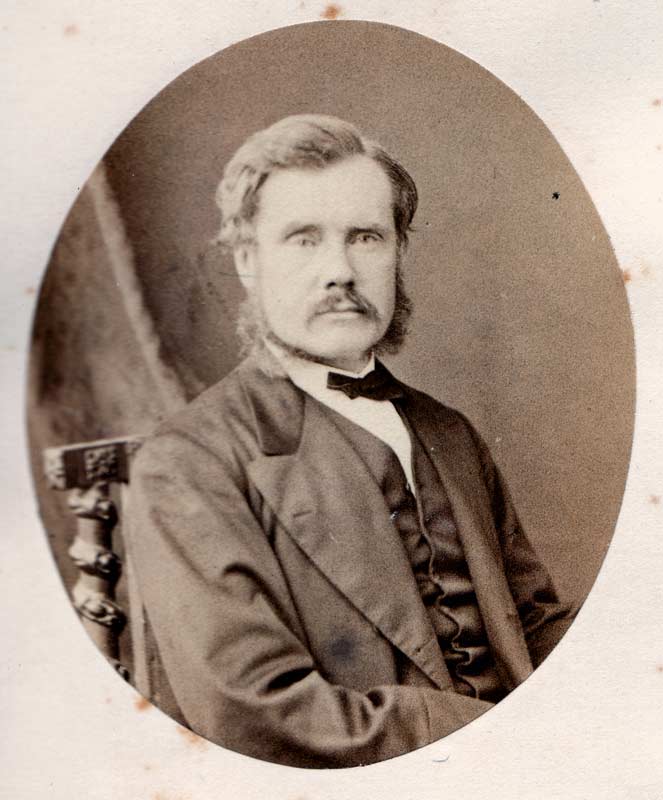
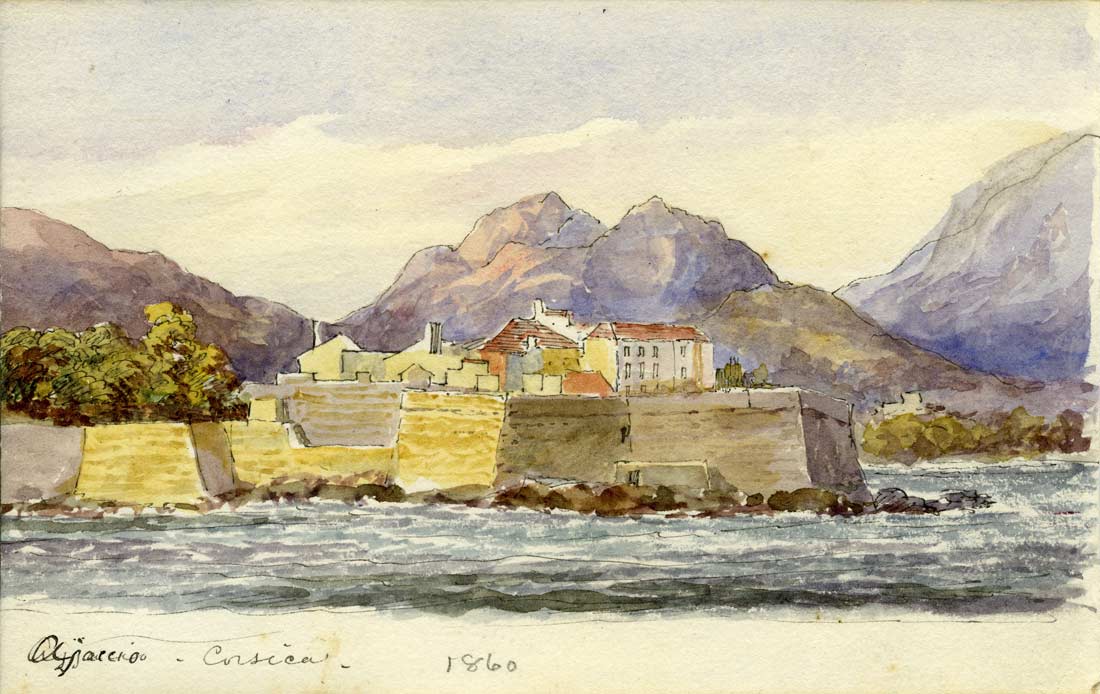
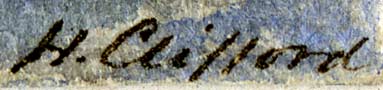
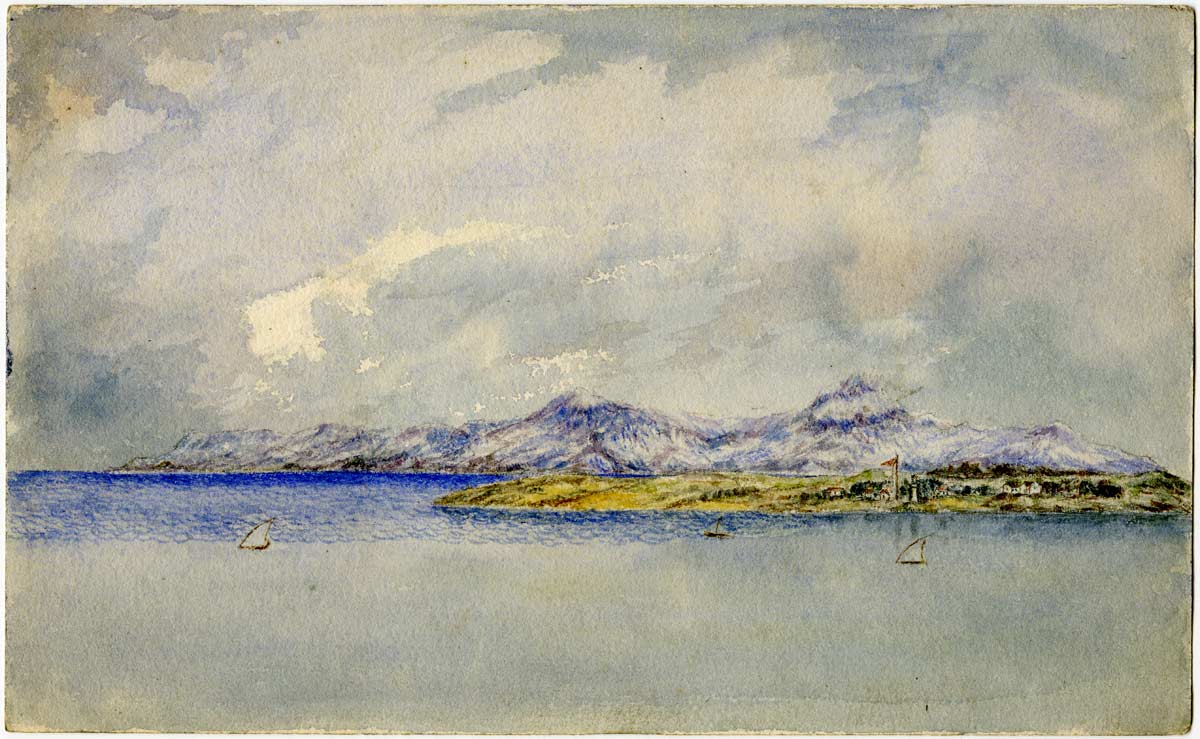
Henry Clifford (1821-1905) was a mechanical engineer, the cousin of Sir Charles Bright’s wife; Bright was instrumental in laying the early Atlantic cables. Introduced to the cable business through his friendship with Bright, Clifford served as an engineer on all the Atlantic cable expeditions from 1857 to 1866. He designed the paying-out machinery which was successfully used on Great Eastern in 1865 and 1866, and worked at Greenwich for the Telegraph Construction and Maintenance Company (Telcon) as its chief engineer until his retirement in 1894. While not engaged in engineering duties, Clifford took the opportunity to draw and paint scenes of cableships and surrounding scenery, beginning in 1857 with views of the Agamemnon. The first of this group of four 19th century watercolours of the Mediterranean is titled in pencil on the mount “Marabut”, and is signed in ink “H. Clifford”. A pencil note on the mount reads: “Marabut, 4 P.M. Sep 21 1861.” Marabut is on the Mediterranean coast in the Straits of Gibraltar, and according to the 1898 biography of Sir Charles Bright (Vol. II, p.3), in the latter part of 1861 Clifford represented Glass Elliot & Co for the laying of the Malta-Alexandria cable. A letter in the Times from its Malta correspondent, datelined Valetta, September 17th, reported that CS Rangoon, with Clifford, Canning, and De Sauty on board, had commenced laying the section of the cable from Alexandria to Bengazi on 15 September, the rest of the cable from Bengazi to the Gulf of Syrtis to be laid by CS Malacca, completing the project. Marabut lies west of the route of this cable, so it is a reasonable assumption that Clifford painted the watercolour while on board Rangoon at the conclusion of the expedition. Mediterranean Cables In June 1861 Clifford was engineer on the Malta and Alexandria cable expedition, again assisting Samuel Canning, and sailed on the Malacca. Wildman Whitehouse was also on this expedition. On this voyage the Malta-Tripoli section was laid, and Henry arrived at Malta on 6 June. From there he went to Toulon to lay the Corsican cable, where he painted this watercolour:
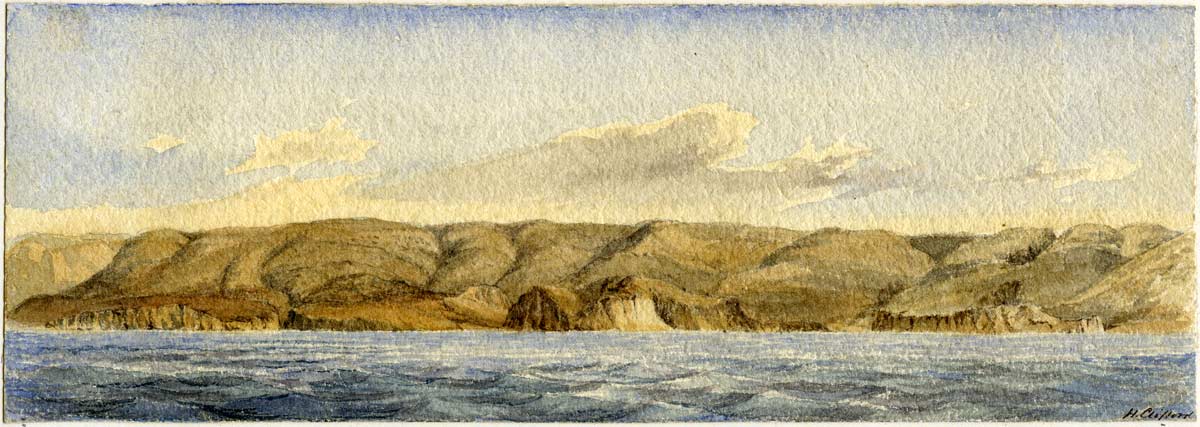
Later that year, in September 1861, Clifford continued the cable from Alexandria to Benghazi [(Bright 1898 p64]. For more information see this page. While on this expedition he painted two watercolours of Libyan coastal scenery between Ras al Milhr and Benghazi. Both were made on 21 September 1861, one at 3pm “139.1 Nauts from Ras al Milhr”, and one at 4pm “145 Nauts”, according to the pencil captions on the back of each painting.
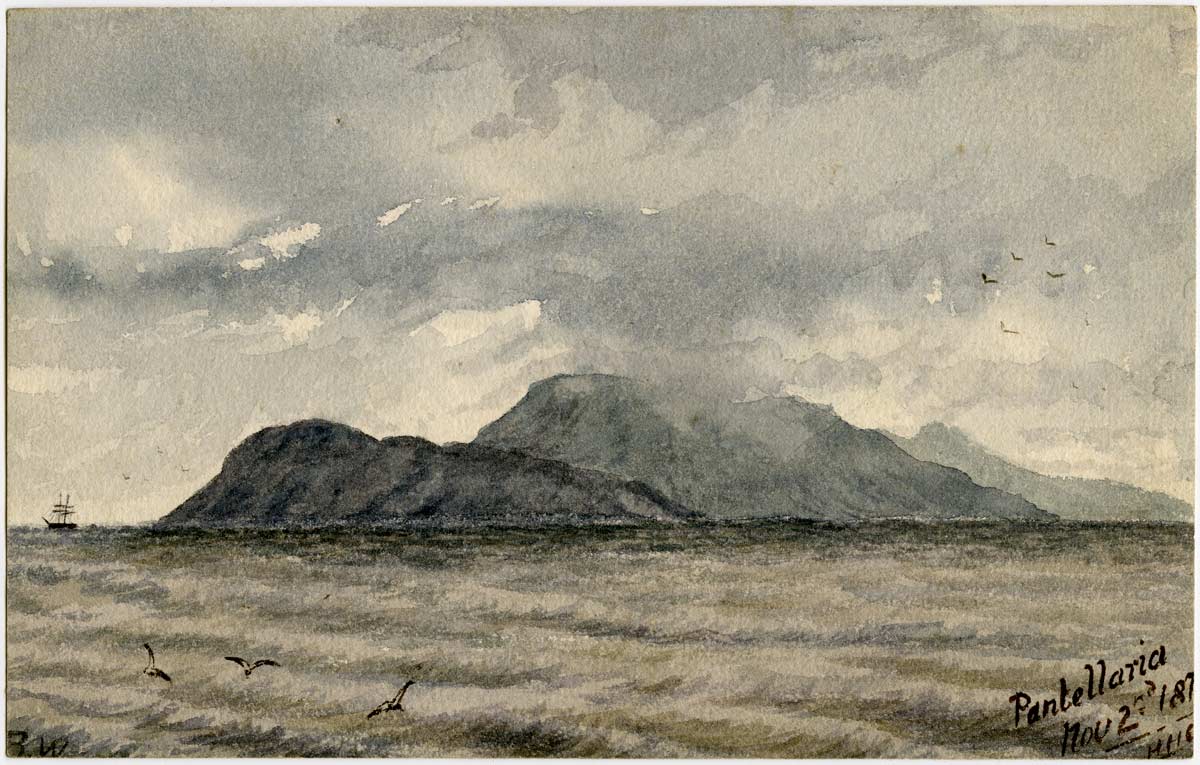
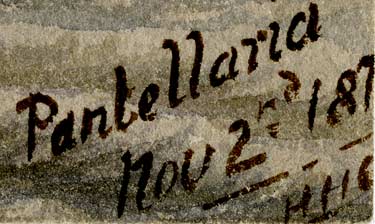
Following the line of the cable from Ras al Milhr (near present-day Bardiya) for 139.1 nautical miles (~258 kilometers) gives a location for the paintings somewhere near Derna, on the Libyan coast. About the same distance again would have brought the expedition to Benghazi. The Rangoon arrived at Benghazi on 23 September 1861, two days after the date of the watercolours, and from there returned to England. The Malacca completed the final section, from Tripoli to Benghazi, between 26 and 28 September, and communication between Malta and Alexandria was then established. On the back of the mount for the Marabut watercolour is a photograph of the landing of the shore end of the 1871 Port Darwin (Australia) to Java cable. As with the Malta-Alexandria cable, this cable was laid by Telcon (the successors to Glass, Elliot & Co.), but it’s not known if Henry Clifford sailed on this expedition. The next watercolour is dated Nov 2nd 187?, and is of the island of Pantellaria (modern Pantelleria), an Italian possession located in the Strait of Sicily between Sicily and Tunisia. The partial signature on this watercolour (initials H.H., last name beginning with C, G, O or Q) leads to a cable connection for this and the following watercolour of the Pharos at Alexandria, both of which were almost certainly painted on the 1870 Malta-Alexandria cable expedition.
Chief engineer for this voyage was Sir Samuel Canning, and his staff included Harold Hawksworth Gibson, the grandson of Henry Clifford's 1840s foundry business partner. Gibson started working for Clifford at Telcon in 1870 and sailed on two Mediterranean expeditions that year [Hull Gibson-Clifford archive]. The second of these was the Malta-Alexandria cable, laid by Telcon for the Anglo-Mediterranean Telegraph Company using CS Chiltern and CS Belgian, and handed over to the company on 22 November 1870 [date from The Manual of Submarine Telegraph Companies]. Gibson's notebook log of the "Anglo Mediterranean Duplicate Cable, Commencing Friday October 7th 1870" [NMM Henry Clifford Papers] has the following entry:
The correspondence of the dates and names makes it a reasonable assumption that the watercolour date is Nov 2nd 1870, and the signature H.H. Gibson. The two-masted ship shown at the tip of the island in the watercolour may be the Kangaroo.
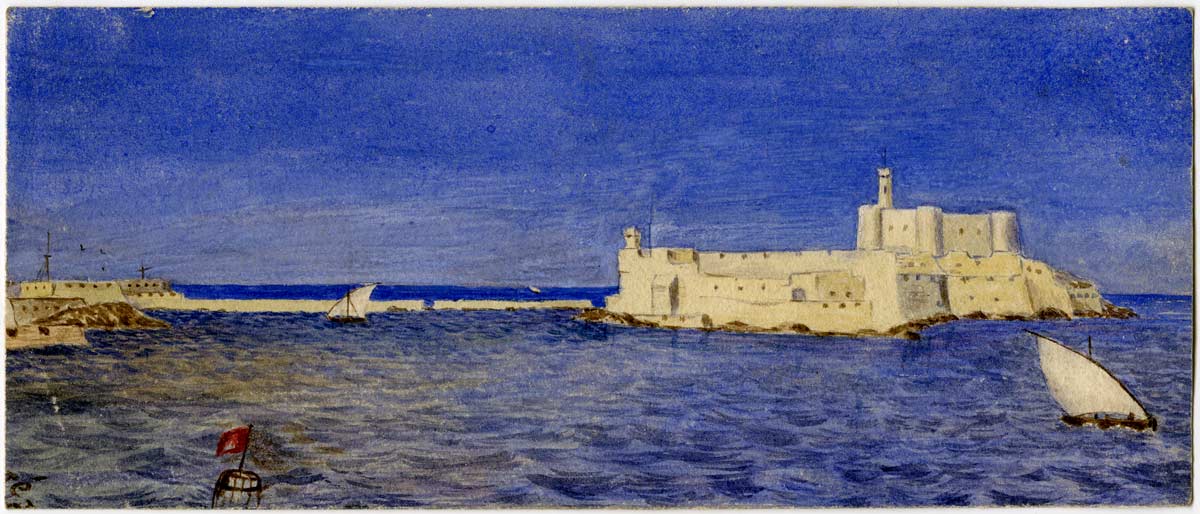
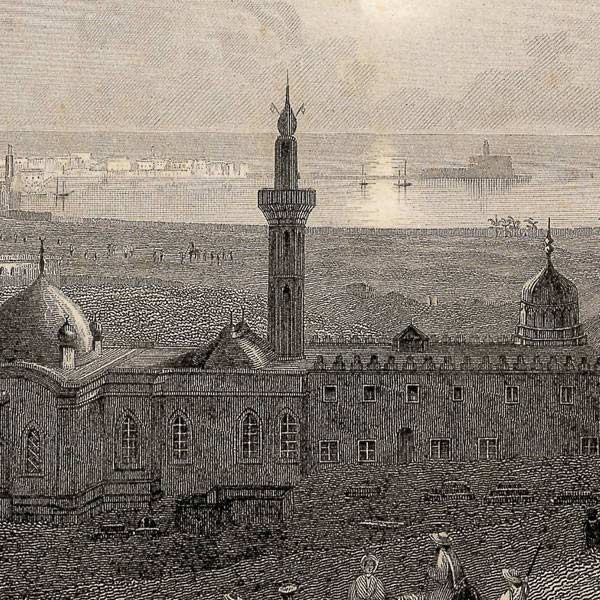
The next watercolour is of the Pharos at Alexandria, Egypt. It is titled in pencil on the reverse: “The Pharé, Alexandria”, and has a partial caption (“...ré”) which appears to be in the same hand as the Pantellaria painting. Gibson's log of the cable expedition records:
This c.1800 illustration of Alexandria shows the Pharos in the distance; the scene had hardly changed by the time of the watercolour, about 1870.
|
||||||||||||||||
|
Alexandria Harbour The location of the subject of the fourth watercolour is at present unknown, but the style of the sails on the small boats is similar to that in the watercolour The Pharé above. This piece was perhaps unfinished, as the foreground has little or no detail.
Harold Gibson also laid cables for Telcon at Singapore in 1871; Malta and Tripoli in 1872; and from Ireland to Newfoundland in 1873 At the other end of Gibson's notebook is an essay titled: Something about Telegraph Cables. A paper read before the “Hornsea Mutual Improvement Society” by HH Gibson, V. President. A revised copy of this paper is currently (November 2008) offered for sale by Jeremy Norman. This gives details of the 1873 Great Eastern expedition, which laid a cable from Ireland to Newfoundland for the Anglo American Telegraph Co., the cable having been manufactured by Telcon. Harold Gibson left the cable service in 1874 on the death of his father and returned to Hull to take over the family business. |
||||||||||||||||
Map showing Gibraltar, Pantelleria, Malta, Alexandria | ||||||||||||||||
|
Last revised: 8 December, 2019 |
|