History of the Atlantic Cable & Undersea Communications
from the first submarine cable of 1850 to the worldwide fiber optic network
With A Cable Expedition (1883)
|
History of the Atlantic Cable & Undersea Communications |
|
With A Cable Expedition (1883) |
|
|
Introduction: This article, published in Scribner's Magazine, October 1890, describes the 1883 cable laying expedition from Cadiz, Spain, to Teneriffe in the Canary Islands. For reasons known only to the author, he has disguised the name of the cable company and the cableships. The cable was manufactured by the India Rubber Gutta Percha & Telegraph Company, whose tradename was "Silvertown"; the author renders this as "The Argentville Company". Cableships Dacia and International, which laid the 1883 cable, are here called Dalmatia and Cosmopolitan. This background information on H.L. Webb appeared in Science, September 19, 1890:
|
|
With A Cable Expedition In these days of rapid development in new fields of electrical science and their commercial application, it is easy to overlook the magnitude of the work accomplished in the laying of deep-sea cables. According to the latest report of the International Bureau of Telegraph Administrations, the submarine telegraph system of the world consists of 120,070 nautical miles of cable. Government administrations own 12,524 miles, while 107,546 are the property of private companies. The total cost of these cables is in the neighborhood of two hundred million dollars. The largest owner of submarine cables is the Eastern Telegraph Company, whose system covers the ground from England to India, and comprises 21,860 miles of cable. The Eastern Extension, which exploits the far East, has 12,958 miles more. Early in last year the system of West African cables, which started from Cadiz only six years ago, was completed to Cape Town, so that the dark continent is now completely encircled by submarine telegraph, touching at numerous points along the coast. More than 17,000 miles of cable have been required to do this, and several companies, with more or less aid from the British, French, Spanish, and Portuguese governments, have participated in carrying out the work. The North Atlantic is spanned by no less than eleven cables, all laid since 1870, though I think not all are working at the present time; five companies are engaged in forwarding telegrams between North America and Europe, and the total length of the cables owned by them, including coast connections, is over 30,000 nautical miles. The cable fleet of the world numbers thirty-seven vessels, of an aggregate gross tonnage of about 54,600 tons. Ten ships belong to the construction companies, their aggregate gross tonnage being about half that of the entire fleet; the other twenty-seven are repairing steamers belonging to the different government and telegraph companies; they are stationed in ports all over the world, keeping a watchful eye on the condition of its submarine nerves, and doctoring them up whenever they need attention. The Silvertown and the Faraday head the list of cable ships in point of size, the former being 4,935 tons, and the latter 4,916 tons; while the Scotia (an old Cunarder) is a close third with 4,667. The Faraday has laid several of the Atlantic cables, and the Silvertown has done a great deal of work on both coasts of South America and on west coast of Africa. This ship has exceptional capacity for carrying cable, her main tank being fifty-three in diameter and thirty feet deep, large enough to stow a good-sized house in. On one expedition she carried 2,370 knots of cable, weighing 4,881 tons, the whole length being coiled on board in 22 days, or at the rate of over 100 knots a day. Better still, she laid the whole length without a single hitch, much of it being paid out at the high speed of nine knots an hour. Among the repairing ships the best known is the Minia, the Anglo-American Telegraph Company's steamer, which patrols the North Atlantic, keeping the many ramifications of submarine cables which radiate from the Newfoundland and Canadian coasts in working order. The life on one of these cable-vessels is unique and most interesting, combining the adventures of voyaging with operations demanding the highest scientific skill and knowledge, and with the the most ingenious mechanical work. The men brought together are, of course, of widely varied experience and accomplishments, each in his way an expert some branch of electrical or mechanical engineering. It was the writer's good fortune, in 1883, to be connected with the technical staff of such a vessel - the cable-ship Dalmatia - and he hopes that this narrative of his experiences will give a pleasant insight into the work of constructing the costliest and most wonderful half of Puck's girdle round the world. In the summer of that year the Spanish Government decided to establish telegraphic communication between the group of Atlantic islands known as the Canary Islands, and the Spanish Peninsula, by means of a submarine cable, and also to connect various of the principal islands of the group with each other by the same method. This important work was intrusted to a leading English cable manufacturing company with a very long name, commonly called for short, "The Argentville Company," from the name of the place where the company's works are situated. It was for the purpose of laying these cables that the Dalmatia and Cosmopolitan made the voyage which I shall describe. Let us first see what a submarine cable is, and how it is made. To do this a visit must be made to the enormous factory on the banks of the Thames, a few miles below London. Here the birth of the cable may be traced through shop after shop, machine after machine. The foundation of all is the conductor, a strand of seven fine copper wires. This slender copper cord is first hauled through a mass of sticky, black compound, which causes the thin coating of gutta-percha applied by the next machine to adhere to it perfectly, and prevents the retention of any bubbles of air in the interstices between the strands, or between the conductor and the gutta-percha envelope. One envelope is not sufficient, however, but the full thickness of insulating material has to be attained by four more alternate coatings of sticky compound and plastic gutta-percha. The conductor is now insulated, and has developed into "core." Before going any further the core is coiled into the river, taking in her priceless cargo and it is safe to say that the loading of no other ship presents such a curious and interesting scene. The cable is undulating in the air like an enormous eel as it emerges from the factory on the river-bank and travels over guides mounted on tall floating frames until it reaches the ship's side, over which it glides and immediately dives down into the dark recesses of the hold, where a gang of men are busy coiling it away at the rate of four or five miles an hour, into one of the four iron tanks with which the ship is provided. On board the ship there is a scene of confusion. The deck is strewn with packing-cases galore; stores of every description, some for use on board, others comprising complete equipments - from heavy furniture down to buckets and brooms - for the telegraph stations which the cable is presently to call into existence, coils of wire, huge spools or drums of underground cable (similar to those which have lately become familiar objects on the street to every New-Yorker), to connect the landing-places of the submarine line with the town offices, galvanized iron cable-huts to be erected for the reception of shore-ends and instruments at these landing-places, tools of every description, huge iron buoys, coils of rope and heavy chain, grappling-irons and mushroom-anchors, cases of instruments, and formidable looking trays of electric batteries; all these myriad objects - many of them labelled with queer-sounding Spanish names indicating their ultimate destination - surround one on all sides, as the work goes on of taking them on board and stowing them away in their proper places; there to remain until the hour arrives when they shall be called into action or unloaded in distant ports, to undergo stern and critical examination at the hands of grave and dignified, or perhaps fussy and exacting, Iberian custom-house officials. The cable, which, after all, is the principal character in this varied scene, is being dragged on board by steam machinery in a sluggish, hesitating sort of manner. Perhaps it is being coiled away into one of the tanks somewhat distant from the engine which is hauling it on board; in which case it is guided to the hatchway above the tank by means of grooved pulleys and long wooden troughs provided with little iron rollers, over which it rattles and whirrs merrily. In order to see the most important passenger that the ship is to carry installed in the depths of the dark, capacious state-room provided for its accommodation, it is necessary to take a peep between decks, and find one's way to "tank square," as the square opening on the main deck above the tank is called. Arrived at the tank in action, and standing at its edge, one can peer down into the gloomy depths; overhead a large grooved wheel, fixed above the centre of the tank, guides the cable so that it hangs clear and in a position to be easily manipulated by the gang of men, who gradually appear visible below as one becomes accustomed to the dim light shed by a few ship's lanterns hung around the sides of the tank. In the centre of the tank is a large iron truncated cone, which forms the eye of the coil of cable, and which, being hollow, also serves as a receptacle for perishable stores or fresh water for the consumption of the ship's company. The cable is arranged in flat coils occupying the whole space between the cone and the side of the tank; each coil is technically known as a "flake." In order to prevent one turn of the cable adhering to either of its neighbors, and thus producing a "foul," one skein of several turns of cable coming up together when paying out, the cable is freely treated with whitewash to counteract the natural stickiness of the pitch-like exterior compound; as an additional precaution, boards are placed at intervals over each completed flake, thus obviating the risk of a "foul flake." The whole scene, to an unaccustomed observer, possesses a weird, uncanny air; the gloomy cavernous tank, the lithe black cable, writhing and swishing around with a ceaseless serpentine motion, the ghostly figures of the men, who, viewed by the dim and fitful yellow light below, seem like creatures of another world; and to heighten the unearthly effect, a sort of gruff incantation, echoing and reverberating as it ascends from the gigantic caldron, assails the ear and accentuates the general resemblance to some seance of the black arts on a large scale; until, by listening intently, the mysterious notes are found to resolve themselves into a chorus in vogue with sailors all the world over, but peculiarly appropriate among such surroundings. "Heigho! Roll
the man down!" The ships were loaded, the cable was all coiled snugly down in the tanks, batteries, instruments, and stores were all stowed away, and on the date appointed for sailing, which turned out to be a glorious September day, we sped through the green fields of "the garden of England," down to Greenhithe, where the two ships composing the expedition were lying at anchor, only awaiting the final operation of "swinging ship," and the arrival of the numerous staff of engineers and electricians, who generally join the ships at the last moment. Our train discharged quite a number of fellow-voyagers, some of them accompanied by their friends. A turn of the road brought the river in view, and right before us were the two good ships in which our principal interests were to centre for the next few weeks. They were looking their very best; yards squared, rigging taut and trim, bunting flying gayly in the autumn breeze; the blue peter at the fore, a few whiffs of steam escaping from the waste-pipe, and a thin haze of smoke ascending from the smoke-stacks, indicated that all was in readiness for departure. At the landing-stage we found the ship's gig awaiting us and in a few moments we were standing on the deck of the Dalmatia, the flag-ship of the expedition, as indicated by the swallowtailed house-flag flying at the main, which signified that we carried the commodore of the squadron, in the person of the engineer-in-chief of the expedition. The ship was in spick and span order, the deck clean and white, brass-work shining like gold, ropes coiled neatly away, wood and iron redolent of fresh paint and varnish; and, were it not for the absence of guns and the very evident presence of the cable machinery which on all sides arrests the attention, we might have fancied ourselves on board some man-of-war commanded by a strict martinet.
The life on board a cable-ship is, as I have said, a thing of itself, differing widely from that of any other of the floating homes which at all moments are ploughing the seas. This we soon found out as we commenced to settle down and become familiar with our surroundings. We were not on board a passenger steamer, because there were no passengers of either sex; neither were we on a man-of-war - we had no big guns and no stern discipline. This latter element, however, was not entirely absent on the Dalmatia; every man on board had a certain position and certain work to do, and all the members of the staff wore uniforms similar to those of the ship's officers, the rank of each one being denoted by the number of stripes on his sleeve. The engineer-in-chief was the head of the whole expedition, and had entire charge of all the operations, and the ships were navigated according to his instructions. Immediately after him ranked the captain of the ship, and the engineers and electricians of the cable staff, and the ship's officers and engineers followed in due order, according to their functions and standing in the company's service. Our party in the saloon also comprised two Spanish officials, who represented their government at all the operations of the expedition. Cable engineers are naturally great travellers, and among our party of some twenty odd, a large proportion had visited almost every part of the world, and could relate many a good story of their varied experiences and give us much interesting information about foreign lands. Conversation in the saloon was carried on in at least three languages - English, French, and Spanish. As our voyage was to be a very short one before we reached the port where we were to commence operations, little time was devoted to the amusements which while away the long hours on an extended trip. Everybody on board was busy preparing for the work in perspective. Here was a group of engineers conning over charts, studying the proposed track for the cable, and discussing the knotty point of selecting a suitable spot for landing the shore-end. A little further on, the paymaster, surrounded by papers, writing up his "log," and near by the hydrographer, preparing a large chart which takes in all the ground to be covered by the entire system of cables. In the testing-room, the electrician would explain the functions of the glittering instruments of ebonite and brass with which he was making a test on the cable in the tanks below. The only visible demonstration of what was being done was to be found in the movements of a little spot of light, which would be deflected from zero on a horizontal scale, and finally come to rest several hundred degrees to one side, as the assistant allowed the electric current to pass through the reflecting galvanometer. If the spot of light were to make sudden kicks or fly off the scale, the existence of something wrong would be revealed, perhaps a fault in the cable. But faults rarely develop on board ship, because the cable is perfect when it leaves the factory. In the ship's tanks it is kept cool by being always submerged in water, and as yet it has been subjected to no severe strain. When the time comes for paying-out, and the cable is straightened and has to bear a strain of several tons as it leaves the ship's stern, then any slight imperfection will be revealed; and although it may consist merely of a minute bubble of air which has burst and made a puncture in the gutta-percha into which you could not introduce a fine hair; although it may be only a crack so imperceptible that it would not admit of the insertion of the corner of a cigarette-paper, yet the current would escape, and, like the insignificant stream which trickles over a dam, would gradually widen the breach until the cable was electrically "broken down," and entirely useless for communication. Pondering over the watchful skill which manufactures hundreds, and even thousands, of miles of this slender cord with such widely different materials as iron, steel, hemp, gutta-percha, and copper, and triumphantly attains a degree of perfection which necessitates the exclusion of even such minute flaws and imperfections as would pass unnoticed in almost any other branch of industry, we dived down below to the main deck and spent an instructive half-hour inspecting the huge iron buoys, grappling-ropes and irons, mooring-chains and anchors, and other paraphernalia which the cable hands were busily painting, splicing, and overhauling generally in order to prepare them for use. On deck the same activity was to be seen; the heavy cable machinery was being examined and tried, to insure all being fit for action, and at the stern a small machine was being fitted up and got into place; this was the sounding machine, with which we shall shortly become more intimately acquainted. The dreaded Bay of Biscay was crossed without undue pitching and tossing; for once its troublous waters were comparatively calm. In due course, one fine September morning, we steamed into Cadiz Bay. The scene is a beautiful one. On one side the bright, clean-looking little town almost entirely surrounded by the sea; on the other, some eight miles across the bay, the old town of Puerto Santa Maria. We were delayed a few days while the necessary formalities as to landing instruments and stores, and other kindred questions, were gone through. Some difficulty was also found in selecting a suitable landing-place for the cable. Cadiz is surrounded by rocks, and also by currents. Rocks are undesirable in the vicinity of a cable under any circumstances, but rocks and currents combined arouse a feeling of unconquerable horror and aversion in the mind of an experienced cable engineer. Finally, one afternoon, when we had been at anchor in Cadiz Bay some three or four days, orders were given for both ships to weigh anchor, and we found that it had been decided to land the shore-end on a sandy beach at the far side of the bay, near Puerto Santa Maria; the connection with Cadiz town to be afterward made by means of a short cable skirting the anchorage in the bay. Thus the main cable would be safe from damage by rocks and currents, or by ships' anchors, and if the bay cable should be broken at any time by either of these causes, communication could always be maintained from the landing-place of the main line.
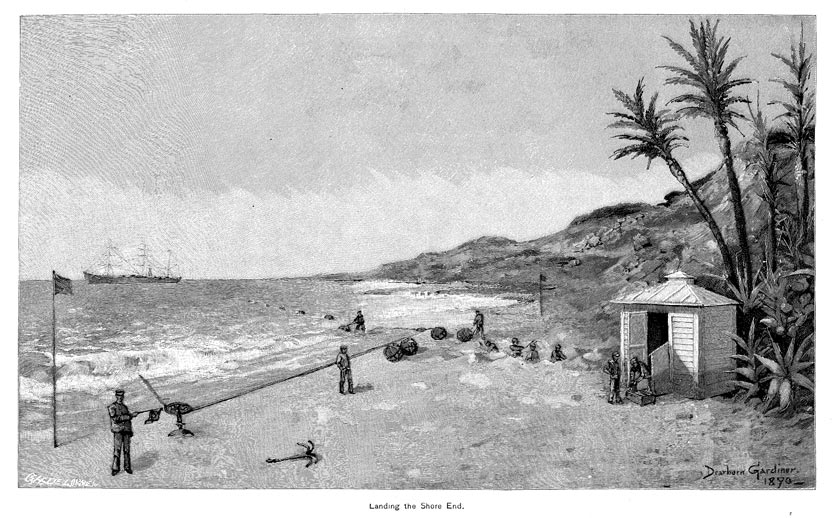
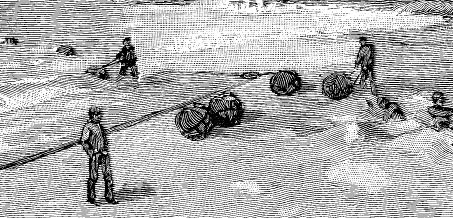
On board, both picking-up and paying-out gear were being made ready for action, as they both played their part in landing the shore-end; huge coils of rope and a number of collapsed air-balloons made their appearance from below. These balloons were inflated with air to their full diameter of some three or four feet, and the quarter-deck of the Dalmatia began to assume the appearance of a giant's toy-shop. Meanwhile the shore party had firmly anchored to the beach two large "spider-sheaves," or skeleton iron pulleys.
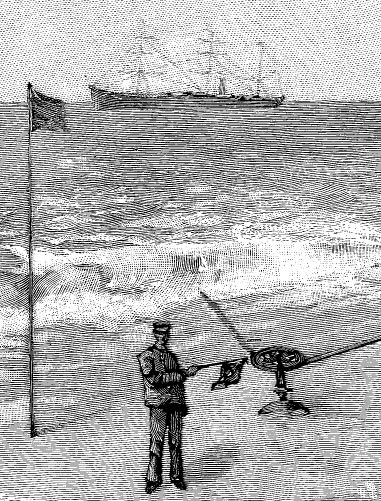
So far all had gone swimmingly, and our first bit of cable was over the stern and fairly in the water, and we felt that the work of the expedition was begun in earnest. However, interruption came from an unexpected quarter. The Spanish littoral is dotted around with coast-guard stations, the special mission of whose occupants (who are called carabineros) is the prevention of smuggling. We had no permission to land tools of any sort, much less a cable, and as we happened to pitch upon a spot close to a coastguard station, the carabineros, alarmed at the sight of so many strange implements, came off in hot haste to order us to put a stop to our unlawful proceedings. It was explained to them that the cable was for the Spanish Government, and that everything had been arranged with the authorities in Cadiz; but they were obdurate, and, having received no instructions, were bent upon vindicating their authority. Your true Spanish official is nothing if he is not dictatorial, and the lower his rank the more authoritative he becomes. Diplomacy was then resorted to, and proved successful. The carabineros were assured that their demands should be complied with, and one of our best Spanish scholars was deputed to show them over the ship, down below. While they were being thus entertained (the contents of the chief-steward's bar formed no unattractive feature of the entertainment, and served to prolong it considerably), operations were continued, and by the time the carabineros came on deck again, a long line of balloons could be seen bobbing gayly on the water, all the way from the ship to the shore, and the end of the cable was safely on the beach. During the operation of landing the shore-end, communication was maintained between the party on shore and those on board by means of flag-signalling, a small hand-flag being employed to send messages in the Morse code.
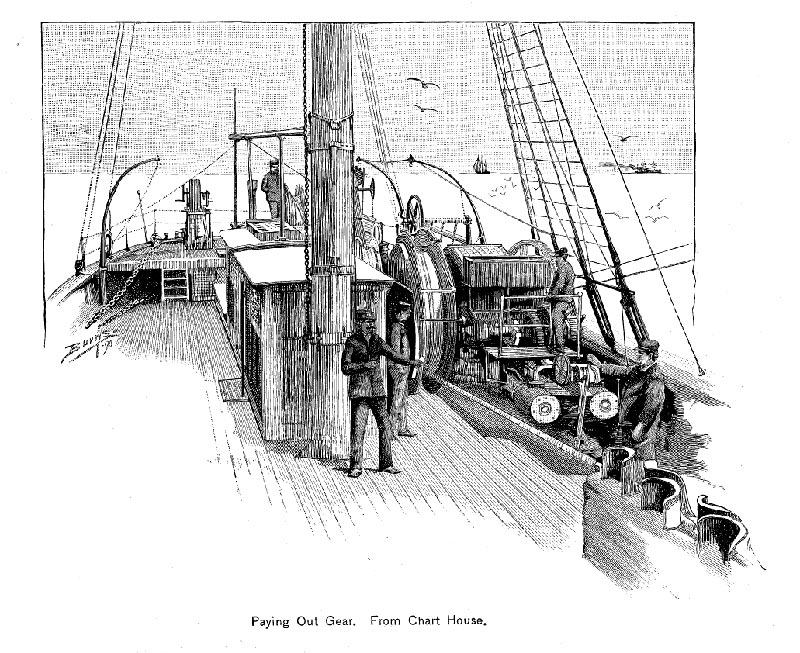
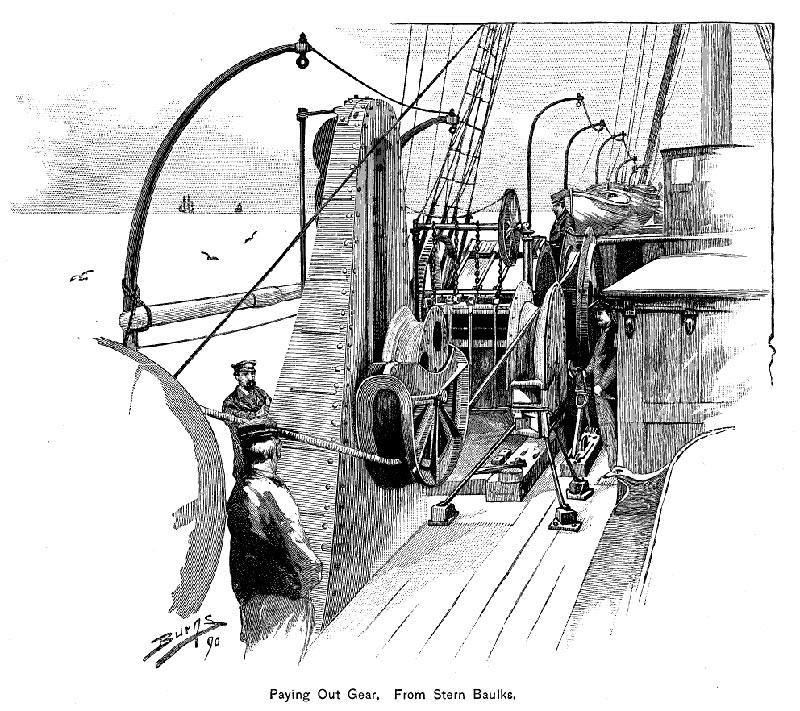
By this time it was nearly dark and flag signalling had to be exchanged for flash-lamps, by which the Dalmatia signalled to the shore party to take all gear to the Cosmopolitan, as she was about to start paying-out seaward. All being made fast on shore and the last balloon buoy having been removed, we weighed anchor and moved on slowly toward the open sea. The cable now needed no steam power to help it out of the ship; on the contrary, it ran out freely of its own accord, and it was necessary to apply the brakes to the paying-out drum to prevent the cable running out too fast. It was astonishing to see the great heavy ironbound cable, a single yard of which would weigh over ten pounds, come swishing round the tank, up on deck and over pulleys and guides, take four or five turns round a drum six feet in diameter, bob under the dynamometer, and up over the stern-sheave, and finally dive into the water with all the ease, grace, and pliability with which a silken cord might go through the same performance. One striking thing in cable operations is the hearty will with which everyone works, and the extreme anxiety evidenced on all sides for the welfare and safety of the cable. I have seen the engineer-in-chief, during the landing of a shore-end, up to his waist in the surf, cutting the lashings which secure the balloon-buoys to the cable; and on another occasion, when, the ship being hove-to, the cable had got foul of the propeller, the chief of the expedition, after passing word to the ship's engineers not to move the engines, took a header into the water, and, holding on to a blade of the propeller, succeeded in freeing the cable, to the great relief of everybody on board, as all efforts from above had failed to dislodge it and a rupture seemed unavoidable. During paying-out a test is always kept on the cable from the electricians' headquarters, the testing-room. Before the cable left the ship the end was carefully sealed by softening the gutta-percha and drawing it over the copper conductor; the cable was then charged with an electric current through the end on board, the current also passing through the galvanometer, We paid a visit to the testing-room and found by the steady deflection of the spot of light on the scale that the cable was sound and perfect.
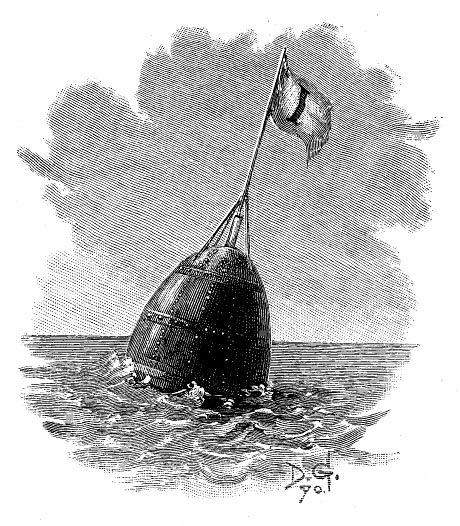
A huge red iron buoy is in readiness, lashed to the mizzen rigging; paying-out is stopped and the cable made fast close to the stern sheave, the turns are taken off the drum, the cable is cut, and the extremity of the core sealed; the cable end is then secured to the moorings of the buoy, which consist of two heavy mushroom-anchors attached to the buoy by a length of stout iron chain. The lashings which hold the cable at the stern sheave are then removed, and the cable end is dropped overboard with the buoy-moorings; the chain rattles out with an appalling noise, above which a stentorian "Let go" is heard, whereupon the buoy is released, and, dropping with a splash into the water, floats gayly off, dancing in the rays of the electric light. There the buoy will remain securely anchored by its moorings, until the Dalmatia returns from the Canaries paying-out the main cable; the end of the piece we have just buoyed will then be brought on board and spliced on to the main cable, thus making it complete. As we set on full speed for our anchorage, everyone on board felt that the work of the expedition had been successfully begun. An air of contentment prevailed on all sides; at dinner the health of the cable was drunk with due solemnity, and afterward an impromptu smoking-concert was held on deck. On the following day, our business at Cadiz having been completed for the present, the expedition put to sea en route for the Canaries. The Cosmopolitan steamed out first, saluting the Dalmatia as she passed by dipping her ensign, to which we responded with three cheers, and a few hours later we followed suit. The programme to be carried out by the two vessels was as follows: The Cosmopolitan was to make a zigzag course to the Canaries, taking short slants east and west of the proposed route of the cable, and sounding at intervals; the Dalmatia was to proceed in the same manner, except that her zigzags were to be longer and at a different angle to those of the Cosmopolitan. In this way it was hoped that a thorough survey would be made of the ocean depths between Cadiz and the Canaries, and a safe route selected for the cable. At Cadiz our scientific staff had been augmented by the arrival on board of a distinguished chemist and naturalist, who accompanied the famous Challenger expedition, and who, therefore, was an authority on the subject of ocean surveys, and took a vast interest in all such matters. This gentleman was prepared to analyze and tell us all about the constitution and properties of as many samples of "bottom" as we could obtain for him, and he has since produced some remarkably interesting papers of high scientific value, embodying the results of the immense amount of work performed by the expedition. By the time we got clear of Cadiz harbor the Cosmopolitan was "hull down," and we saw no more of her till we met in Grand Canary. The course of the Dalmatia was shaped for the Straits of Gibraltar, and soon after leaving Cadiz we took our first sounding. The little machine which then came into action, and played a prominent part in the work of the next few weeks, is worthy of a little attention, both on account of its simplicity and because of the amount of good work that it performs in a rapid and trustworthy manner. The sounding machine consists mainly of a light iron drum or spool, upon which are wound several thousand fathoms of steel pianoforte wire; to the wire is attached a sinker which is provided with a receptacle at the lower extremity for securing a specimen of the bottom. When the wire is being paid out the drum projects over the ship's stern, and for hauling-in it is run in-board a few feet and connected to a small steam engine, which makes short work of winding up the wire and bringing the sinker to the surface. Besides the ordinary sinker there is a whole battery of other apparatus, such as sinkers with weights which are detached automatically on reaching the bottom, leaving only the tube to be brought up; thermometers which register the temperature of the water at different depths; tubes constructed to obtain samples of water from the bottom, and so on ad infinitum. Our first piece of scientific work was a survey of the "Gut," as the entrance to the Straits of Gibraltar is commonly called by mariners. This was slightly out of our strict programme, but served to get our hands in for more important operations to follow. Having spent nearly three days in this interesting work, during which time we obtained a quantity of new and valuable information as to the formation of the bank at the entrance to the Mediterranean, we started out seaward, and rapidly got into deep water. Here the sounding machine showed to great advantage. In olden times, when hemp lines were used for sounding, it was necessary to employ a weight of about four hundred and fifty pounds to keep the line vertical, and about three hours were occupied in taking a sounding in a depth of two thousand fathoms. With steel wire we used a sinker of only fifty pounds, which in twenty-two minutes reached bottom at a depth of a little over two thousand fathoms; there was a delay of a few minutes in detaching the weight and in connecting the drum to the engine to wind-in. The weight was detached automatically, the wire by which it was suspended to the tube being cut through by a hinged knife on the head of the tube at the moment when strain was applied to wind-in; the weight was thus left on the bottom and the tube alone brought to the surface. In this way there is very little strain on the wire, and consequently but slight risk of breakage. The little engine commenced to buzz away, and in forty-eight minutes from the time of letting go the tube was on board again, and the ship proceeded on her course. We all crowded round to examine the little instrument which had made its venturesome descent through some two and a half miles of blue water. General satisfaction was caused by the fact that the specimen obtained was one of globigerina ooze, which consists of myriads of tiny shells of carbonate of lime. The existence of this ooze denotes the entire absence of currents, and the ooze itself forms a soft, yielding bed into which the cable would sink luxuriously, and might rest undisturbed to the end of time. About every four hours we stopped to take a sounding, and the results were almost invariably satisfactory. Occasionally a sounding was spoiled by the wire kinking and breaking, the consequence being the loss of the tube and a certain amount of wire; but so carefully were the operations conducted that this was a very rare occurrence. Deep-sea sounding is very interesting work, but it is a trifle annoying sometimes to hear the engine-room gong sound, and have to leave a good hand at cards and rush up on deck, especially if the weather is rough, when the whole sounding party stands a chance of getting a good drenching from a "poop sea." One night we were astonished by the sinker stopping at about one thousand two hundred fathoms, when it ought to have gone nearly twice as deep. It was at once suspected that we were in the neighborhood of a bank. A sounding was taken three miles further on and showed deeper water, so we retraced our course eight miles; here we got only eight hundred fathoms. Expectancy then ran high, and it was fully justified when, two miles further back, the sinker stopped at four hundred and fourteen fathoms; but the crowning event occurred at the next dip, after another run of two miles. Here, to our surprise and delight, the sinker brought up at sixty-six fathoms! There was immense excitement on board, as it was obvious that we had pitched upon a bank, or rather a mountain, of startling proportions, perhaps the lost island of Atlantis itself. As this submarine mountain lay close to the proposed line of the cable, it was necessary to make a thorough survey, and two days were spent in doing this. A mark-buoy was put down to work by, and numerous soundings were taken in all directions so as to clearly define the limits of the bank. The shoalest water found was forty-nine fathoms, and half a mile distant two hundred and thirty fathoms were obtained, showing a steep slope. When the buoy, which was moored in one hundred and seventy-five fathoms, was taken up, the mooring rope was found to be nearly chafed through seventy-five fathoms from the bottom. This showed that the bank must rise almost precipitously, and that there exists a wall of about four hundred and fifty feet in height. A very curious effect observed was a long ripple on the calm sea, apparently caused by the ground-swell breaking on the edge of the bank. Nothing further of an exciting nature happened during the soundings, and after one more zigzag our course was shaped for Grand Canary, our rendezvous with the Cosmopolitan. The Cosmopolitan had made no such interesting discoveries as had fallen to our lot, and having been awaiting our arrival several days, those on board finally became alarmed at our delay and started out to look for the Dalmatia. We met the night before our ship was due to arrive at Canary, and rockets being fired, the two steamers recognized each other, and a conversation was kept up by means of the steam-whistles, the Morse code adapting itself as well to this method of signalling as to any of the many others in daily use. The following morning both ships were at anchor in the harbor of Las Palmas, the capital of Grand Canary. During the next week or two we visited the different islands, taking soundings between them and spending a few days at each port. Receptions were given on board to which the authorities and principal inhabitants were invited, and all the wonders of the ships were explained to them. Everywhere the greatest enthusiasm was displayed, as the natives looked upon the establishment of telegraphic communication as a great step in putting them in touch with the civilized world. Public rejoicings and fetes were the order of the day. At Las Palmas a ball was given to the officers and staff of the expedition, and (considering that we were in such an out-of-the-way place) we were fairly astonished at the scale of magnificence on which the entertainment was carried out, and at the dresses and jewels of the ladies, while not a few members of the staff were considerably smitten with the personal charms of their partners; but unfortunately, with but few exceptions, they could not exchange five words with them. At Teneriffe the chiefs of the expedition were escorted through the streets by a band of music and an immense crowd, and at La Palma, the western island of the group, the ships were serenaded, the town was en fete and decorated with triumphal arches, and another ball was given. Altogether, we were the heroes of the day throughout the Canaries. It was decided to lay the cable between Teneriffe and La Palma first, and the necessary soundings having been taken, both ships steamed round Teneriffe one fine November evening, and came to anchor off Garachico, a little village on the southwest coast of Teneriffe. Here it was proposed to land the cable, the connection between Garachico and Santa Cruz, the capital of Teneriffe, to be afterward made by a land-line across the island.
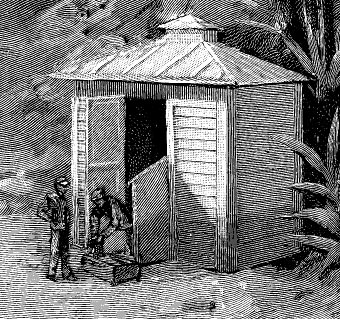
The next few days were occupied in erecting the cable-hut (a small structure of galvanized iron about twelve feet square), in fitting up the testing instruments in the hut, and in transferring a few miles of heavy cable from the Cosmopolitan to the Dalmatia. Finally all operations at Garachico were completed, and early one morning we started for the buoy and picked it up, and with it the end of the cable secured to the buoy moorings. The cable end was brought on board and spliced to the cable in the tank from which it was intended to pay-out. The splice is always an interesting operation to watch. First the jointer and his assistant go to work and nimbly and rapidly join and solder the ends of the copper conductor, and then cover it over with sticky black compound and gutta-percha sheet, producing a homogeneous joint but little larger than the machine-made core, and every bit as impervious to the action of the water. The joint is tested by the electricians to make sure that it is sound and perfect, and this being ascertained, the cable hands at once go to work on the splice; and it is surprising to observe how skilfully they manipulate the stiff iron wires, first carefully wrapping the core with its protective hemp covering, then laying on the armor wires and butting them together, and finally winding over the whole length of the splice a stout cord of spun yarn. The splice was finished and we started paying-out, slowly at first, but with gradually increasing speed, until deep water was reached and the light deep-sea cable went whizzing through the machinery at the rate of seven or eight knots an hour. Now we were at work in earnest. One of the engineering staff was in charge of the quarter-deck, keeping a watchful eye on the dynamometer and the indicator on the paying-out drum; by the former he knew the strain on the cable, and by the latter the amount of cable paid out; of these data an assistant was continually taking notes. In the testing-room we found that a careful watch was being kept on the electrical conditions of the cable. The sensitive spot of light was doing its duty both here and in the cable-hut, and the electricians on shore exchanged signals every few minutes with those on the ship. Thus both the mechanical and electrical behavior of the cable were continually under such scrupulous and accurate observation, that it was impossible for anything to go wrong without those in charge being at once aware of it. The ship steamed steadily ahead and everything worked as smoothly as clockwork; coil after coil of the cable unwound from the tank, glided over pulleys and through troughs, wound around the swiftly revolving paying-out drum, dived under the wheel of the dynamometer and over the stern sheave, and trailed away after the ship until, a good many yards astern, it silently dipped into the water to seek its final resting-place in the motionless depths. As darkness came on the arc-lamp was lighted, and with the aid of its brilliant rays work was done as easily as during the daytime. Toward midnight we approached La Palma, and the Cosmopolitan steamed ahead to show us a good position for buoying the end, which operation was necessary, as the La Palma shore-end had yet to be laid. Gradually our speed was slowed down; the electrician on duty in the testing-room informed those in the hut at Garachico that we were about to cut the cable and buoy the end, and immediately afterward, as the ship had come to a standstill, the cable was made fast, the turns were taken off the paying-out drum, the executioner advanced with his axe and severed the cable, the wounds to its centre-nerve were healed up by means of a spirit-lamp, it was fastened securely to the moorings of the buoy, and in a few minutes cable, moorings, and buoy were all overboard and we steamed off for port. The next day the Cosmopolitan took up the work and met with ill-luck, which proved to be only the commencement of a series of disasters. To begin with, while the cable-hut and tools were being landed, one of the boats was capsized by the surf, the contents scattered broadcast, and a man imprisoned under the overturned boat. This unfortunate was, however, quickly rescued by his companions and equally quickly resuscitated, being more frightened than hurt. The shore-end was successfully landed, and, as night was coming on, the Cosmopolitan started to pay out toward the buoy put down the previous night; the buoy was picked up and the mooring-rope taken to the picking-up drum, which at once commenced to heave-in; but after a few turns, a sudden diminution of the strain on the rope showed that it had parted, and the end of the cable was lost! There was nothing to be done but buoy the end of the short length just paid-out and return to port, as it was too late to attempt to grapple for the lost cable. For the next two or three days the weather was so bad that nothing could be done, but finally, when everybody's patience was thoroughly exhausted, wind and sea moderated sufficiently for us to set to work. A grapnel was lowered over the bows by means of a long rope, the end of which was taken under the dynamometer to the picking-up drum. The dynamometer serves in this case to show when the grappling-iron hooks the cable, as it at once indicates the increased strain on the rope. We steamed slowly back and forth across the course of the cable, and made four or five unsuccessful drags. Once we hooked the cable but only succeeded in bringing up a loose piece, as it parted further seaward. The scene on board now is very different to a few days back, when paying-out was going on so smoothly. All the machinery on the quarter-deck is motionless and deserted; in the testing-room the active little spot of light is extinguished and the place wears an untenanted air; interest is concentrated forward, where the engineers watch every rise and fall of the pointer on the dynamometer with acute anxiety. Electricians and others on board who find their occupation gone, hang about, listless and dejected, and a general air of discontent reigns. We are grappling in deep water, and, as is evident by the jerky action of the dynamometer, on rocky ground; but finally, after a long and weary day, a steady strain is observed, the picking-up drum is set to work, and after a vast amount of laborious puffing and rumbling, shortly before midnight the grapnel arrives at the bows with the cable securely suspended across two of its prongs! At once all is activity on board. The testing-room brightens up and the spot of light shines cheerfully once more. The cable is cut and handed over to the electricians to be tested. Very shortly the verdict is delivered to the effect that it is in perfect condition, and at once the operation of splicing it to a new length of cable in one of the tanks is commenced; this concluded, we start paying-out, and all goes well until we reach the buoy on the shore-end. Here a double disaster occurred; the experience of the Cosmopolitan was repeated, as the moorings broke shortly after we commenced heaving-in. It was then necessary to pick up a short length of the cable we had just laid, so as to cut and buoy further out. While this was going on we dropped into the testing-room to see that matters were all right there, and scarcely had we commenced to watch the spot of light, when it quivered, oscillated, and finally darted off the scale. Something was wrong, and we made for the deck, where our suspicions were confirmed; the cable bad broken, and a few minutes later we were all gazing mournfully at the jagged end - a mere bunch of tangled wires and hemp! Both ends were now lost, and there was nothing for it but to start grappling again. Drag after drag did we make with the same lack of success; occasionally the strain went up with a rush as the grapnel clutched a rock, only to decrease with equal suddenness as the rock gave way and the grapnel flew off. Our spirits rose and fell with the pointer of the dynamometer, and when it only indicated the normal strain of the rope and grappling-iron, we all sank, mentally speaking, far below zero. This sort of thing went on all day. At 12 P.M. the grapnel was at the bows but no cable, so work was suspended for the night and everyone turned in for a well-earned rest. The following day our luck changed. The cable was hooked at the first drag and brought safely on board; the tests showed that it was still perfect, and the splicing and paying-out were proceeded with in due course. Meanwhile the Cosmopolitan had grappled and rebuoyed the other lost end, so we had no more difficulties to encounter. While paying-out, the submarine crater over which we had evidently been working, and which had given us so much trouble, was carefully avoided by taking a circuitous route. The buoy was soon reached and the other end hauled on board. Both cables were carefully tested and pronounced to be perfect, the final splice was made, and with three hearty cheers the completed cable was lowered overboard. Finis coronat opus. Our first complete section was finished, and Teneriffe and La Palma were in telegraphic communication with each other. The rest of the work among the islands was carried out without a hitch of any sort, the long cable from Teneriffe to Cadiz being left to the last. This was of course a matter of several days, and may be taken as a good example of the routine on board when laying a long cable. Mile after mile of cable goes steadily out; the machinery whirrs and revolves as if it never would stop, the spot of light in the testing-room behaves with perfect propriety, and only oscillates once every five minutes, when those on board exchange a signal with the man on watch in the cable-hut at Teneriffe. Every four hours tired engineers and electricians go below and take their share of refreshment and rest, as sleepy substitutes come on deck to take their places. One startling incident relieves the monotony of this prosperous state of affairs. On the third night out, the eccentric behavior of the dynamometer indicating a varying strain, shows signs of an irregular bottom. At the same moment the Cosmopolitan, engaged in taking soundings a few miles ahead, is seen to fire a rocket. Shoal water is immediately suspected, and the Dalmatia is put full speed astern and cable paid out freely. It was found that the Dalmatia's course lay directly across a bank with only eighty-four fathoms of water on top, and nothing but the prompt way in which the situation was grasped by the engineer on watch averted an accident; for if paying-out had been continued at full speed, the cable would have festooned from the edge of the bank and most infallibly been broken. The foregoing narrative of a cable-laying expedition is a typical description of the manner in which the great work of lessening the separation set up between continent and continent by the trackless ocean is carried out. Nowadays it is not the good fortune of all cable expeditions to open up new ground and be welcomed and feasted by the natives, as much of the cable work which is being constantly carried on in all parts of the world consists of the renewing, duplication, or triplication of existing lines; and the laying of a new cable has come to be so much a matter of course that such an event arouses the merest spark of passing interest, although books which have become classical were published chronicling the progress of the early Atlantic cable expeditions. The reader has taken a glance at the manufacture of the submarine cable of to-day, he has seen how the ocean depths are surveyed almost with as much care as the land for a new railroad; he has watched the landing of a shore-end, and has seen the deep-sea cable trailing steadily out into blue water; he has participated in the joy and enthusiasm of dropping overboard a final splice, and in the disappointments and anxiety attendant on grappling for a broken cable on rocky bottom. Altogether he has made a fair acquaintance with life on board a cable-ship; and if he can point out any other branch of electrical work equally interesting and fascinating, I should much like to know which he would select. |
|
Last revised: 3 June, 2016 |
|